TQM vs Six Sigma: what is the difference?
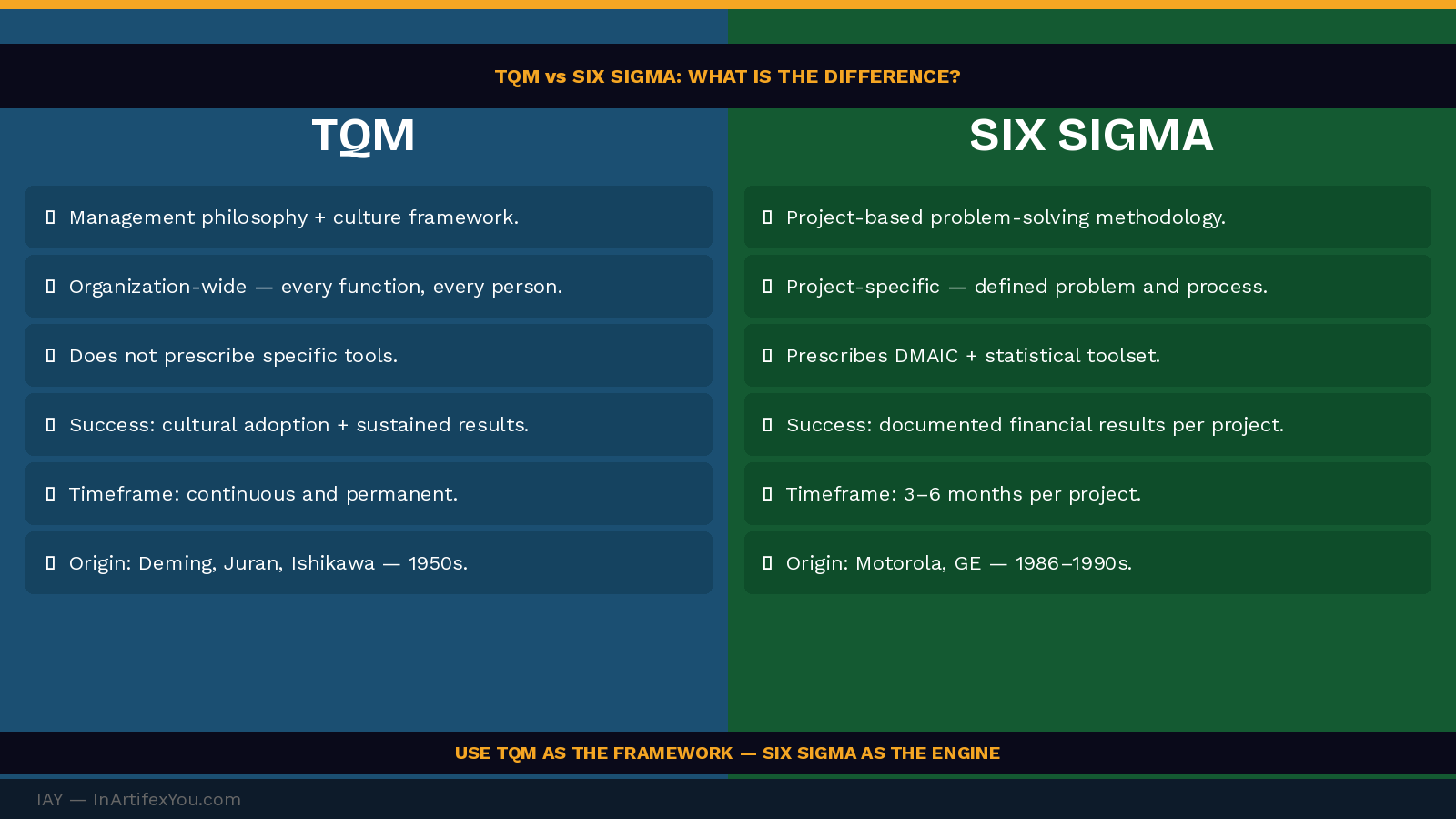
TQM (Total Quality Management) and Six Sigma are complementary, not competing. TQM is a management philosophy — it defines how an organization should think about quality, customer focus, and continuous improvement. Six Sigma is a methodology — it provides a structured, data-driven approach (DMAIC) and statistical tools for solving specific quality problems. The key differences: TQM is organization-wide and culture-focused; Six Sigma is project-specific and data-focused. TQM does not prescribe specific tools; Six Sigma prescribes a rigorous toolset. TQM success depends on cultural adoption; Six Sigma success depends on analytical execution. In practice, the most effective organizations use TQM as their management framework and Six Sigma as their primary problem-solving methodology — with Lean providing the flow and waste-elimination tools that complete the system.
The TQM vs. Six Sigma question is one of the most common sources of confusion among quality and improvement practitioners. It reflects a genuine conceptual difference — but also a false opposition. Understanding how they relate is essential for any practitioner who wants to apply both effectively.
The Core Difference: Philosophy vs. Methodology
|
TQM A management philosophy and culture framework. Organization-wide scope — every function and person. Does not prescribe specific tools or methods. Success measured by cultural adoption and sustained results. Timeframe: continuous and permanent. Origin: Deming, Juran, Ishikawa — 1950s–1980s. |
SIX SIGMA A project-based problem-solving methodology. Project-specific scope — defined problem and process. Prescribes DMAIC and a specific statistical toolset. Success measured by documented financial results. Timeframe: project-bound (typically 3–6 months). Origin: Motorola, GE — 1986–1990s. |
Where They Overlap
- Both place the customer at the center of quality definition.
- Both require data-driven decision making rather than opinion-based management.
- Both emphasize process improvement over output inspection.
- Both require leadership commitment to deliver sustained results.
- Six Sigma's DMAIC methodology is an operationalization of TQM's continual improvement principle.
When to Use Each
|
Situation |
Use TQM |
Use Six Sigma |
|
Building a quality culture organization-wide. |
✅ Primary framework. |
Support tool. |
|
Solving a specific high-cost defect problem. |
Framework context. |
✅ Primary methodology. |
|
Aligning all functions to customer value. |
✅ Primary framework. |
Not applicable. |
|
Reducing DPMO on a production process. |
Framework context. |
✅ Primary methodology. |
|
Developing quality thinking in leadership. |
✅ Primary framework. |
Not applicable. |
|
Certifying practitioners in quality methods. |
Context knowledge. |
✅ Green/Black Belt path. |
The Integrated Approach
The most effective quality systems do not choose between TQM and Six Sigma — they use TQM as the management operating system and Six Sigma as the improvement engine. TQM tells the organization why quality matters and how to think about it. Six Sigma gives the practitioner the tools to measure, analyze, and improve specific processes within that quality framework.
Lean completes the system by adding waste elimination and flow improvement — giving practitioners a complete toolkit for addressing variation (Six Sigma), waste (Lean), and culture (TQM) simultaneously.
Back to hub: All About Total Quality Management.
- What is Total Quality Management? Definition and core principles.
- Cost of Poor Quality in TQM: how to calculate and reduce it.
- How to implement TQM step by step.
🔗 INTERNAL LINK SUGGESTIONS
|
||||||||||||||||||||||
The Continuous Improvement Certification at InArtifexYou gives you a complete, practical system to map, baseline, improve, and sustain any process — and the verified credential to prove you can lead it.
inartifexyou.com/continuous-improvement-certification-online.html |
||||||||||||||||||||||
|