Advanced Lean Training in manufacturing vs services:
what actually changes
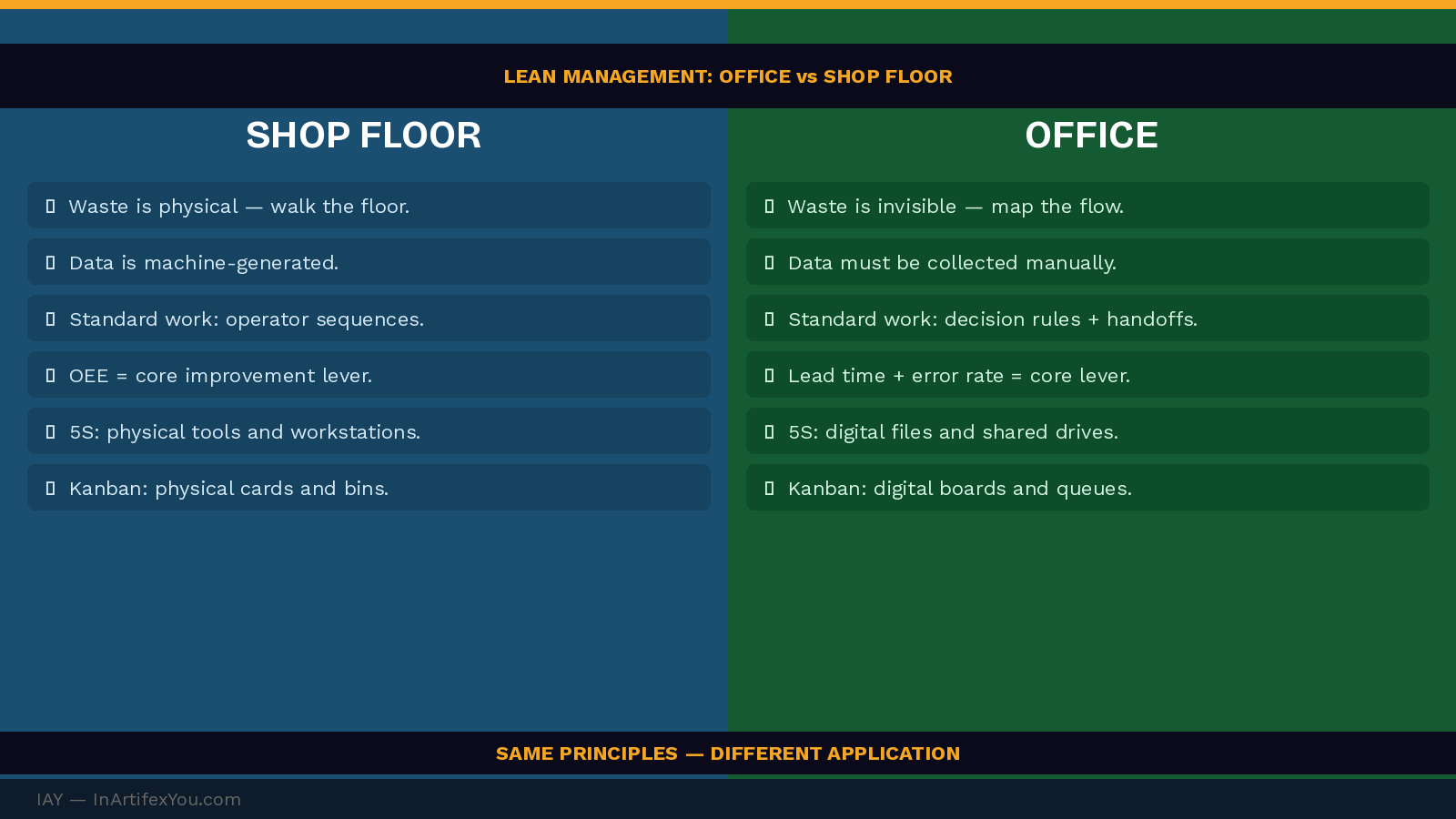
Advanced Lean Training applies to both manufacturing and service environments, but three things change when you cross from factory to office. First, waste definition: manufacturing waste is physical and visible — defective parts, excess inventory, idle machines. Service waste is transactional and invisible — rework on a report, waiting for an approval, over-processing a form. Second, flow mapping: Value Stream Mapping in manufacturing traces physical material. In services, it traces information and decisions — and the handoffs between people are where waste hides. Third, cycle time measurement: manufacturing counts seconds and minutes per unit. Service Lean measures hours and days per transaction. The tools — 5S, Kanban, Kaizen, standard work — all translate. What changes is how you apply them to work you cannot see or touch.
Advanced Lean Training was developed in manufacturing. Toyota did not have an accounts payable department in mind when Taiichi Ohno mapped the seven wastes. But Lean's core insight — that every process has waste, and waste can be identified, measured, and eliminated — applies wherever work happens.
Here is what changes, and what stays the same, when Advanced Lean Training moves from a production floor to a service environment.
The 3 Things That Change
|
MANUFACTURING Waste is physical: scrap, excess WIP, idle machines Flow mapping: material moves through physical space Cycle time: seconds to minutes per unit Standard work: operator task sequences 5S: physical workplace organization Pull: kanban cards, bins, physical signals |
SERVICES Waste is transactional: rework, waiting, over-processing Flow mapping: information and decisions move through people Cycle time: hours to days per transaction Standard work: process steps and decision rules 5S: digital files, shared drives, email management Pull: digital kanban boards, queue management systems |
Waste in Services: The Hidden Factory
The most powerful concept Advanced Lean Training introduces to service practitioners is the hidden factory — the rework, corrections, and workarounds that happen in every service process but never appear on a process map because they are informal and untracked.
In manufacturing, a defective part is visible and counted. In a hospital billing department, an incorrect claim is routed to a separate correction team and never counted as a defect in the original process. The hidden factory is real — it just requires different eyes to see it.
- Transportation waste in services: emails forwarded through five people before a decision is made
- Inventory waste in services: reports completed but not read, approvals queued for weeks
- Waiting waste in services: process steps that cannot start until someone in another department responds
- Over-processing waste in services: a ten-field form when the process only needs three
Value Stream Mapping for Service Processes
In manufacturing, VSM traces product flow from raw material to finished goods. In services, VSM traces information flow from trigger (a customer request, an order, a claim) to resolution. The swim-lane format — one lane per department — is particularly effective because it makes handoffs visible. Handoffs are where service waste accumulates.
The key difference in service VSM: lead time is often 80–95% wait time. A loan application that takes 12 business days has, in most banks, about 45 minutes of actual processing work. The rest is waiting. Advanced Lean Training teaches practitioners to see that ratio — and attack the wait.
What Does Not Change
The improvement mindset, the PDCA cycle, the respect for people, and the relentless focus on customer value — these are the same in a stamping plant and a customer service center. Advanced Lean Training practitioners who understand the principles deeply can translate the tools to any environment.
The question is never whether Lean applies. The question is how fluent the practitioner is in translating manufacturing-born tools into service-born language.
|
||||||||||||||||||||||
The Continuous Improvement Certification at InArtifexYou gives you a complete, practical system to map, baseline, improve, and sustain any process — and the verified credential to prove you can lead it.
inartifexyou.com/continuous-improvement-certification-online.html |
||||||||||||||||||||||
|
||||||||||||||||||||||
|
IAY — InArtifexYou.com | SBI MasterCraft v2.8 | T3: Advanced Lean Training |