Hands-on simulations for Advanced Lean Training (SMED,
VSM, Kanban): examples
Hands-on simulations are the most effective delivery method in Advanced Lean Training because they force participants to experience waste, not just recognize it. The three most widely used simulations are: SMED Changeover Simulation — participants physically perform a simulated changeover, then identify and separate internal from external elements to cut time by 30–50% in a single round; Value Stream Mapping Exercise — teams map a real or simulated process from trigger to delivery, calculate lead time and process time, and identify the three highest-impact improvement opportunities; Kanban Pull System Simulation — teams run a production game with push logic first, then redesign with pull logic and kanban signals, experiencing the WIP reduction directly. The learning is in doing, not watching. Each simulation should be followed by an immediate debrief tying the exercise to a real process in the participant's own work environment.
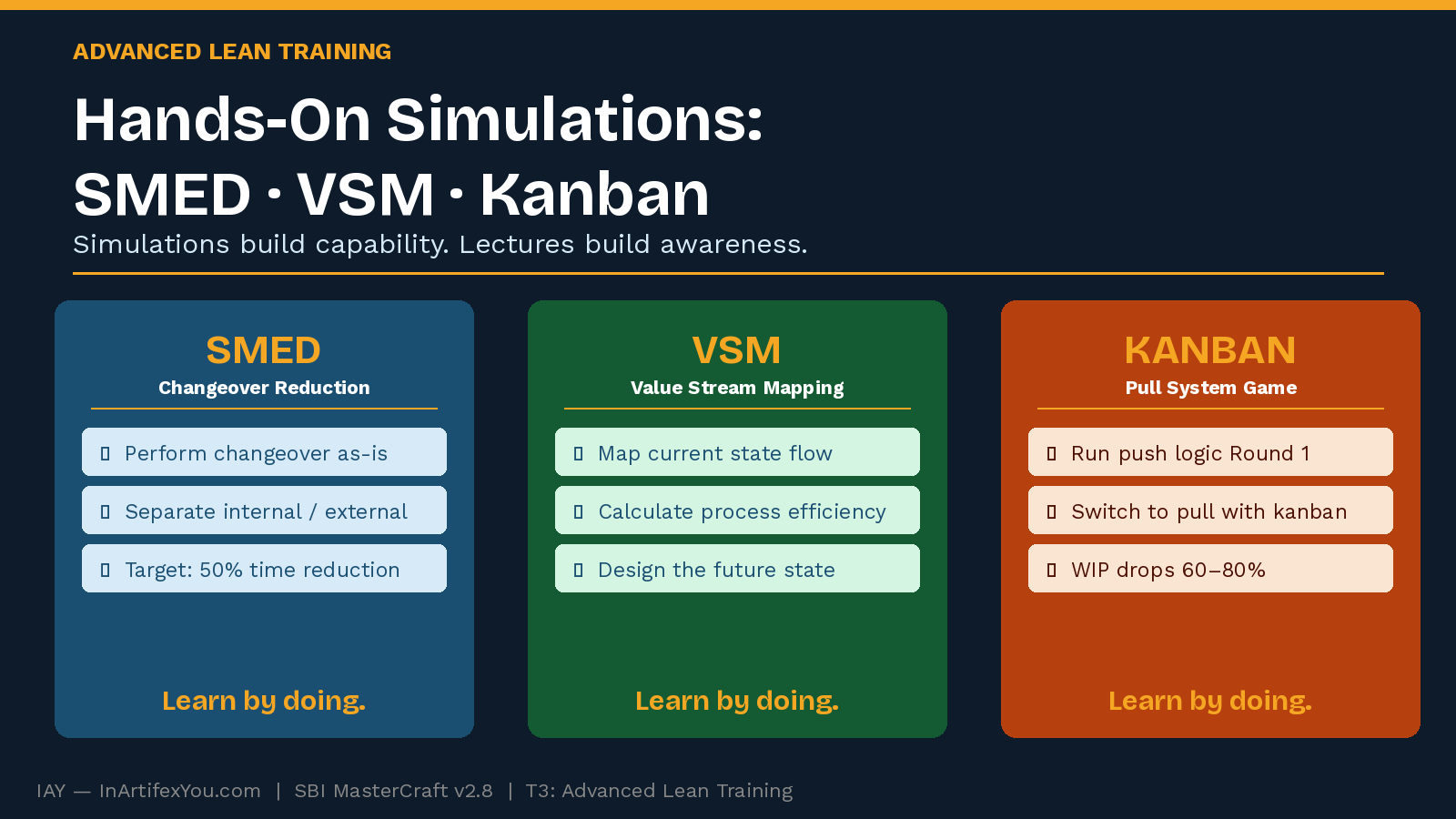
A practitioner who has watched a VSM video and a practitioner who has facilitated a VSM exercise on a real process are not equally prepared. Advanced Lean Training that relies entirely on lecture and slides produces awareness. Simulations produce capability.
Here are three proven simulation formats — with setup, facilitation notes, and debrief structure — that transfer directly to real process improvement work.
Simulation 1: SMED Changeover Exercise
Setup
Use
a physical changeover analog — classic options include a LEGO assembly line, a
bolt-and-washer assembly, or a stamping die setup simulation. Participants
perform the simulated changeover while a timekeeper records total time. Video
recording the first round is powerful for the debrief.
Rounds
- Round 1 — Push and observe: run the changeover as-is, total time 8–12 minutes typical
- Round 2 — Separate internal from external: identify which steps can be done while the machine is still running. Typical reduction: 30–40%
- Round 3 — Convert internal to external and streamline: apply ECRS (Eliminate, Combine, Rearrange, Simplify). Typical final time: under 3 minutes
Debrief
Ask:
where in your real process do you have changeovers — planned or unplanned —
that follow this pattern? What would a 50% reduction in your actual changeover
time mean for your production capacity?
Simulation 2: Value Stream Mapping Exercise
Setup
Use
post-it notes on a wall or a large paper roll. Assign roles: supplier, three
process steps, customer. Use a simple product flow — a service request, a
purchase order, a report — that participants recognize from their own
environment.
Rounds:
- Round 1 — Map the current state: capture process time, lead time, and wait time at each step. Calculate overall lead time and process efficiency ratio
- Round 2 — Identify the three biggest waste sources: circle where wait time is highest, where rework occurs, and where handoffs cause delay
- Round 3 — Map the future state: design a leaner flow with pull triggers and reduced handoffs
Debrief
The
insight that lands hardest: most participants discover their process efficiency
ratio — process time divided by lead time — is under 10%. Meaning 90%+ of lead
time is waste. That number makes the case for Lean better than any presentation
slide.
Simulation 3: Kanban Pull System Game
Setup
A
three-station production game using tokens, cards, or LEGO bricks. Station 1
produces, Station 2 processes, Station 3 ships. Customer demand is simulated
with a random draw.
Rounds
- Round 1 — Push: each station produces at full capacity and pushes to the next. Result: WIP accumulates, quality declines, demand is unmet
- Round 2 — Pull with Kanban: stations only produce when a kanban signal arrives from downstream. Result: WIP drops 60–80%, on-time delivery improves.
Debrief
The
physical experience of WIP piling up in Round 1 — and disappearing in Round 2 —
is something no lecture achieves. Ask participants: where in your process is
the equivalent pile building up right now?
|
||||||||||||||||||||||
The Continuous Improvement Certification at InArtifexYou gives you a complete, practical system to map, baseline, improve, and sustain any process — and the verified credential to prove you can lead it.
inartifexyou.com/continuous-improvement-certification-online.html |
||||||||||||||||||||||
|
||||||||||||||||||||||
|
IAY — InArtifexYou.com | SBI MasterCraft v2.8 | T3: Advanced Lean Training |