Advanced Lean Training ROI: skill assessments and
project pipeline targets
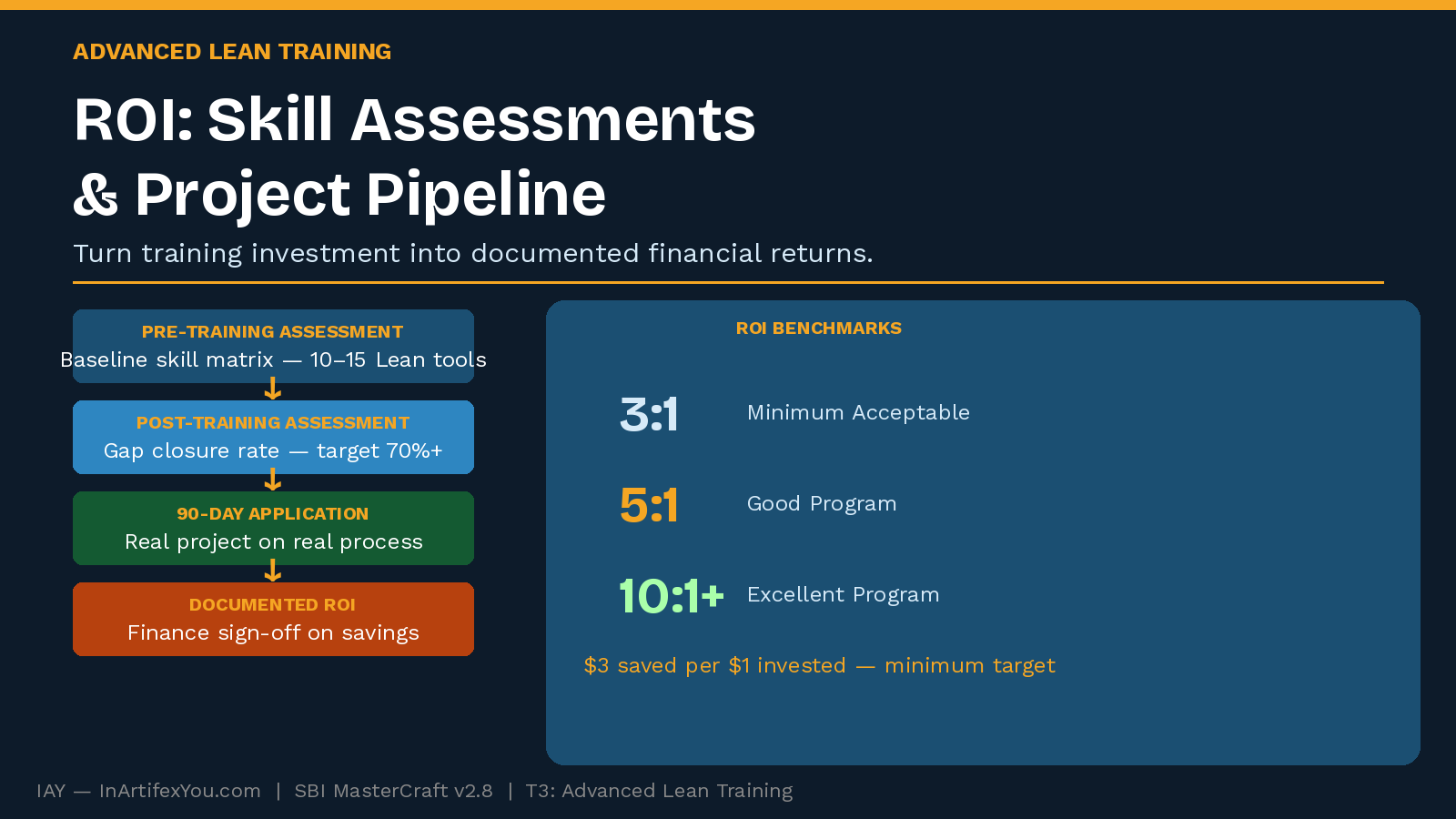
Advanced Lean Training ROI is built through two mechanisms: skill assessments that verify capability transfer, and a project pipeline that converts capability into documented savings. Before training, assess current skill levels using a Lean tool competency matrix — rate each participant on 10–15 core tools (VSM, SMED, 5S, Kanban, SPC). After training, re-assess within 30 days. The gap closure rate tells you whether training transferred. For the project pipeline, each trained practitioner should complete a minimum of one documented Kaizen project within 90 days of certification. Target a 3:1 ROI minimum — $3 in documented savings for every $1 invested in training. Organizations that combine skill assessments with a structured project pipeline consistently achieve 5:1 to 10:1 ROI within 12 months of program launch.
Advanced Lean Training is an investment. Like any investment, the question is not whether you spent the money — it is whether you got a return. Most organizations measure training satisfaction. The ones that build competitive advantage measure skill transfer and project output.
Here is how to build an ROI framework that produces numbers your finance team will accept and your leadership team will act on.
Mechanism 1: Skill Assessments
A skill assessment measures whether training transferred to capability. Without it, you cannot distinguish between a participant who understood the material and one who will apply it on the floor next Monday.
Use a three-phase assessment model:
- Pre-training assessment: rate each participant on 10–15 Lean tools using a 1–4 scale (1 = no awareness, 4 = can teach). Capture the baseline.
- Post-training assessment (within 30 days): re-rate using the same rubric. Gap closure rate = (post-score − pre-score) ÷ (4 − pre-score). Target 70%+ closure.
- 90-day application assessment: observe whether the participant has applied at least one tool in a real process. This is the true transfer measure.
Mechanism 2: The Project Pipeline
Skill without application does not create ROI. The project pipeline is the mechanism that converts trained capability into documented financial return.
|
Pipeline Stage |
Target |
Time Frame |
|
Project Identification |
Each practitioner identifies 2–3 improvement opportunities |
Week 1 post-training |
|
Project Selection |
Sponsor approves 1 project per practitioner |
Week 2–3 |
|
Kaizen Event / DMAIC |
Complete the improvement cycle |
Days 30–60 |
|
Documentation |
Document savings with finance sign-off |
Day 60–75 |
|
Replication |
Identify where improvement can be replicated |
Day 75–90 |
ROI Calculation: What Finance Needs
Document savings in four categories that finance departments recognize:
- Hard savings: direct cost reduction — scrap reduction, labor hours recovered, materials saved
- Soft savings: productivity improvement — cycle time reduction expressed in capacity gained
- Cost avoidance: prevented defects, prevented downtime, prevented warranty claims
- Strategic value: lead time improvements that enable new customer commitments
ROI BENCHMARK TARGETS
Minimum acceptable: 3:1 ($3 saved per $1 invested in training)
Good program: 5:1 within 12 months
Excellent program: 10:1+ — typical of organizations with strong sponsor accountability
Source: ASQ Quality Progress benchmarking surveys, 2022–2024
The Single Biggest ROI Killer
Trained practitioners who return to their roles with no project assignment and no leadership accountability for applying the skills. Within 60 days, retention drops to below 20% of training content. The project pipeline is not optional — it is the mechanism that turns training from an expense into an asset.
Assign every trained participant a project within two weeks of certification. Assign a sponsor. Set a 90-day deadline. Review progress in every operations meeting. That discipline is what creates the 5:1 return.
|
||||||||||||||||||||||
The Continuous Improvement Certification at InArtifexYou gives you a complete, practical system to map, baseline, improve, and sustain any process — and the verified credential to prove you can lead it.
inartifexyou.com/continuous-improvement-certification-online.html |
||||||||||||||||||||||
|
||||||||||||||||||||||
|
IAY — InArtifexYou.com | SBI MasterCraft v2.8 | T3: Advanced Lean Training |