Building a quality team culture: how to sustain team
engagement in improvement
Building a quality team culture means creating the organizational conditions where participation in quality improvement is seen as a professional opportunity — not an additional burden on top of regular work. The four practices that sustain quality team culture over time are: visible recognition of team contributions (publicly celebrating improvement results and the people who produced them — not just the outcome, but the team's specific contribution to it), skill development investment (providing team members with the analytical and facilitation skills needed to lead improvement — making participation a professional development opportunity, not a time tax), improvement visibility (making team results visible across the organization through dashboards, briefings, and internal communications — so that the value of quality teams is understood by everyone, not just the participants), and team continuity planning (identifying and developing the next generation of quality team leaders from within the current team — building a pipeline, not just a program).
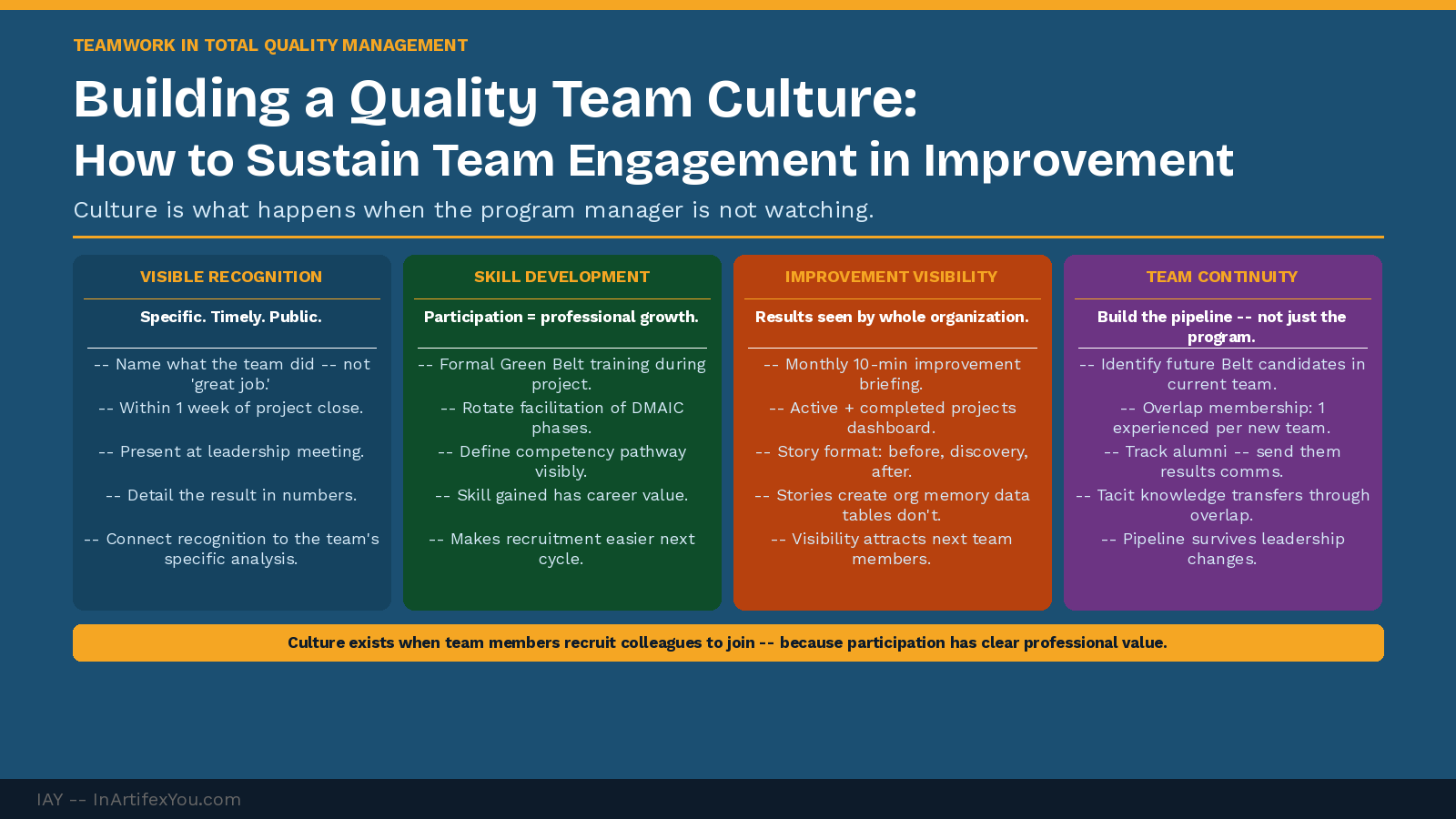
Building a quality team culture addresses the most common long-term failure in TQM team programs: the launch energy that produces excellent first-project results, then fades as the organizational novelty wears off, team members return to full operational workloads, and the next improvement project struggles to recruit participants with the motivation of the first cohort. Culture is the system that sustains team engagement when the launch energy is gone.
Practice 1: Visible Recognition of Team Contributions
Recognition sustains team culture when it is specific, timely, and visible — not when it is generic, delayed, or private:
- Specific: recognize the team for what they did — 'this team reduced defect rate at Station 4 from 3.2% to 0.8% by identifying and eliminating a measurement system error that had been contributing to false rejects for 14 months' — not 'great job on the quality project.'.
- Timely: recognize within one week of project close — not at the annual quality awards event six months later.
- Visible: present results at a leadership meeting the whole organization can see — not just to the team members and their direct managers.
Practice 2: Skill Development as Participation Benefit
When team participation is framed as a skill development investment — not just an improvement task — recruitment and retention of capable team members improves significantly:
- Provide formal training: Green Belt or problem-solving skills training delivered as part of project participation — not as a prerequisite for it.
- Rotate facilitation: give team members the opportunity to lead specific DMAIC phases — building facilitation capability that has career value beyond the current project.
- Create a visible competency pathway: define what skills team participation develops and how they connect to career progression — make the professional development value explicit.
Practice 3: Improvement Visibility Across the Organization
Quality teams produce results that are invisible to 95% of the organization unless deliberately communicated:
- Monthly improvement briefing: a 10-minute slot in an all-hands or management meeting where a team presents a completed improvement — problem, root cause, solution, result.
- Improvement dashboard: a visible display showing active projects, completed projects, and cumulative improvement impact — updated monthly.
- Story format communication: frame team results as stories — before state, investigation, discovery, solution, after state — not as data tables. Stories create organizational memory that data tables do not.
Practice 4: Team Continuity Planning
- Identify future team leaders from within current teams: the team member who showed analytical leadership or facilitation capability in the current project is the candidate for Belt development.
- Overlap team membership: when a new project begins, include one experienced member from a previous team — transfers tacit knowledge that training cannot fully convey.
- Track alumni engagement: former team members who are not on active projects should receive improvement results communications — sustaining their connection to the quality improvement community.
The Culture Principle
Culture is what happens when the program manager is not watching.
A quality team culture exists when team members recruit their colleagues to join improvement projects — because participation has clear professional value and visible organizational recognition.
Build the conditions for that to happen. The culture follows.
Back to hub: Teamwork in Total Quality Management.
| ||||||||||||||||||||||
The Continuous Improvement Certification at InArtifexYou gives you a complete, practical system to map, baseline, improve, and sustain any process — and the verified credential to prove you can lead it.
inartifexyou.com/continuous-improvement-certification-online.html | ||||||||||||||||||||||
|