Cross-functional
team design in TQM: how to build teams that improve quality
Cross-functional team design in TQM requires five decisions before the team is launched: team size (5–8 members is the effective range — large enough for diverse expertise, small enough for shared accountability), role composition (at least one representative from each function that contributes to or is affected by the quality problem — not just the quality department), scope definition (a specific, bounded problem statement with a measurable improvement target — teams that start with a vague scope produce vague results), authority level (pre-defined authority to implement solutions below a defined cost or process change threshold — without pre-authorization, teams produce recommendations that wait months for approval), and team charter (a one-page document defining the problem, the goal, the team members, the timeline, the authority, and the reporting structure). Teams designed with all five decisions made before the first meeting produce results 3–4 times faster than teams that discover their constraints during the work.
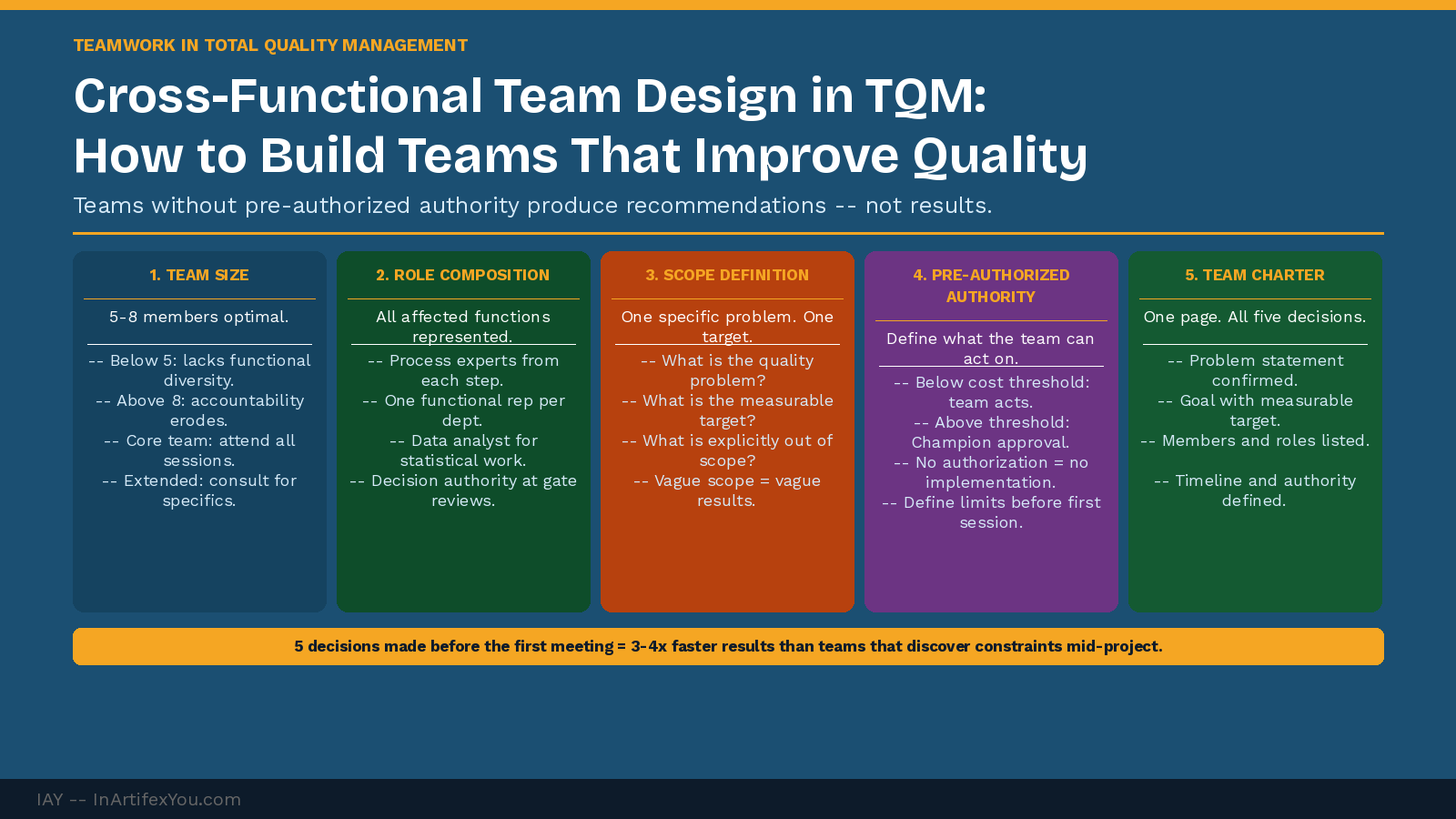
Cross-functional team design in TQM determines whether an improvement team reaches a solution or stalls — before a single improvement idea is generated. The most common reason quality improvement teams fail is not the quality of their analysis or the validity of their solutions — it is that the team was designed without the clarity, authority, or focus needed to convert analysis into implementation. The five design decisions below address these failure modes before the team begins.
Decision 1: Team Size
The effective range for a cross-functional quality improvement team is 5–8 members. Below 5, the team lacks the functional diversity to understand the full problem. Above 8, decision-making slows and individual accountability erodes.
- Core team: 5–8 members with direct knowledge of the process being improved — attend all sessions, own all deliverables.
- Extended team: subject matter experts consulted for specific analysis steps but not required at every session — keeps core team small without losing access to expertise.
Decision 2: Role Composition
|
Role |
Who |
Contribution to the Team |
|
Team Leader. |
Process owner or quality practitioner. |
Facilitates sessions, maintains momentum, owns charter. |
|
Process Experts. |
Operators, technicians, or frontline staff from each affected step. |
Know what actually happens — not what the procedure says. |
|
Functional Representatives. |
One person from each dept contributing to the problem. |
Prevent siloed solutions that fix one area while creating problems in another. |
|
Data Analyst. |
Quality engineer or data-capable team member. |
Provides statistical support for root cause analysis and results measurement. |
|
Decision Authority. |
Manager with authority to approve and fund solutions. |
Present at gate reviews — not every session. Removes approval bottleneck at close. |
Decision 3: Scope DefinitionWhat is out of scope
A team charter scope statement should answer three questions in one sentence:
- What is the specific quality problem? (Not 'improve quality' — 'reduce defect rate at Station 4 from 3.2% to below 1.5%').
- What is the measurable improvement target? (A number — not a direction).
Decision 4: Pre-Authorized Authority
|
WITHOUT PRE-AUTHORIZATION Team produces recommendation. |
WITH PRE-AUTHORIZATION Team designs solution within authority. |
The Team Design Principle
A quality improvement team is only as effective as the authority it has been given to act on its findings.
Pre-authorize solutions below a defined cost and process change threshold before the team begins. The team discovers the root cause — it should not then wait months for permission to address it.
Back to hub: Teamwork in Total Quality Management.
| ||||||||||||||||||||||
The Continuous Improvement Certification at InArtifexYou gives you a complete, practical system to map, baseline, improve, and sustain any process — and the verified credential to prove you can lead it.
inartifexyou.com/continuous-improvement-certification-online.html | ||||||||||||||||||||||
|