Team roles in DMAIC: how to assign responsibilities in
improvement projects
A DMAIC improvement project requires six roles with distinct responsibilities: Champion (the senior leader who owns the business case, removes organizational barriers, and approves phase gate decisions — not a day-to-day participant but present at every phase gate review), Black Belt or Green Belt (the project leader who facilitates the DMAIC methodology, performs or guides statistical analysis, and is accountable for project results), Process Owner (the manager responsible for the process being improved — must approve the final solution and own the control plan after project close), Team Members (subject matter experts from each function contributing to or affected by the process — responsible for data collection, process knowledge, and solution testing), Data Analyst (statistical support for Measure, Analyze, and Control phases — may be the Belt or a dedicated resource), and Sponsor (the organizational authority who approved the project and will present results to leadership). Role confusion — particularly when the Champion is also the Process Owner, or the Belt is also expected to own implementation — is the most common cause of DMAIC project delays.
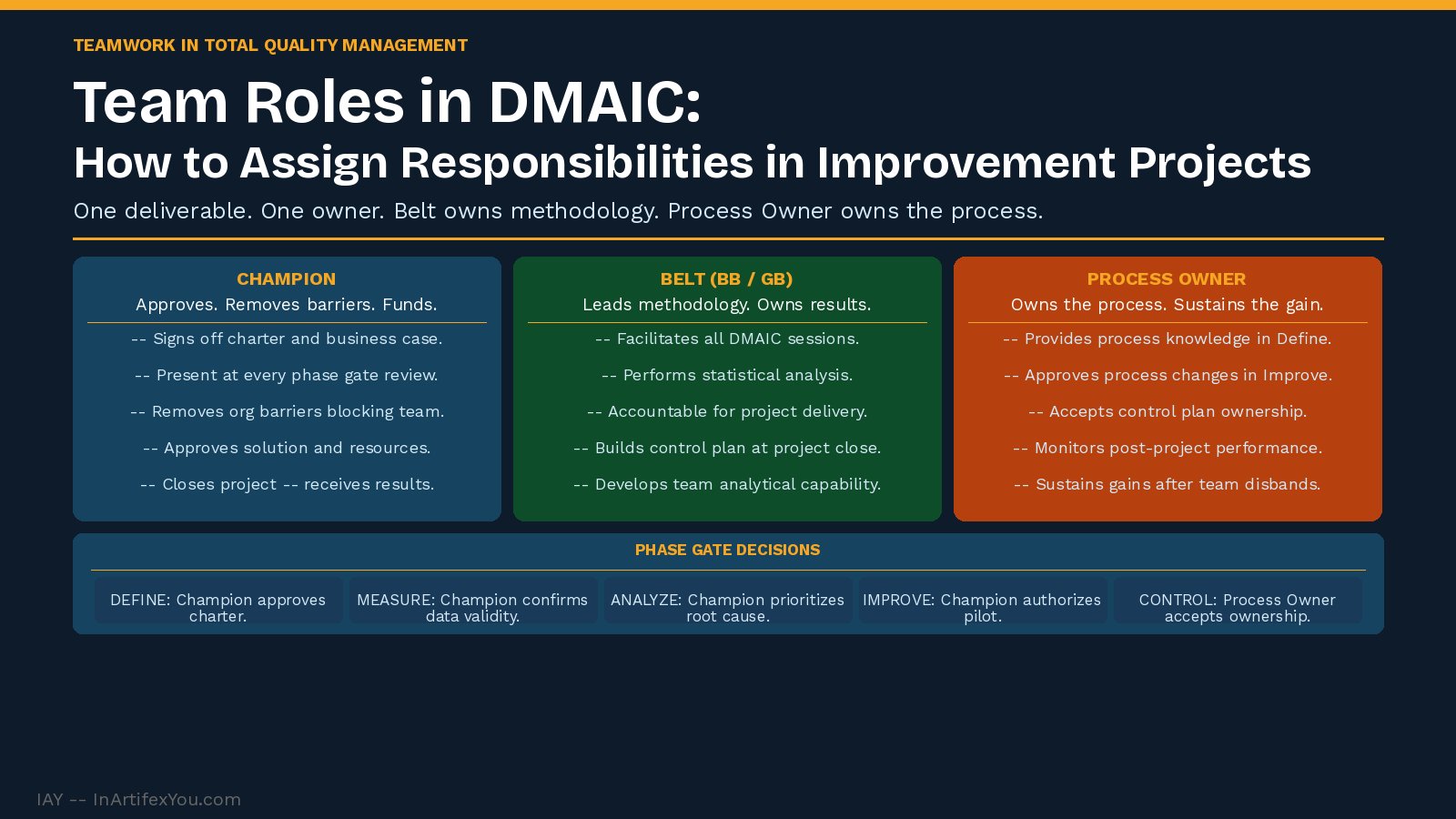
Team roles in DMAIC determine who makes which decisions, who owns which deliverables, and who has authority to approve which actions at each phase. The most common DMAIC project failure pattern is not methodological — it is structural: the wrong person is asked to perform the wrong role, creating bottlenecks, confusion, and the kind of slow decision-making that converts a 90-day project into a 9-month one.
The Six DMAIC Roles — Responsibilities by Phase
|
Role |
Define |
Measure |
Analyze |
Improve |
Control |
|
Champion. |
Approves project charter and business case. |
Reviews measurement plan. Removes data access barriers. |
Reviews root cause analysis. Confirms priority. |
Approves solution design. Authorizes pilot resources. |
Approves control plan. Ensures handoff to process owner. |
|
Belt (BB/GB). |
Leads charter. development. Facilitates scope definition. |
Designs measurement system. Performs Gage R&R. |
Leads root cause analysis. Applies statistical tools. |
Designs and pilots solution. Documents standard work. |
Builds control plan. Trains process owner. Closes project. |
|
Process Owner. |
Provides process knowledge. Validates scope. |
Supports data collection. Confirms current state. |
Reviews root cause. Confirms operational feasibility. |
Tests solutions. Approves changes to process. |
Accepts control plan ownership. Sustains gains. |
|
Team Members. |
Contribute process knowledge for problem definition. |
Collect baseline data. Identify measurement gaps. |
Map root causes. Contribute fishbone analysis. |
Test solutions. Document standard work changes. |
Monitor control charts. Sustain new standard. |
|
Data Analyst. |
Defines metrics and measurement approach. |
Validates measurement system. Establishes baseline. |
Performs statistical analysis. Confirms root causes with data. |
Designs experiment or pilot measurement. |
Sets SPC parameters. Monitors process capability. |
|
Sponsor. |
Approves business case and resource allocation. |
Reviews baseline data. |
Reviews analysis findings. |
Approves solution for implementation. |
Receives final results presentation. |
Phase Gate Decisions — Who Decides What
- Define phase gate: Champion approves the problem statement, scope, and business case before the team moves to Measure. Belt presents. Process Owner confirms scope is correct.
- Measure phase gate: Champion reviews baseline data and confirms the measurement system is valid. Belt presents Gage R&R results and baseline capability.
- Analyze phase gate: Champion confirms that the root causes identified are the priority for the organization to solve. Belt presents statistical evidence. Process Owner confirms operational validity.
- Improve phase gate: Champion approves solution design and authorizes pilot resources. Process Owner commits to testing the solution in their process.
- Control phase gate: Process Owner formally accepts the control plan and ongoing ownership of the sustained process. Champion receives final results and closes the project.
The Role Clarity Principle
In DMAIC, every deliverable needs one owner — not a committee.
The Belt owns the project methodology and results. The Process Owner owns the process change and sustaining. The Champion owns the organizational barriers and approvals.
When these three roles are clear, DMAIC projects move. When they overlap or are unassigned, they stall.
| ||||||||||||||||||||||
The Continuous Improvement Certification at InArtifexYou gives you a complete, practical system to map, baseline, improve, and sustain any process — and the verified credential to prove you can lead it.
inartifexyou.com/continuous-improvement-certification-online.html | ||||||||||||||||||||||
|