Team conflict resolution in quality projects: how to
keep teams productive
Team conflict in quality improvement projects takes four forms, each requiring a different resolution approach. Data conflict: team members disagree about what the data shows — resolved by returning to the raw data and agreeing on the analysis method before re-running, not by debating interpretations. Priority conflict: team members disagree about which root cause or solution to pursue — resolved by applying agreed decision criteria (impact, feasibility, cost) rather than advocacy. Territorial conflict: a team member is protecting their process or department from the project's findings — resolved by refocusing on the customer impact of the current state and the shared benefit of improvement. Personality conflict: interpersonal friction is reducing team effectiveness — resolved by the team leader through direct conversation, ground rule reinforcement, and if necessary, role reassignment. The single most effective conflict prevention practice in quality projects is establishing explicit team ground rules at the first session — before any content work begins.
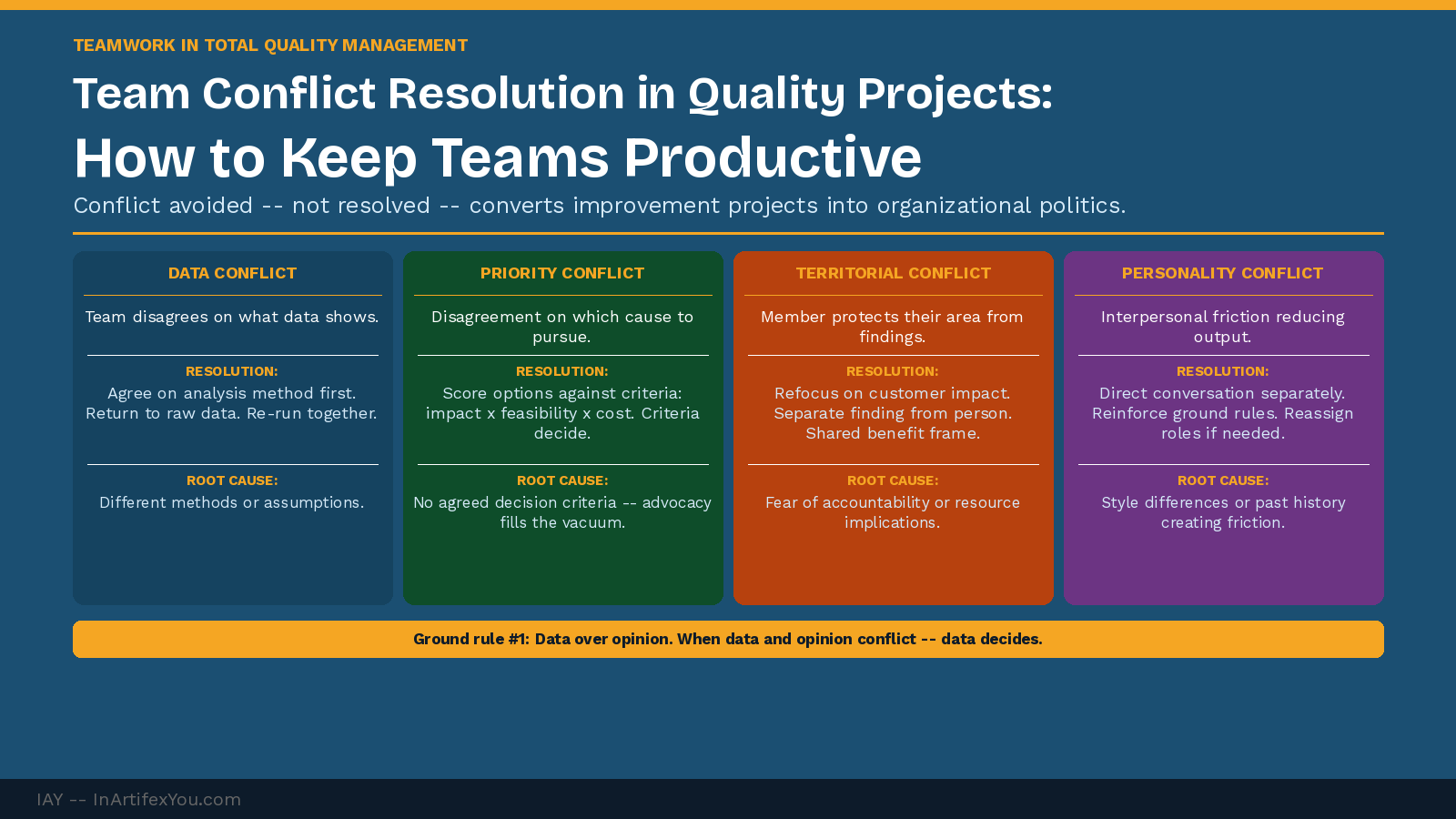
Team conflict resolution in quality projects is a leadership competency — not a personality trait. The quality practitioner who can identify which type of conflict is occurring, apply the appropriate resolution approach, and return the team to productive work is the one whose projects complete on time and with organizational buy-in. Conflict that is avoided, rather than resolved, converts quality improvement projects into organizational politics exercises — where the best-analyzed root cause loses to the most protected process.
The Four Conflict Types and Resolution Approaches
|
Conflict Type |
How It Appears |
Root Cause |
Resolution Approach |
|
Data conflict. |
Team members reach different conclusions from the same data. |
Different analytical methods, assumptions, or data subsets. |
Agree on the analysis method first. Return to raw data. Re-run together. Document the agreed approach for future reference. |
|
Priority conflict. |
Team disagrees on which root cause or solution deserves focus. |
No agreed decision criteria — advocacy fills the vacuum. |
Establish explicit priority criteria (impact x feasibility x cost). Score each option against criteria. Decision follows the score — not the loudest voice. |
|
Territorial conflict. |
A team member resists findings that reflect poorly on their area. |
Fear of accountability or resource implications. |
Refocus on customer impact. Separate the finding from the person. Frame improvement as shared benefit — not individual failure. |
|
Personality conflict. |
Interpersonal friction reduces participation and productivity. |
Style differences, past history, or communication mismatch. |
Direct conversation with individuals separately. Reinforce ground rules. Reassign roles if friction is process-specific rather than universal. |
Ground Rules That Prevent Conflict
The most effective conflict prevention tool is a set of explicit team ground rules established at the first session — before any content work begins:
- Data over opinion: when data and opinion conflict, data takes precedence. State the source and method whenever presenting a finding.
- Separate the process from the person: criticism of a process is not criticism of the person who runs it. Findings about process performance are not personal evaluations.
- One voice at a time: no side conversations during analysis sessions. Every perspective deserves to be heard before decisions are made.
- Decisions by criteria, not advocacy: establish the decision criteria before evaluating options — so the criteria drive the decision, not the most persuasive presenter.
- Parking lot for out-of-scope items: when important issues arise that are outside the project scope, capture them in a parking lot for future attention — preventing scope creep while respecting the insight.
When Conflict Indicates a Design Problem
Persistent conflict in a quality project sometimes signals a team design problem rather than an interpersonal one:
- Recurring data conflict: the measurement system is not defined clearly enough — everyone is measuring something slightly different.
- Recurring priority conflict: the scope is too broad — the team is trying to solve multiple problems simultaneously.
- Recurring territorial conflict: the Champion has not established clear organizational support for the project — team members are protecting themselves from consequences the Champion should be preventing.
Back to hub: Teamwork in Total Quality Management.
| ||||||||||||||||||||||
The Continuous Improvement Certification at InArtifexYou gives you a complete, practical system to map, baseline, improve, and sustain any process — and the verified credential to prove you can lead it.
inartifexyou.com/continuous-improvement-certification-online.html | ||||||||||||||||||||||
|