Choosing a quality management system: ISO, EFQM, or
TQM first?
Choosing between ISO 9001, EFQM, and TQM depends on four factors: external requirements, organizational maturity, strategic objective, and available resources. ISO 9001 first if: customers or regulators require a certified QMS, the organization lacks documented processes, or the quality management foundation needs to be established before cultural change can be sustained. EFQM first if: the organization already has a quality management system and wants a strategic diagnostic to identify where excellence gaps exist, particularly across leadership, strategy, and people dimensions. TQM first if: senior leadership is committed to a comprehensive culture change and the organization has the stability and resources to sustain a multi-year cultural transformation without an external certification milestone. In most cases, ISO 9001 is the right starting point — it establishes the discipline, documentation, and audit culture that both EFQM self-assessment and TQM cultural change require to be sustainable.
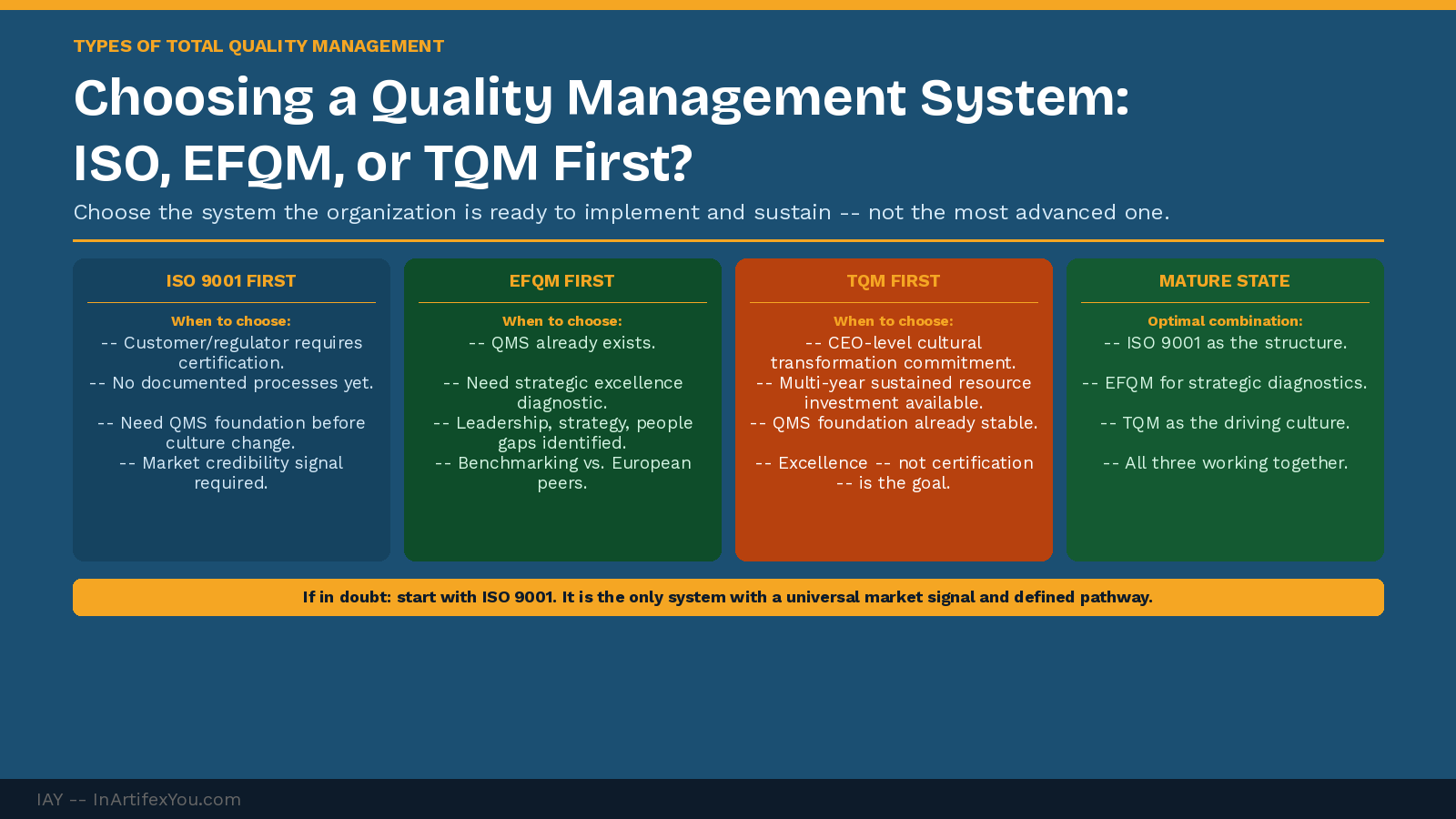
Choosing a quality management system is a strategic decision — not a technical one. The right system is the one that fits the organization's current state, external requirements, and strategic objectives. The most common mistake is choosing the system that sounds most advanced rather than the one the organization is actually ready to implement and sustain.
Decision Factor 1: External Requirements
- Customer-required certification: if major customers require ISO 9001 certification as a condition of doing business, the choice is made — ISO 9001 first.
- Regulatory requirements: some industries (medical devices, aerospace, automotive) have sector-specific standards derived from ISO 9001 (ISO 13485, AS9100, IATF 16949) — these take precedence.
- No external requirements: organizations without customer or regulatory certification requirements have full flexibility — choose based on factors 2, 3, and 4.
Decision Factor 2: Organizational Maturity
|
Current State |
Recommended Starting Point |
Rationale |
|
No documented processes, inconsistent execution. |
ISO 9001. |
Establish process discipline before attempting cultural transformation. |
|
Documented processes, some quality metrics. |
ISO 9001 or EFQM. |
ISO 9001 if certification is valued; EFQM if strategic diagnostic is the priority. |
|
Certified QMS, quality culture emerging. |
EFQM + TQM principles. |
Use EFQM to diagnose gaps; TQM to drive cultural depth. |
|
Mature QMS, strong quality culture. |
TQM full implementation. |
All foundation elements in place; pursue excellence without ceiling. |
Decision Factor 3: Strategic Objective
- Market credibility: ISO 9001 certification is globally recognized — it signals to customers and regulators that the organization has a verified, conforming QMS.
- Strategic excellence: EFQM provides a comprehensive diagnostic across nine organizational dimensions — leadership, strategy, people, processes, and results — that ISO 9001 does not assess.
- Cultural transformation: TQM is the right choice when the objective is a fundamental change in how the organization approaches quality at every level — from leadership behavior to frontline engagement.
Decision Factor 4: Available Resources
ISO 9001 implementation requires significant resource investment in documentation, training, internal auditing, and the certification audit itself. EFQM self-assessment is lower cost but requires senior leadership time and a skilled facilitation capability. TQM is the highest resource investment — a multi-year cultural transformation that requires sustained leadership commitment and organizational energy.
The Practical Recommendation
If in doubt: start with ISO 9001.
ISO 9001 is the only system with a universal market signal (the certificate), a defined implementation pathway, and an external verification step that forces honest assessment of QMS effectiveness.
Build on the ISO 9001 foundation with EFQM diagnostics and TQM culture as the organization matures.
Back to hub: Types of Total Quality Management.
| ||||||||||||||||||||||
The Continuous Improvement Certification at InArtifexYou gives you a complete, practical system to map, baseline, improve, and sustain any process — and the verified credential to prove you can lead it.
inartifexyou.com/continuous-improvement-certification-online.html | ||||||||||||||||||||||
|