ISO 9001 audit preparation: how to pass your QMS
certification audit
ISO 9001 audit preparation requires two distinct tracks: Stage 1 readiness (documentation) and Stage 2 readiness (implementation evidence). Stage 1 preparation: ensure all required documented information is complete, current, and accessible — Quality Policy, Quality Objectives, process maps, procedures, and the QMS scope statement. The registrar will review these before the site visit. If key documents are missing, the Stage 2 audit is postponed. Stage 2 preparation: collect objective evidence — records — that each process is being executed as documented. The auditor will interview process owners and request records for specific activities. The most common Stage 2 nonconformities are: missing management review records, incomplete internal audit programs, quality objectives without measurement and action plans, and documented procedures that do not reflect actual practice. Run a complete internal audit cycle before the Stage 2 audit — the findings it reveals are exactly what the registrar will find if you do not.
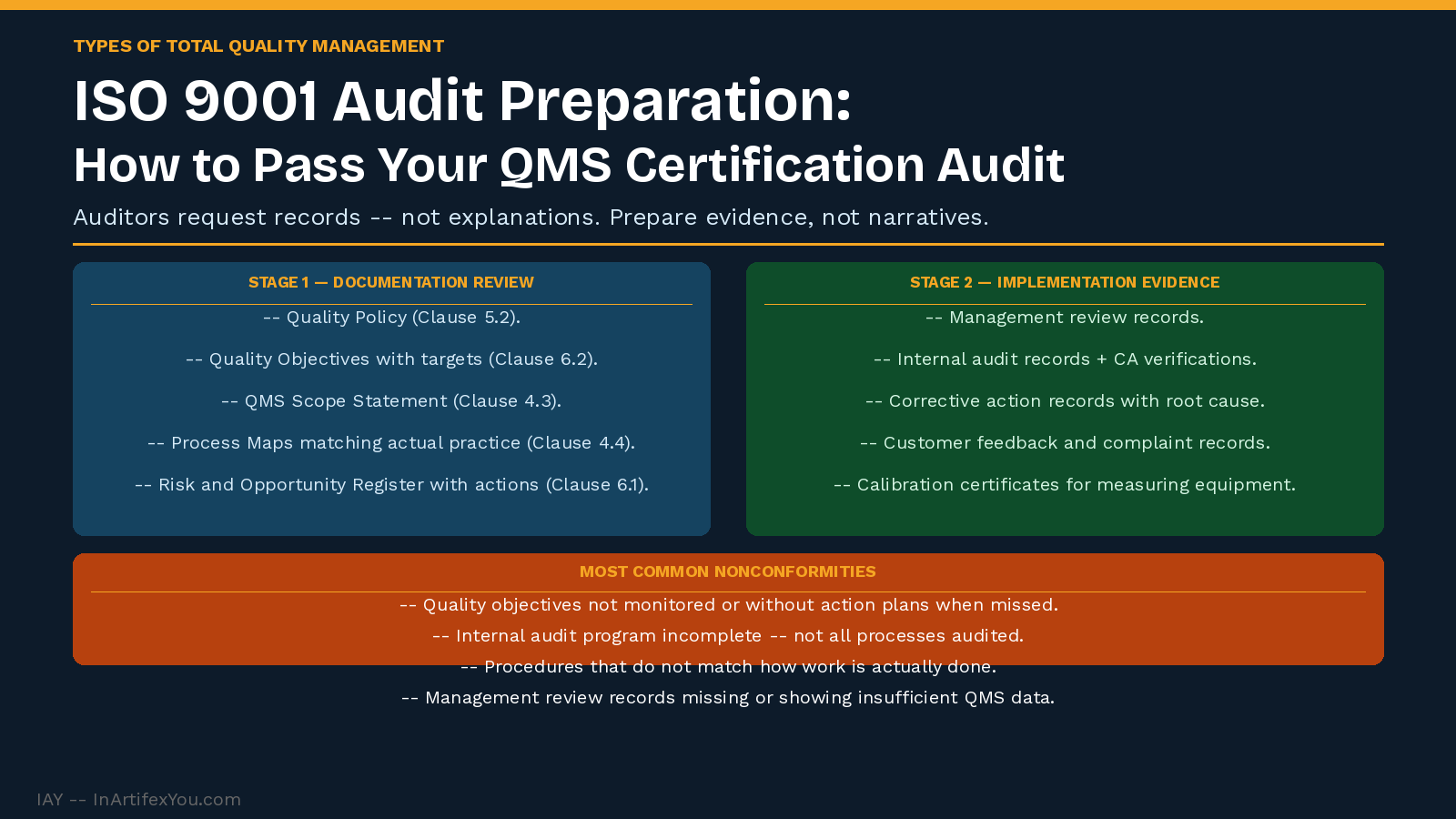
ISO 9001 audit preparation is not about impressing the auditor — it is about demonstrating that the quality management system is real, operational, and effective. Organizations that treat audit preparation as a documentation sprint the month before the audit consistently receive more nonconformities than organizations that maintain their QMS continuously. The audit reveals what the QMS actually is — not what the organization wishes it were.
Stage 1 Audit Preparation: Documentation
The Stage 1 audit is a documentation review. The registrar verifies that all required documented information exists and addresses the relevant ISO 9001 requirements. Prepare the following:
|
Document |
ISO 9001 Clause |
Common Finding |
|
Quality Policy. |
5.2. |
Generic statements that don't address the organization's specific context. |
|
Quality Objectives. |
6.2. |
Objectives without measurement methods, targets, or action plans. |
|
QMS Scope Statement. |
4.3. |
Scope too broad or too narrow — doesn't match actual certification boundary. |
|
Process Maps / Procedures. |
4.4. |
Procedures that describe ideal practice — not actual practice. |
|
Risk and Opportunity Register. |
6.1. |
Risk assessment that lists risks but doesn't describe treatment actions. |
Stage 2 Audit Preparation: Evidence
The Stage 2 audit is an implementation verification. The auditor interviews process owners, observes operations, and requests records. Prepare evidence in five areas:
- Management review records: minutes showing that leadership reviewed QMS performance data, quality objectives status, customer satisfaction results, and internal audit outcomes.
- Internal audit records: completed audit plans, audit checklists, nonconformity reports, and corrective action verifications for each audited process.
- Corrective action records: documented corrective actions for every nonconformity found in internal audits — with root cause analysis, implemented actions, and effectiveness verification.
- Customer feedback records: documented processes for capturing, analyzing, and responding to customer complaints and satisfaction data.
- Calibration and maintenance records: current calibration certificates for all measurement equipment used to verify product or service conformance.
The Most Common Nonconformities
- Quality objectives not monitored or without action plans when targets are missed.
- Internal audit program incomplete — not all processes audited within the surveillance period.
- Documented procedures that don't match how work is actually done — discovered when auditor observes the actual process.
- Management review records missing or showing review of insufficient QMS data.
- Corrective actions closed without evidence that the root cause was actually eliminated.
The Audit Readiness Test
Before the certification audit, ask this question for every ISO 9001 clause: 'If the auditor asks for objective evidence that we are doing this, what record can I show them?'
If the answer is 'I would explain what we do' rather than 'I would show them this record' — you have a preparation gap.
Records are the language of ISO 9001 audits. Explanations are not evidence.
Back to hub: Types of Total Quality Management.
| ||||||||||||||||||||||
The Continuous Improvement Certification at InArtifexYou gives you a complete, practical system to map, baseline, improve, and sustain any process — and the verified credential to prove you can lead it.
inartifexyou.com/continuous-improvement-certification-online.html | ||||||||||||||||||||||
|