ISO 9001 implementation: how to build a compliant
quality management system
ISO 9001 implementation follows seven phases. Phase 1 — Gap Analysis: compare current quality management practices against ISO 9001:2015 requirements to identify what is missing or non-conforming. Phase 2 — Implementation Planning: define the project scope, assign process owners, set a timeline, and allocate resources. Phase 3 — Process Documentation: document the Quality Management System — quality manual, procedures, work instructions, and forms — at the level of detail needed to ensure consistent execution. Phase 4 — Training: train all relevant staff on the QMS, their specific process responsibilities, and the internal audit process. Phase 5 — Implementation and Records: operate the QMS and collect objective evidence — records — that demonstrate conformance to each requirement. Phase 6 — Internal Audit: audit each process against the standard before the certification audit. Phase 7 — Certification Audit: the external registrar audits Stage 1 (documentation review) then Stage 2 (implementation verification) and issues the certificate if no major nonconformities are found.
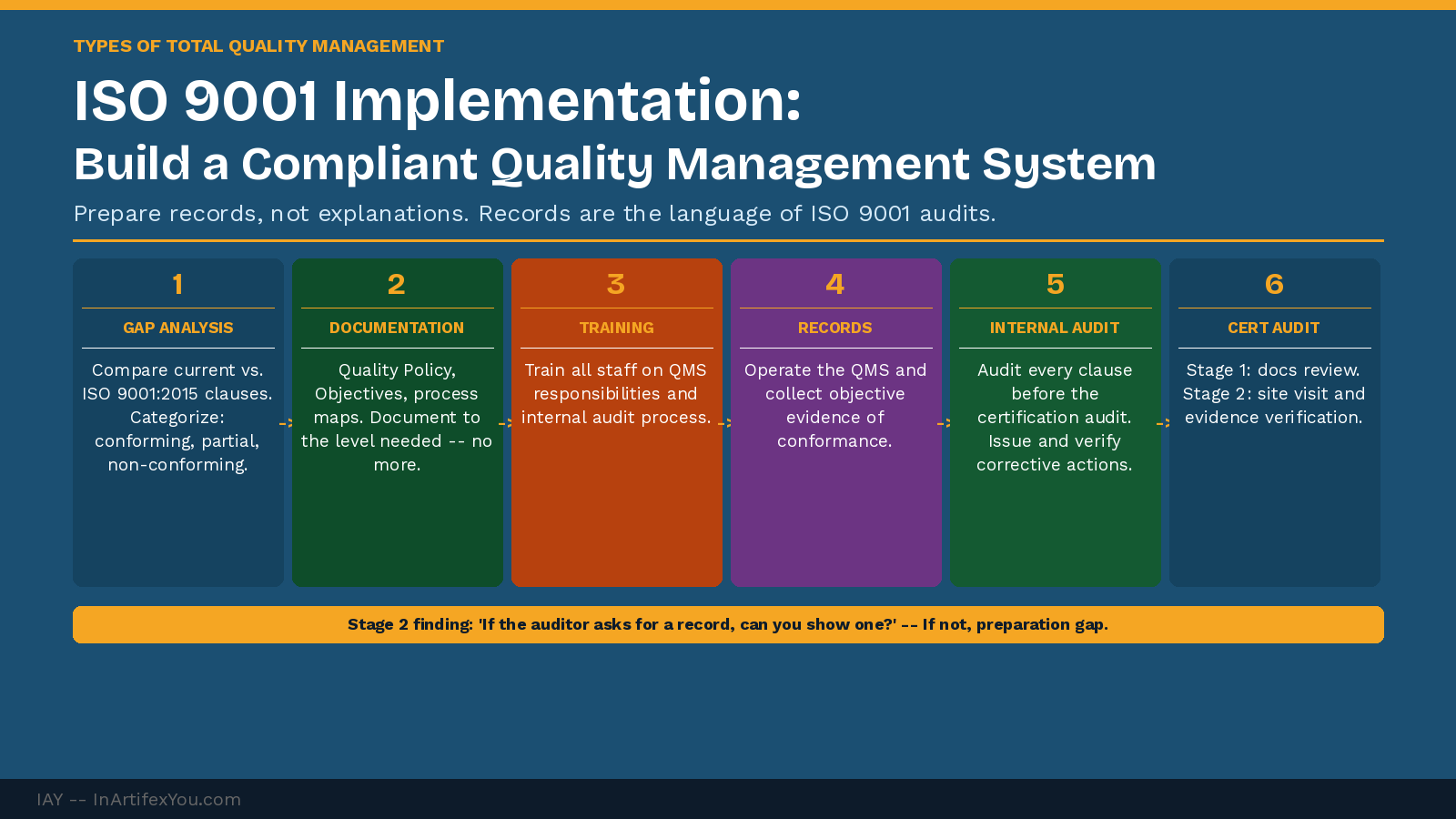
ISO 9001 implementation is the most common entry point for organizations that want a structured quality management system — because ISO 9001 is globally recognized, customer-accepted, and provides a defined framework that can be applied to any industry and any organization size. The implementation process has a clear sequence, but it is consistently derailed at the same two points: inadequate gap analysis at the start and insufficient internal auditing before the certification audit.
Phase 1: Gap Analysis
A structured gap analysis compares current practice against each ISO 9001:2015 clause requirement and identifies three categories of finding:
- Conforming: the requirement is already met by current practice — document the evidence and move on.
- Partially conforming: the requirement is partially met — document what exists and define the specific gap to close.
- Non-conforming: no current practice addresses the requirement — define the new process or procedure needed.
The gap analysis output is the implementation work plan: a prioritized list of what needs to be built, changed, or documented before the certification audit.
Phase 2: Process Documentation
ISO 9001:2015 requires documented information — but specifies that the organization determines what documented information is necessary for the QMS to function effectively. This is a significant change from ISO 9001:2008, which required a fixed set of mandatory procedures. The documentation principle: document to the level needed to ensure consistent execution — no more, no less.
|
Document Type |
Purpose |
ISO 9001:2015 Requirement |
|
Quality Policy. |
States the organization's commitment to quality and its quality objectives. |
Clause 5.2 — required. |
|
Quality Objectives. |
Measurable targets for quality performance. |
Clause 6.2 — required. |
|
Process Maps / Procedures. |
Define how key processes are executed consistently. |
Clause 4.4 — required where absence would lead to variation. |
|
Work Instructions. |
Step-by-step guidance for specific tasks. |
As needed — where absence would cause nonconformity. |
|
Records. |
Objective evidence that processes were followed and requirements met. |
Multiple clauses — specific records required throughout the standard. |
Phase 3: Internal Audit
The internal audit is the most important phase for certification success — and the most frequently underinvested. An organization that arrives at the Stage 2 certification audit without having run a complete internal audit cycle is almost guaranteed to receive major nonconformities.
- Audit every clause of the standard against objective evidence — not the process owner's description of what they do.
- Issue corrective actions for every nonconformity found and verify implementation before the certification audit.
- Conduct a management review after the internal audit cycle — this is a specific ISO 9001 requirement and a common audit finding when missing.
The Certification Audit Reality
Stage 1 audit: the registrar reviews documentation. If key documents are missing or don't address the requirements, Stage 2 is postponed.
Stage 2 audit: the registrar interviews process owners and reviews records. If records don't exist, the process is assumed not to be happening — regardless of what people say.
Prepare your records, not your explanations.
Back to hub: Types of Total Quality Management.
| ||||||||||||||||||||||
The Continuous Improvement Certification at InArtifexYou gives you a complete, practical system to map, baseline, improve, and sustain any process — and the verified credential to prove you can lead it.
inartifexyou.com/continuous-improvement-certification-online.html | ||||||||||||||||||||||
|