ISO 9001 vs TQM: how the standard and the philosophy
compare
ISO 9001 and TQM are related but fundamentally different: ISO 9001 is a standard — a defined set of requirements that an organization must demonstrate conformance to through a third-party audit. TQM is a philosophy — a comprehensive approach to managing quality that encompasses culture, leadership, continuous improvement, customer focus, and employee engagement. ISO 9001 sets a minimum quality management baseline and verifies that the organization meets it. TQM pursues excellence without a ceiling — there is no point at which TQM is complete. In practice, ISO 9001 certification is often the starting point: it establishes the documented processes, records discipline, and audit culture that TQM requires to function. TQM then builds on that foundation — driving continuous improvement beyond the standard's minimum requirements toward customer delight and operational excellence.
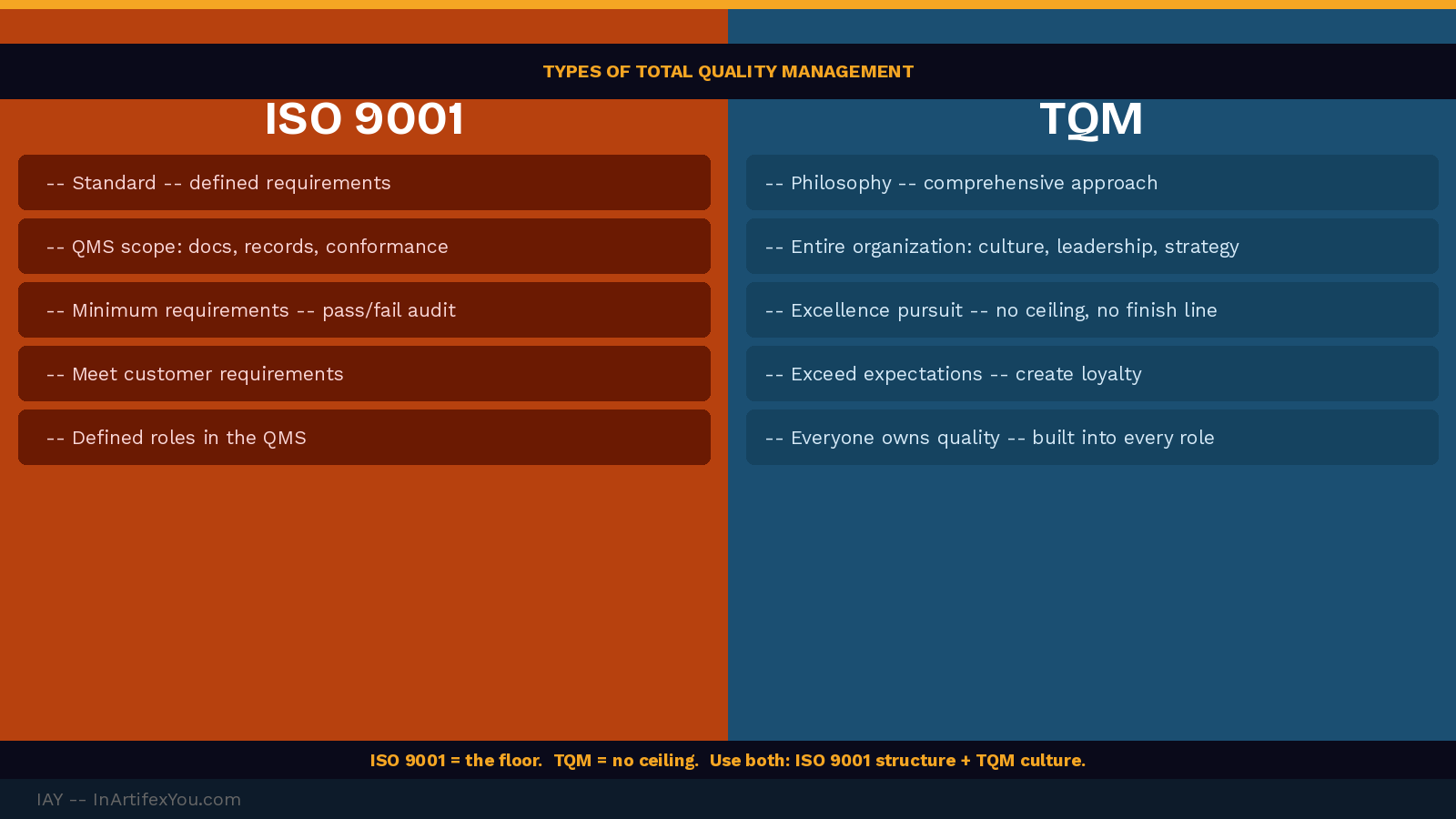
The ISO 9001 vs TQM question is one of the most common in quality management — and the most commonly misunderstood. Organizations that treat ISO 9001 certification as equivalent to TQM implementation are missing the point of both. ISO 9001 establishes the floor. TQM pursues the ceiling. The distinction matters because it determines how an organization uses each — and what it expects each to deliver.
Five Key Differences
|
Dimension |
ISO 9001 |
TQM |
|
Nature. |
Standard — defined requirements verified by external audit. |
Philosophy — comprehensive approach without external verification |
|
Scope. |
Quality Management System — documented processes, records, and conformance. |
Entire organization — culture, leadership, people, processes, and strategy. |
|
Objective. |
Demonstrate conformance to minimum requirements. |
Pursue continuous improvement toward excellence — no ceiling. |
|
Customer focus. |
Determine and meet customer requirements. |
Exceed customer expectations — create loyalty, not just satisfaction. |
|
Employee involvement. |
Defined roles and responsibilities within the QMS. |
Active participation in improvement — quality is everyone's job. |
|
|
|
|
|
|
|
|
Where They Overlap
ISO 9001 and TQM share eight quality management principles — customer focus, leadership, engagement of people, process approach, improvement, evidence-based decision making, relationship management, and context of the organization. The overlap is not coincidental: ISO 9001 was designed with TQM principles as its foundation. The standard codifies the minimum requirements for applying those principles. TQM applies them at the maximum level.
The Recommended Sequence
|
ISO 9001 FIRST — THEN TQM Establishes process documentation discipline. |
TQM WITHOUT ISO 9001 Cultural change without structural foundation. |
The Integration Principle
ISO 9001 and TQM are not alternatives — they are sequential layers.
ISO 9001 gives the organization the discipline to document, measure, and audit its processes. TQM gives it the culture, leadership, and continuous improvement system to improve those processes without limit.
The strongest quality organizations have both: ISO 9001 as the structure, TQM as the philosophy that drives it.
Back to hub: Types of Total Quality Management.
| ||||||||||||||||||||||
The Continuous Improvement Certification at InArtifexYou gives you a complete, practical system to map, baseline, improve, and sustain any process — and the verified credential to prove you can lead it.
inartifexyou.com/continuous-improvement-certification-online.html | ||||||||||||||||||||||
|