EFQM model in practice: how to apply the excellence
framework
The EFQM Excellence Model is applied through a structured self-assessment process using RADAR logic — Results, Approaches, Deployment, Assessment, and Refinement. The model has nine criteria divided into two groups: five Enablers (Leadership, Strategy, People, Partnerships and Resources, and Processes, Products and Services) and four Results (Customer Results, People Results, Society Results, and Business Results). Self-assessment scores each criterion using RADAR on a 0–1000 point scale. The self-assessment process: assemble a cross-functional team, score each criterion against the RADAR attributes, identify the criteria with the largest gap between current performance and excellence, and prioritize improvement projects that address those gaps. The EFQM model differs from ISO 9001 in one critical way: ISO 9001 audits conformance to requirements, while EFQM measures progress toward excellence — there is no pass/fail, only a score that reveals where the organization is on the journey.
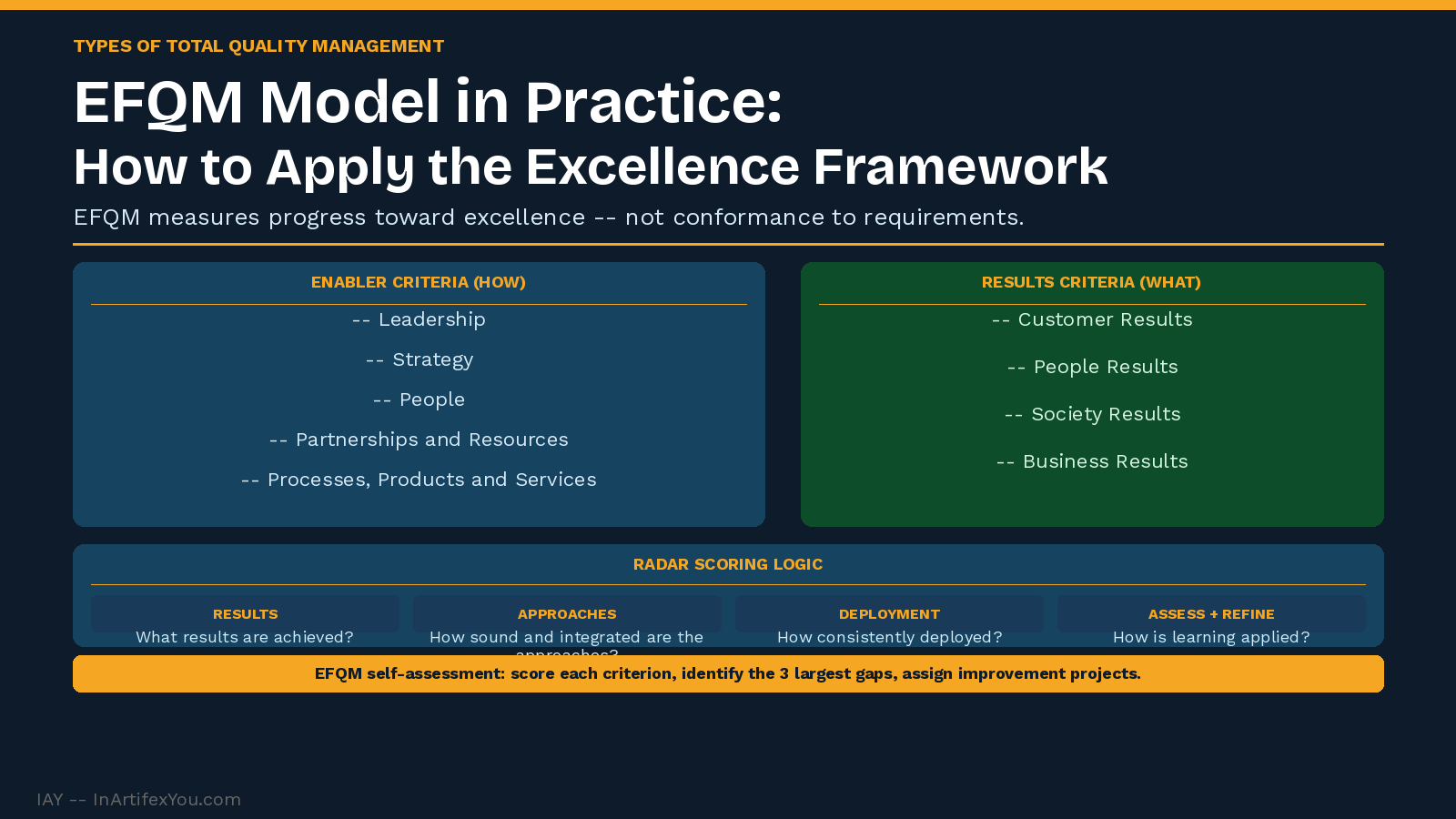
The EFQM model in practice operates as a diagnostic and improvement tool — not a certification standard. Organizations that use it most effectively treat the annual self-assessment as their strategic quality planning process: the assessment reveals where the gaps are, and the improvement plan closes them. Unlike ISO 9001, there is no external audit and no certificate at the end of the self-assessment. The value is in the diagnostic insight, not the score.
The Nine EFQM Criteria
|
Criterion |
Category |
What It Assesses |
|
Leadership. |
Enabler. |
How leaders develop and facilitate the organization's purpose, values, and culture. |
|
Strategy. |
Enabler. |
How the organization translates purpose into strategy and implements it through plans and processes. |
|
People. |
Enabler. |
How the organization manages, develops, and engages its people. |
|
Partnerships and Resources. |
Enabler. |
How the organization manages external partners, suppliers, and internal resources. |
|
Processes, Products and Services. |
Enabler. |
How the organization designs and manages its processes to deliver value. |
|
Customer Results. |
Results. |
What results the organization achieves for its customers. |
|
People Results. |
Results. |
What results the organization achieves for its people. |
|
Society Results. |
Results. |
What results the organization achieves for society and the community. |
|
Business Results. |
Results. |
What results the organization achieves for its key stakeholders financially and operationally. |
RADAR Logic: How to Score Each Criterion
RADAR is the EFQM scoring methodology. Each criterion is evaluated on four dimensions:
- Results: what results does the organization achieve? Are they relevant, segmented, trended, targeted, and benchmarked?
- Approaches: what approaches does the organization use to achieve results? Are they sound, integrated, and focused on stakeholder needs?
- Deployment: how systematically are the approaches deployed across all relevant areas — consistently and in a structured way?
- Assessment and Refinement: how does the organization measure, learn from, and improve its approaches and deployment?
RADAR in Practice
A high Approaches score with a low Deployment score means the organization has good practices that are not consistently applied — the most common EFQM finding.
A high Results score with low Approaches and Deployment scores means results are being achieved inconsistently — they will not be sustained when conditions change.
The RADAR profile reveals where to invest: poor Deployment requires standardization; poor Approaches requires redesign; poor Results requires target-setting and measurement.
How to Conduct an EFQM Self-Assessment
- Assemble a cross-functional self-assessment team of 6–10 people with knowledge across all nine criterion areas.
- Score each criterion independently using RADAR, then reconcile scores as a team — the discussion is as valuable as the score.
- Identify the three criteria with the largest gaps between current score and excellence benchmark.
- Design improvement projects targeting those three criteria — with specific owners, timelines, and measurable outcomes.
- Reassess annually — track score improvement over time as the measure of organizational excellence progress.
Back to hub: Types of Total Quality Management.
| ||||||||||||||||||||||
The Continuous Improvement Certification at InArtifexYou gives you a complete, practical system to map, baseline, improve, and sustain any process — and the verified credential to prove you can lead it.
inartifexyou.com/continuous-improvement-certification-online.html | ||||||||||||||||||||||
|