Crosby's Zero Defects: how to apply the cost of
quality concept today
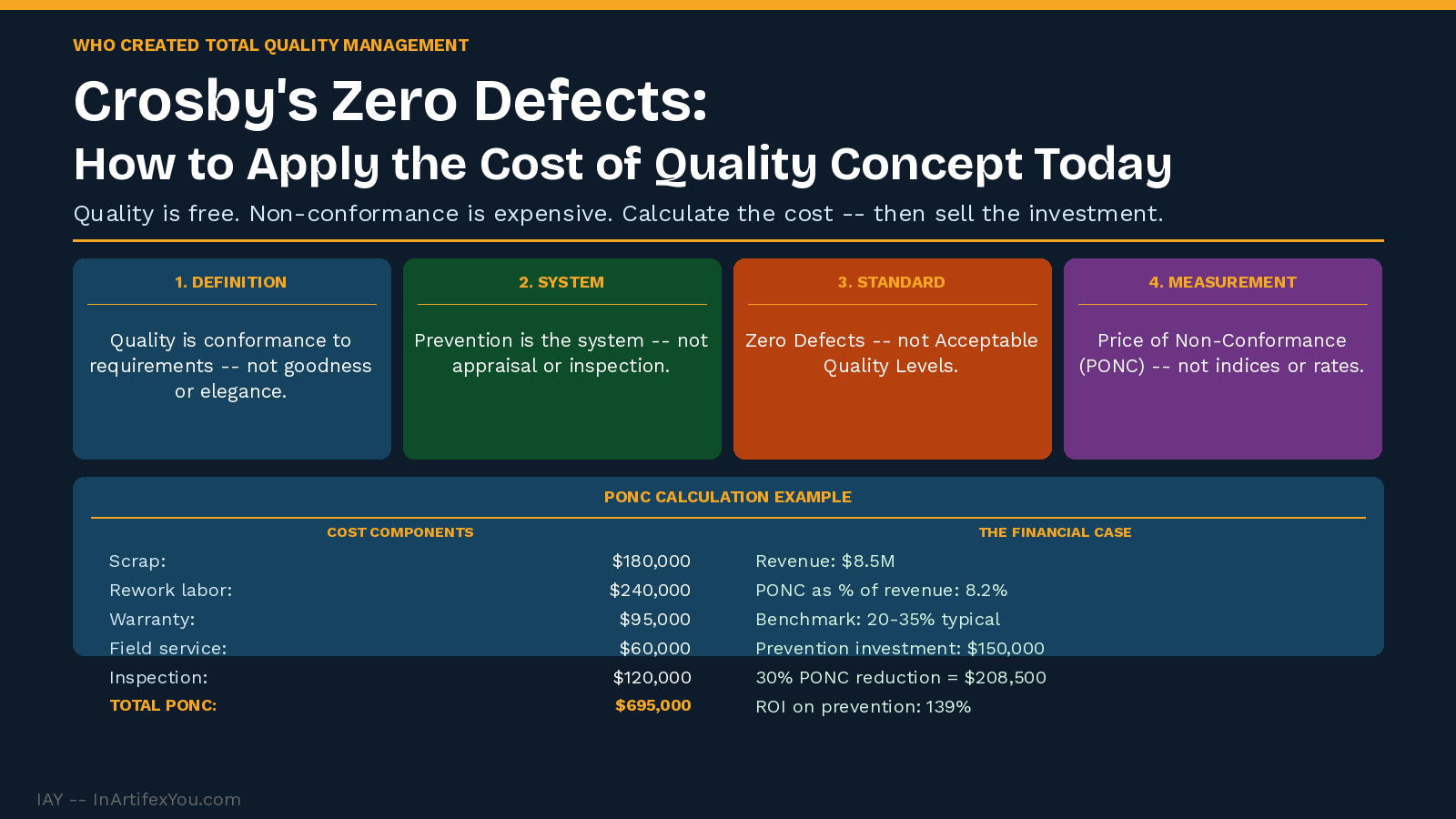
Crosby's Zero Defects concept is grounded in four absolutes of quality management: the definition of quality is conformance to requirements — not goodness or elegance; the system for achieving quality is prevention — not appraisal; the performance standard is Zero Defects — not acceptable quality levels; and the measurement of quality is the Price of Non-Conformance — the cost of not doing things right the first time. The most operationally powerful of these is the fourth absolute: the Price of Non-Conformance (PONC). PONC includes all costs incurred because conformance was not achieved — scrap, rework, warranty, inspection, field failures, and lost customers. Crosby's research showed that PONC typically represents 20–35% of revenue in manufacturing organizations and 35% in service organizations — making quality failure the largest controllable cost in most businesses. PONC calculation converts quality improvement from a technical initiative into a financial imperative.
Crosby's Zero Defects framework and its underlying cost of quality logic remain the most persuasive argument for quality investment in the executive suite — because they convert quality performance into financial language. Crosby's Zero Defects standard is not idealistic: it is the logical conclusion of the first absolute. If quality means conformance to requirements, then any defect is a failure to meet a requirement — and every failure has a cost. The organization that accepts an 'acceptable quality level' is explicitly budgeting for failure.
The Four Absolutes in Practice
|
Absolute |
Statement |
Practical Implication |
|
Definition. |
Quality is conformance to requirements. |
Define requirements precisely. Ambiguous requirements make quality unmeasurable. |
|
System. |
The system for quality is prevention. |
Invest in prevention: process design, training, mistake-proofing — not inspection. |
|
Performance standard. |
Zero Defects — not AQL. 'Acceptable' defect rates normalize failure. |
Zero Defects sets the correct standard even if full achievement is a journey. |
|
Measurement. |
Price of Non-Conformance (PONC). |
Calculate what non-conformance costs. Use PONC as the financial case for every quality improvement investment. |
Calculating PONC — Price of Non-Conformance
PONC calculation follows the same COPQ structure but frames it explicitly as the cost of failure — making the financial case for improvement unavoidable:
- Internal failure costs: scrap value + rework labor hours x fully loaded labor rate + re-inspection costs + downtime caused by quality failures.
- External failure costs: warranty claim processing cost + field service costs + customer credit notes + customer acquisition cost for accounts lost due to quality.
- Appraisal costs: all inspection and testing labor + laboratory costs + audit costs + incoming inspection costs.
The PONC Calculation Example
Annual scrap: $180,000. Rework labor: $240,000. Warranty: $95,000. Field service: $60,000. Inspection: $120,000.
Total PONC: $695,000.
Revenue: $8.5M. PONC as % of revenue: 8.2%.
Crosby benchmark: 20-35% of revenue typical. This organization is below average — but $695,000 is still a compelling improvement target.
Prevention investment of $150,000 targeting 30% PONC reduction = $208,500 return. ROI: 139%.
Zero Defects vs. Six Sigma
|
ZERO DEFECTS (CROSBY) Standard: conform to requirements every time. |
SIX SIGMA (MOTOROLA) Standard: 3.4 DPMO — near-zero statistical target. |
Back to hub: How Created TQM.
| ||||||||||||||||||||||
The Continuous Improvement Certification at InArtifexYou gives you a complete, practical system to map, baseline, improve, and sustain any process — and the verified credential to prove you can lead it.
inartifexyou.com/continuous-improvement-certification-online.html | ||||||||||||||||||||||
|