Quality gurus compared: which methodology fits your
organization?
The four major quality gurus — Deming, Juran, Ishikawa, and Crosby — offer complementary rather than competing approaches. Deming's system is best for organizations whose quality problems are primarily management-system failures — fear, arbitrary quotas, and short-term thinking that prevent the workforce from producing quality. Juran's Trilogy is best for organizations that need a clear framework for organizing quality planning, control, and improvement as distinct but connected disciplines. Ishikawa's tools are best for organizations that need practical, accessible methods that frontline employees can use without statistical expertise — the fishbone and quality circles are powerful precisely because they require no advanced training. Crosby's framework is best for organizations that need to build the financial case for quality investment — PONC calculation converts quality from a technical discussion into a CFO-level conversation. Most effective quality systems use elements of all four: Crosby's financial framing, Deming's management philosophy, Juran's organizational structure, and Ishikawa's practical tools.
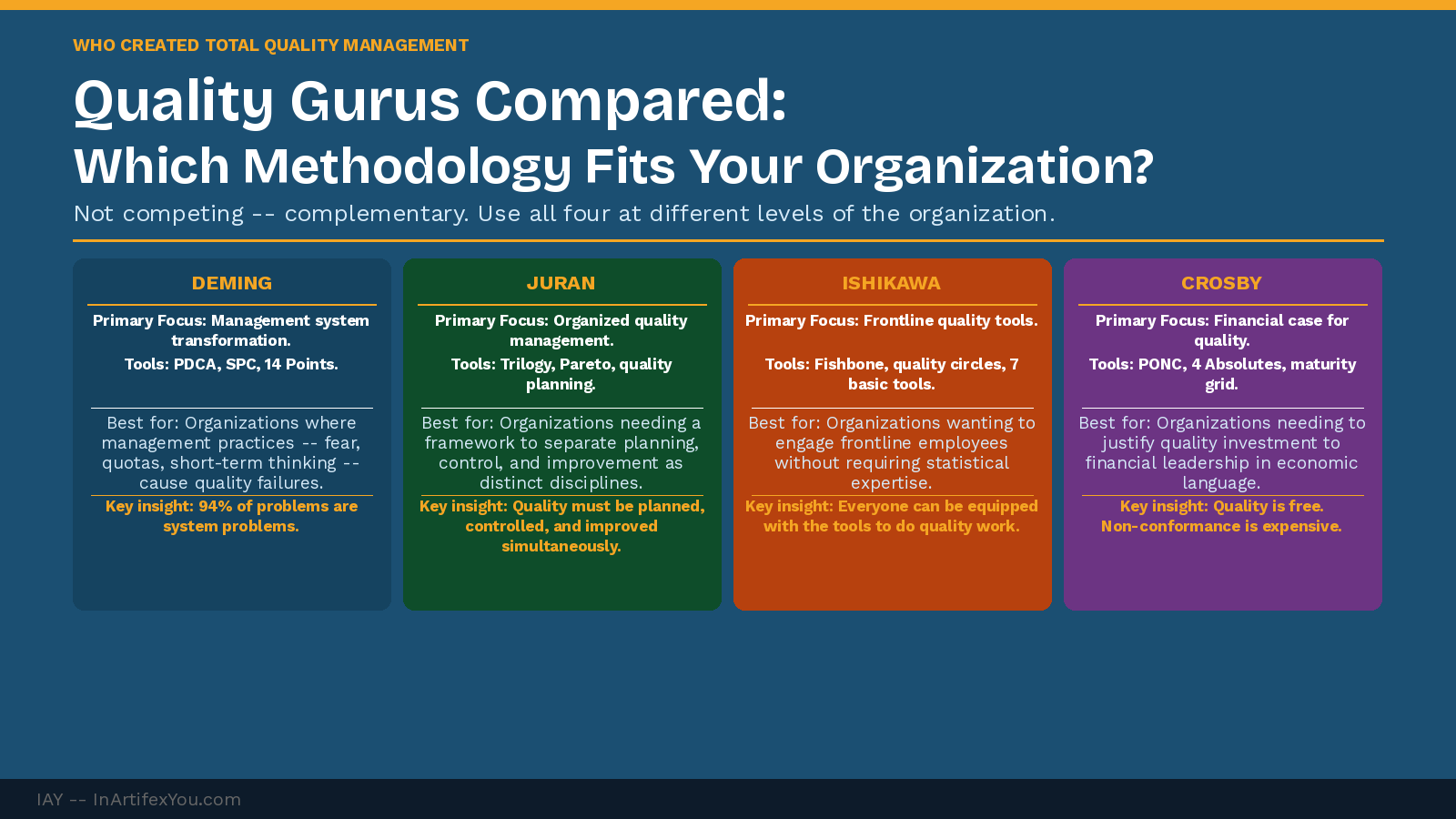
Quality gurus compared side by side reveal that each developed their framework in response to a specific quality failure they observed repeatedly. Understanding what each was responding to is the most practical guide to knowing which applies to your organization's current situation.
The Comparison Framework
|
Guru |
Primary Focus |
Core Tools |
Best-Fit Context |
Signature Insight |
|
Deming. |
Management system transformation. |
PDCA, SPC, 14 Points, System of Profound Knowledge. |
Organizations where management practices — fear, quotas, short-term thinking — are the root cause of quality failures. |
94% of quality problems are system problems. Workers cannot fix what management designed. |
|
Juran. |
Organized quality management. |
Quality Trilogy, Pareto analysis, quality planning roadmap. |
Organizations needing a structured framework to separate planning, control, and improvement as distinct activities. |
Quality does not happen by accident. It must be planned, controlled, and improved — simultaneously. |
|
Juran. |
Organized quality management. |
Quality Trilogy, Pareto analysis, quality planning roadmap. |
Organizations needing a structured framework to separate planning, control, and improvement as distinct activities. |
Quality does not happen by accident. It must be planned, controlled, and improved — simultaneously. |
|
Ishikawa. |
Frontline quality tools. |
Fishbone diagram, quality circles, seven basic quality tools. |
Organizations wanting to engage frontline employees in quality analysis without requiring statistical expertise. |
Quality is everyone's job — and everyone can be equipped with the tools to do it. |
|
Crosby. |
Financial case for quality. |
PONC calculation, four absolutes, quality maturity grid. |
Organizations needing to justify quality investment to financial leadership in economic language. |
Quality is free. Non-conformance is expensive. Calculate the cost — then you can sell the investment. |
The Integrated Application
The most effective quality systems do not choose one guru and ignore the others — they layer the frameworks:
- Start with Crosby: calculate PONC to establish the financial case for quality improvement investment — this secures leadership commitment and resources.
- Apply Deming: examine the management system — are fear, arbitrary quotas, and short-term thinking preventing the workforce from producing quality? Address system failures first.
- Use Juran: structure quality management into planning, control, and improvement processes — ensuring all three are active simultaneously.
- Deploy Ishikawa: equip frontline teams with fishbone analysis and quality circles — the practical tools that operationalize all three of the above at the point of work.
The Integration Principle
Crosby provides the financial why. Deming provides the management how. Juran provides the organizational structure. Ishikawa provides the frontline tools.
None of the four alone produces a complete quality system. Together, they cover every level of the organization — from the CFO conversation to the operator's workstation.
Back to hub: How Created TQM.
| ||||||||||||||||||||||
The Continuous Improvement Certification at InArtifexYou gives you a complete, practical system to map, baseline, improve, and sustain any process — and the verified credential to prove you can lead it.
inartifexyou.com/continuous-improvement-certification-online.html | ||||||||||||||||||||||
|