Environmental KPIs in TQEM: how to measure
quality-environmental performance
Environmental KPIs in TQEM measure how well the organization controls its significant environmental impacts — using the same measurement discipline applied to quality performance. The five essential environmental KPI categories are: Energy intensity (energy consumed per unit of production or revenue — tracks efficiency and carbon footprint), Water intensity (water consumed per unit of production — tracks water stewardship), Waste diversion rate (percentage of waste diverted from landfill through recycling, composting, or energy recovery — tracks circular economy progress), GHG emissions intensity (Scope 1 and Scope 2 greenhouse gas emissions per unit of production — the carbon performance metric), and Environmental compliance rate (percentage of applicable environmental regulatory requirements met without exceedance or violation — the baseline legal performance metric). Each KPI should have a baseline, a target, a measurement method, a reporting frequency, and a responsible owner — the same structure used for quality KPIs.
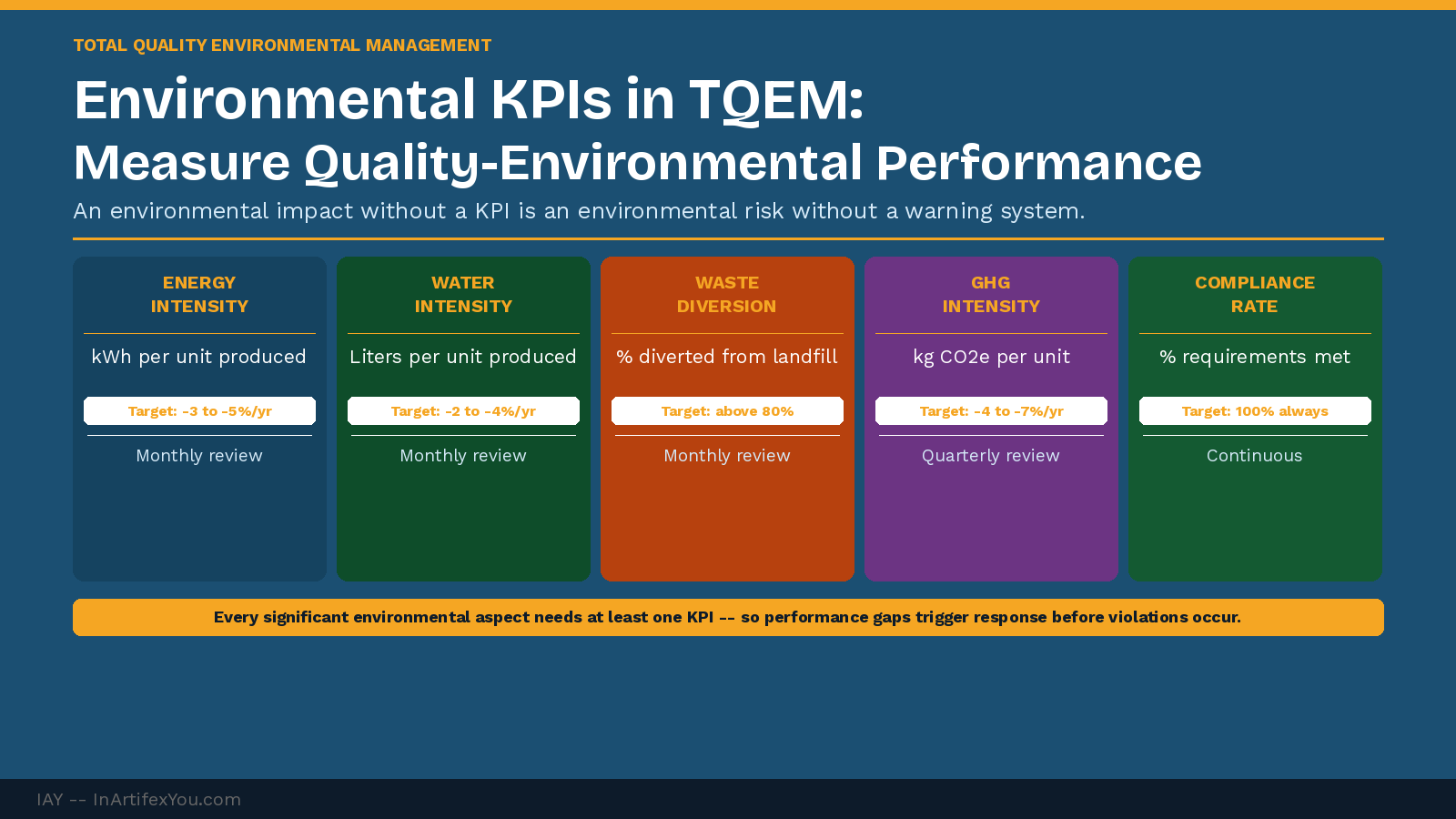
Environmental KPIs in TQEM follow the same logic as quality KPIs: measure what matters, set targets that drive improvement, review performance at defined intervals, and act on deviations. The difference is the measurement domain — instead of defect rate and COPQ, the organization tracks energy intensity and waste diversion. The management discipline is identical.
The Five Essential Environmental KPI Categories
|
KPI Category |
Metric |
Formula |
World-Class Target |
Review Frequency |
|
Energy intensity. |
kWh or GJ per unit of production. |
Total energy consumed / Total units produced. |
Annual reduction of 3-5%. |
Monthly. |
|
Water intensity. |
Liters or m3 per unit of production. |
Total water consumed / Total units produced. |
Annual reduction of 2-4%. |
Monthly. |
|
Waste diversion rate. |
% of waste diverted from landfill. |
(Total waste - Landfill waste) / Total waste x 100. |
Above 80% diversion. |
Monthly. |
|
GHG emissions intensity. |
kg CO2e per unit of production. |
(Scope 1 + Scope 2 emissions) / Total units produced. |
Annual reduction of 4-7%. |
Quarterly. |
|
Compliance rate. |
% of regulatory requirements met. |
(Requirements met / Total requirements) x 100. |
100% at all times. |
Continuously monitored. |
How to Set Environmental KPI Targets
Environmental targets follow the same three-level structure as quality targets:
- Minimum acceptable: the floor below which regulatory or reputational risk becomes unacceptable — compliance rate below 100% is always a minimum-threshold trigger.
- Improvement target: the performance level the organization commits to achieving within the planning period — based on current baseline plus a realistic improvement rate.
- Benchmark target: the performance achieved by environmental leaders in the industry — used to calibrate ambition and prevent self-congratulation on modest gains.
Connecting Environmental KPIs to the Management Review
Environmental KPIs belong in the same management review as quality KPIs — reviewed together, with the same rigor, by the same leadership team:
- Monthly operational review: energy intensity and water intensity trend — identify processes driving increase and assign corrective action.
- Quarterly strategic review: GHG emissions intensity trend, waste diversion rate, and compliance rate — connect to annual environmental objectives and adjust if off track.
- Annual planning review: full environmental performance assessment — set next year's targets, allocate improvement investment, and update the environmental aspects register.
The Measurement Principle
An environmental impact without a KPI is an environmental risk without a warning system.
Every significant environmental aspect identified in the baseline assessment must have at least one KPI — so that deteriorating performance triggers management response before it triggers a regulatory violation or a community complaint.
Back to hub: Total Quality Environmental Management.
| ||||||||||||||||||||||
The Continuous Improvement Certification at InArtifexYou gives you a complete, practical system to map, baseline, improve, and sustain any process — and the verified credential to prove you can lead it.
inartifexyou.com/continuous-improvement-certification-online.html | ||||||||||||||||||||||
|