TQEM in supply chain: how to extend environmental
quality to suppliers
TQEM in supply chain applies environmental quality management principles to the suppliers and partners whose activities contribute to the organization's total environmental footprint. For most manufacturing organizations, 60–80% of total environmental impact occurs in the supply chain — upstream in raw material extraction, component manufacturing, and logistics — not in the organization's own operations. Extending TQEM to suppliers follows four steps: Supplier environmental risk tiering (classify suppliers by environmental significance based on spend, material type, and geographic location), Environmental assessment (evaluate each Tier 1 supplier's environmental management capability using a structured questionnaire or on-site audit), Performance requirements (set minimum environmental standards as contractual requirements for critical suppliers — ISO 14001 certification, specific emission limits, or waste diversion targets), and Capability development (provide training, tools, or joint improvement projects to help strategic suppliers meet environmental performance requirements they cannot currently achieve independently).
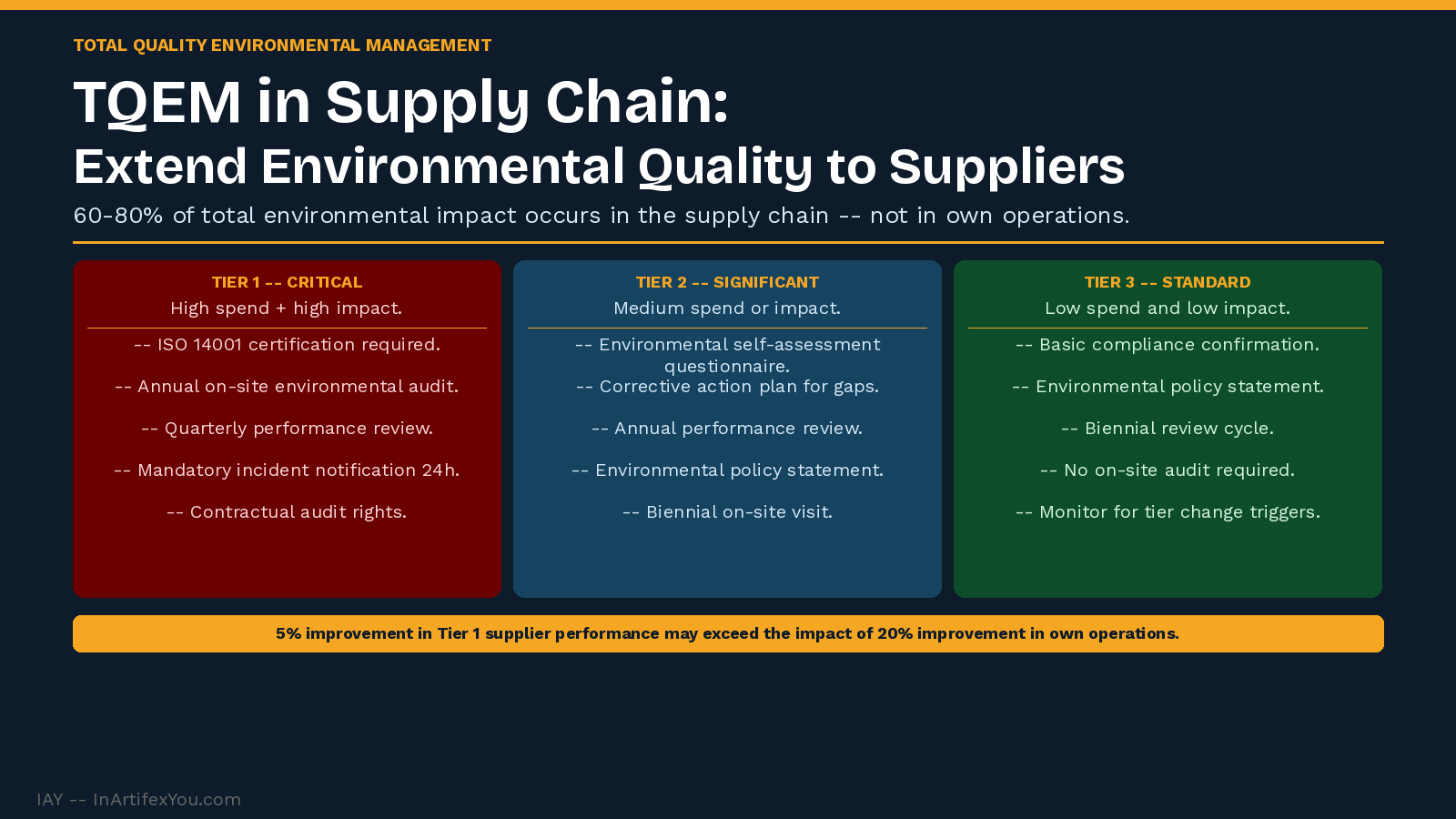
TQEM in supply chain addresses the most significant and most commonly overlooked portion of an organization's environmental footprint. Organizations that manage their own operations to environmental excellence while ignoring supplier environmental performance are managing a small fraction of their actual impact. Supply chain environmental management is not optional for organizations with genuine TQEM ambition — it is the largest leverage point available.
Step 1: Supplier Environmental Risk Tiering
Not all suppliers have equal environmental significance. Risk tiering focuses management attention where it produces the most environmental impact:
|
Tier |
Criteria |
Environmental Management Requirement |
Review Frequency |
|
Tier 1 — Critical. |
High spend + high environmental impact materials or processes. |
ISO 14001 certification or equivalent. Annual on-site environmental audit. |
Quarterly performance review. |
|
Tier 2 — Significant. |
Medium spend or moderate environmental impact. |
Environmental self-assessment questionnaire. Corrective action plan for gaps. |
Annual performance review. |
|
Tier 3 — Standard. |
Low spend and low environmental impact. |
Environmental policy statement and basic compliance confirmation. |
Biennial review. |
Step 2: Supplier Environmental Assessment
The supplier environmental assessment evaluates current environmental management capability across five areas:
- Environmental management system: does the supplier have a documented EMS? ISO 14001 certified, certified to another standard, or unstructured?
- Significant impacts: has the supplier identified its significant environmental aspects and impacts? Are controls in place for each?
- Compliance status: is the supplier compliant with all applicable environmental regulations? When was the last regulatory inspection, and what was the outcome?
- Environmental performance data: does the supplier track energy, water, waste, and emissions metrics? Are trends improving or deteriorating?
- Incident history: has the supplier experienced environmental incidents — spills, permit violations, or community complaints — in the past three years?
Step 3: Environmental Performance Requirements in Contracts
Environmental requirements must be contractual — not aspirational — for Tier 1 and Tier 2 suppliers:
- Minimum EMS standard: ISO 14001 certification required for Tier 1 suppliers processing critical materials with high environmental impact.
- Performance floor: specific environmental performance thresholds — e.g., waste diversion above 70%, zero major permit violations, energy intensity trend not deteriorating.
- Incident reporting: mandatory notification within 24 hours of any significant environmental incident at a facility supplying to the organization.
- Audit right: contractual right to conduct or commission an environmental audit of Tier 1 supplier facilities with reasonable notice.
The Supply Chain Leverage Principle
A 5% improvement in Tier 1 supplier environmental performance may produce more total environmental impact reduction than a 20% improvement in the organization's own operations.
Supply chain environmental management is not about compliance monitoring — it is about directing improvement investment to where it produces the greatest total environmental benefit.
Back to hub: Total Quality Environmental Management.
| ||||||||||||||||||||||
The Continuous Improvement Certification at InArtifexYou gives you a complete, practical system to map, baseline, improve, and sustain any process — and the verified credential to prove you can lead it.
inartifexyou.com/continuous-improvement-certification-online.html | ||||||||||||||||||||||
|