ISO 14001 and TQM: how to integrate environmental and
quality management
ISO 14001 and TQM share the same structural DNA — both use process-based management, PDCA as the operating cycle, leadership commitment as a prerequisite, and continuous improvement as the performance standard. Integration is possible because both systems use the same High Level Structure (HLS) framework adopted across all major ISO management system standards since 2015. The integration points are: policy (one integrated quality and environmental policy), objectives (quality and environmental objectives set together in a single planning process), internal audit (one audit program covering both ISO 9001 and ISO 14001 requirements), corrective action (one system for managing quality and environmental nonconformities), and management review (one review agenda covering quality and environmental performance data). Integrated certification — a single third-party audit covering both ISO 9001 and ISO 14001 — is available from all major registrars and typically costs 20–30% less than two separate audits.
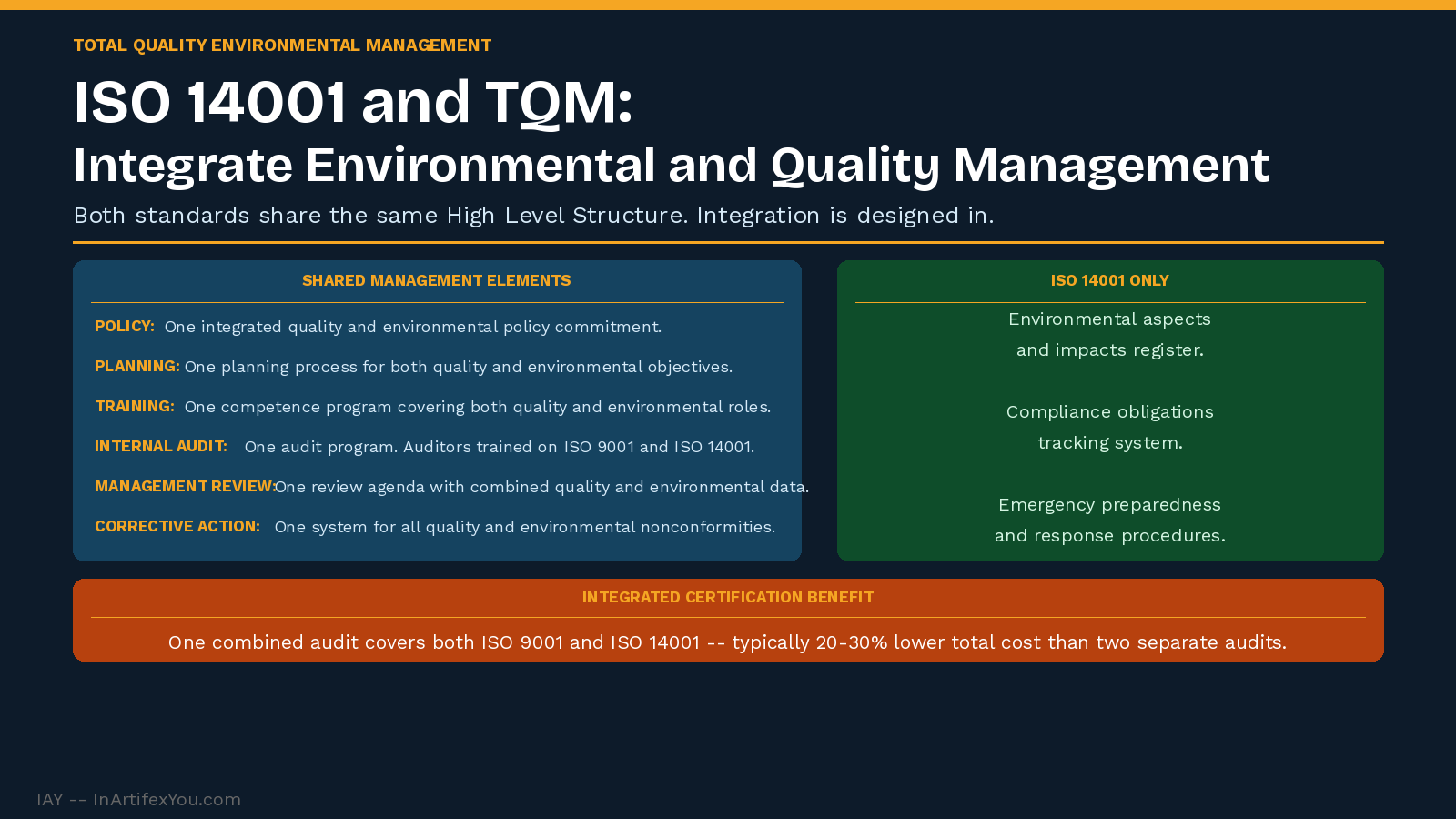
ISO 14001 and TQM integration is structurally straightforward because ISO 14001 was deliberately designed using the same High Level Structure as ISO 9001. Organizations that already have an ISO 9001 quality management system are 60–70% of the way to ISO 14001 readiness — the process discipline, documentation culture, internal audit capability, and management review structure are already in place. The integration work focuses on adding environmental content to existing quality management infrastructure, not building a parallel system.
Structural Overlaps: What Both Systems Share
|
Management System Element |
ISO 9001:2015 Clause |
ISO 14001:2015 Clause |
Integration Approach |
|
Context of the organization. |
4.1 – 4.4. |
4.1 – 4.4. |
Single context analysis covering quality and environmental aspects. |
|
Leadership and policy. |
5.1 – 5.3. |
5.1 – 5.3. |
One integrated policy. One leadership commitment statement. |
|
Planning and objectives. |
6.1 – 6.2. |
6.1 – 6.2. |
One planning process setting both quality and environmental objectives. |
|
Competence and awareness. |
7.1 – 7.3. |
7.1 – 7.3. |
One training program covering both quality and environmental competencies. |
|
Internal audit. |
9.2. |
9.2. |
One audit program. Auditors trained on both standards. |
|
Management review. |
9.3. |
9.3. |
One review meeting with combined quality and environmental agenda. |
|
Corrective action. |
10.2. |
10.2. |
One corrective action system for both quality and environmental nonconformities. |
ISO 14001-Specific Requirements: What TQM Does Not Cover
Three areas in ISO 14001 have no direct equivalent in ISO 9001 or standard TQM — these require specific additional work:
- Environmental aspects and impacts: the systematic identification and evaluation of how the organization's activities, products, and services interact with the environment — unique to ISO 14001.
- Compliance obligations: identification of all applicable legal and regulatory environmental requirements — and a system for monitoring changes and maintaining compliance.
- Emergency preparedness and response: documented procedures for responding to environmental incidents — spills, releases, and abnormal conditions with environmental consequence.
Integrated Certification: The Practical Outcome
|
SEPARATE CERTIFICATIONS Two separate audit programs. |
INTEGRATED CERTIFICATION One combined audit program. |
Back to hub: Total Quality Environmental Management.
| ||||||||||||||||||||||
The Continuous Improvement Certification at InArtifexYou gives you a complete, practical system to map, baseline, improve, and sustain any process — and the verified credential to prove you can lead it.
inartifexyou.com/continuous-improvement-certification-online.html | ||||||||||||||||||||||
|