GEMI framework in practice: how to apply TQEM
principles operationally
The GEMI (Global Environmental Management Initiative) TQEM framework operationalizes Total Quality Environmental Management through five principles applied using a structured self-assessment tool called the SD Planner (Sustainable Development Planner). The five GEMI TQEM principles are: Integrated management (environmental management integrated into all business functions — not isolated in an EHS department), Continual improvement (environmental performance improved systematically using PDCA — not managed to a compliance minimum), Employee empowerment (environmental responsibility distributed to all employees — not centralized in environmental specialists), Stakeholder engagement (environmental performance communicated transparently to customers, communities, and regulators — not treated as proprietary), and Life-cycle thinking (environmental impacts managed across the full product or service life cycle — from raw material through end-of-life — not limited to operational boundaries). The SD Planner assesses organizational performance on each principle on a 1–5 maturity scale and identifies the highest-priority improvement actions.
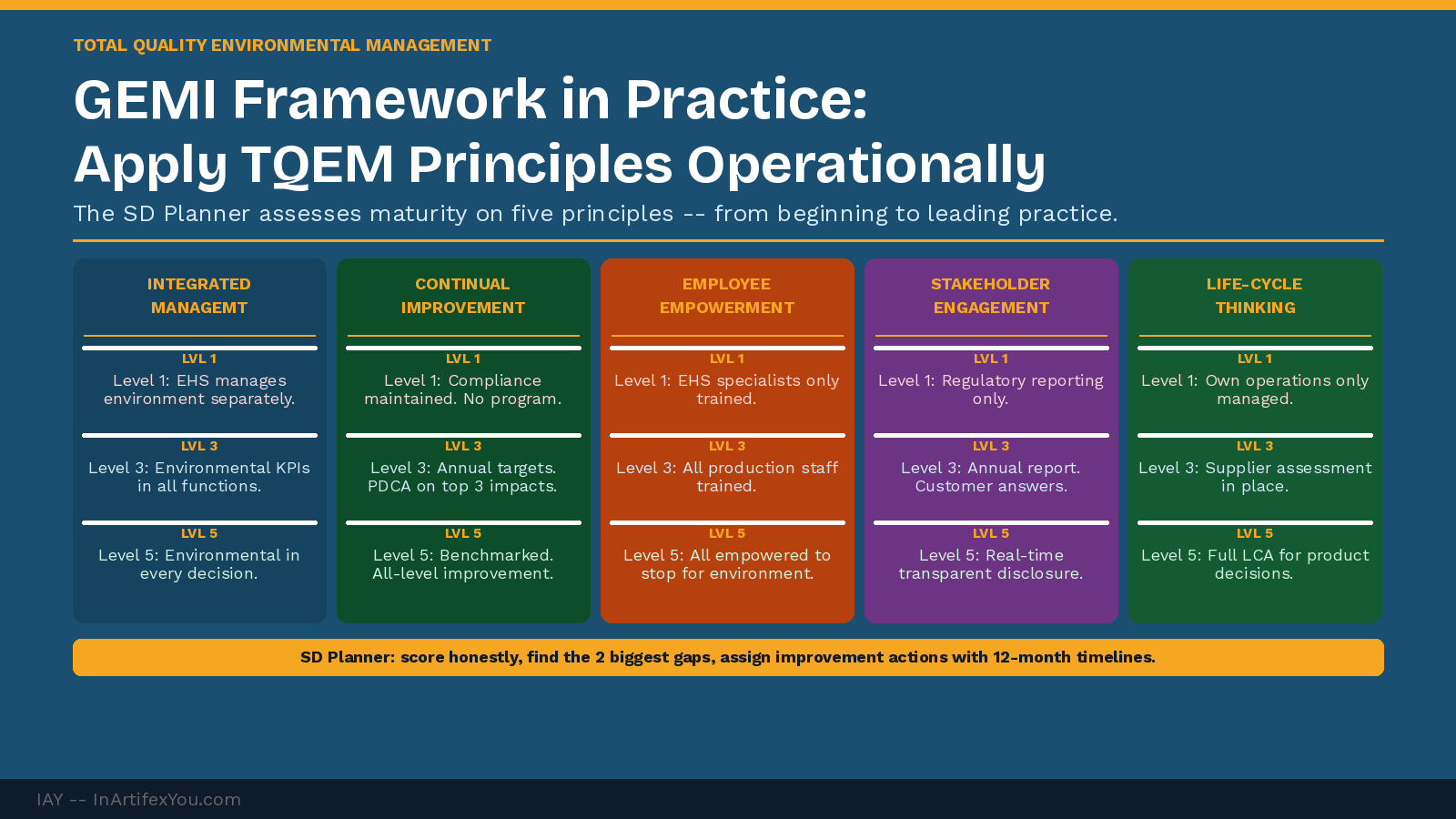
The GEMI framework in practice provides a structured way to assess where an organization stands on each TQEM principle and to identify specific operational actions that will move performance forward. Unlike ISO 14001 — which audits conformance to requirements — the GEMI SD Planner measures progress toward environmental excellence on a maturity scale, revealing not just whether requirements are met but how far the organization is from best practice on each dimension.
The Five GEMI TQEM Principles — Operational Application
|
Principle |
Maturity Level 1 (Beginning) |
Maturity Level 3 (Developing) |
Maturity Level 5 (Leading) |
|
Integrated management. |
EHS function manages environment separately from operations. |
Environmental objectives included in operational planning and business reviews. |
Environmental performance integrated into every function's KPIs and decision-making. |
|
Continual improvement. |
Environmental compliance maintained. No structured improvement program. |
Annual environmental improvement targets set. PDCA applied to top 3 significant impacts. |
Environmental improvement rate benchmarked externally. Improvement projects at all levels. |
|
Employee empowerment. |
Environmental training for EHS specialists only. |
Role-specific environmental training for all production employees. Suggestion system active. |
All employees trained, empowered to stop processes for environmental reasons, and involved in improvement. |
|
Stakeholder engagement. |
Regulatory reporting only. No proactive disclosure. |
Annual environmental report published. Customer environmental questionnaires answered promptly. |
Transparent real-time environmental performance data shared with community, customers, and regulators. |
|
Life-cycle thinking. |
Environmental management limited to owned operations. |
Product design considers material environmental impact. Supplier environmental assessment in place. |
Full life-cycle assessment used for product design decisions. End-of-life take-back programs active. |
How to Use the GEMI SD Planner
- Assemble an assessment team: 4–6 people representing operations, quality, procurement, and environmental management.
- Score each of the five principles on the 1–5 maturity scale independently — then reconcile as a team.
- Identify the two principles with the largest gap between current maturity and target state.
- Design improvement actions for each gap — specific, owned, with a 12-month implementation timeline.
- Reassess annually — track maturity score improvement as the measure of TQEM development progress.
The GEMI Application Principle
The SD Planner's value is not the score — it is the conversation the scoring process produces.
A cross-functional team that honestly assesses each TQEM principle against observable evidence — rather than optimistic self-assessment — identifies the specific operational gaps that formal audits often miss.
Use the assessment as a planning tool, not a reporting tool.
Back to hub: Total Quality Environmental Management.
| ||||||||||||||||||||||
The Continuous Improvement Certification at InArtifexYou gives you a complete, practical system to map, baseline, improve, and sustain any process — and the verified credential to prove you can lead it.
inartifexyou.com/continuous-improvement-certification-online.html | ||||||||||||||||||||||
|