TQEM implementation: how to build an integrated
quality-environmental system
TQEM implementation integrates environmental management into the existing quality management system rather than building a parallel, separate environmental system. The five-phase approach: Phase 1 — Environmental Baseline Assessment: identify all significant environmental aspects and impacts of the organization's operations — emissions, energy use, water consumption, waste generation, and materials. Phase 2 — System Design: design the environmental management processes that will control significant impacts — using the same process-based approach as the quality management system. Phase 3 — QMS Integration: embed environmental objectives, controls, and performance indicators into existing quality processes rather than creating separate environmental procedures. Phase 4 — Employee Engagement: train all relevant personnel on their environmental responsibilities within the integrated system — following the same engagement approach used for quality. Phase 5 — Management Review: include environmental performance data in the regular quality management review — one integrated review covers both quality and environmental performance.
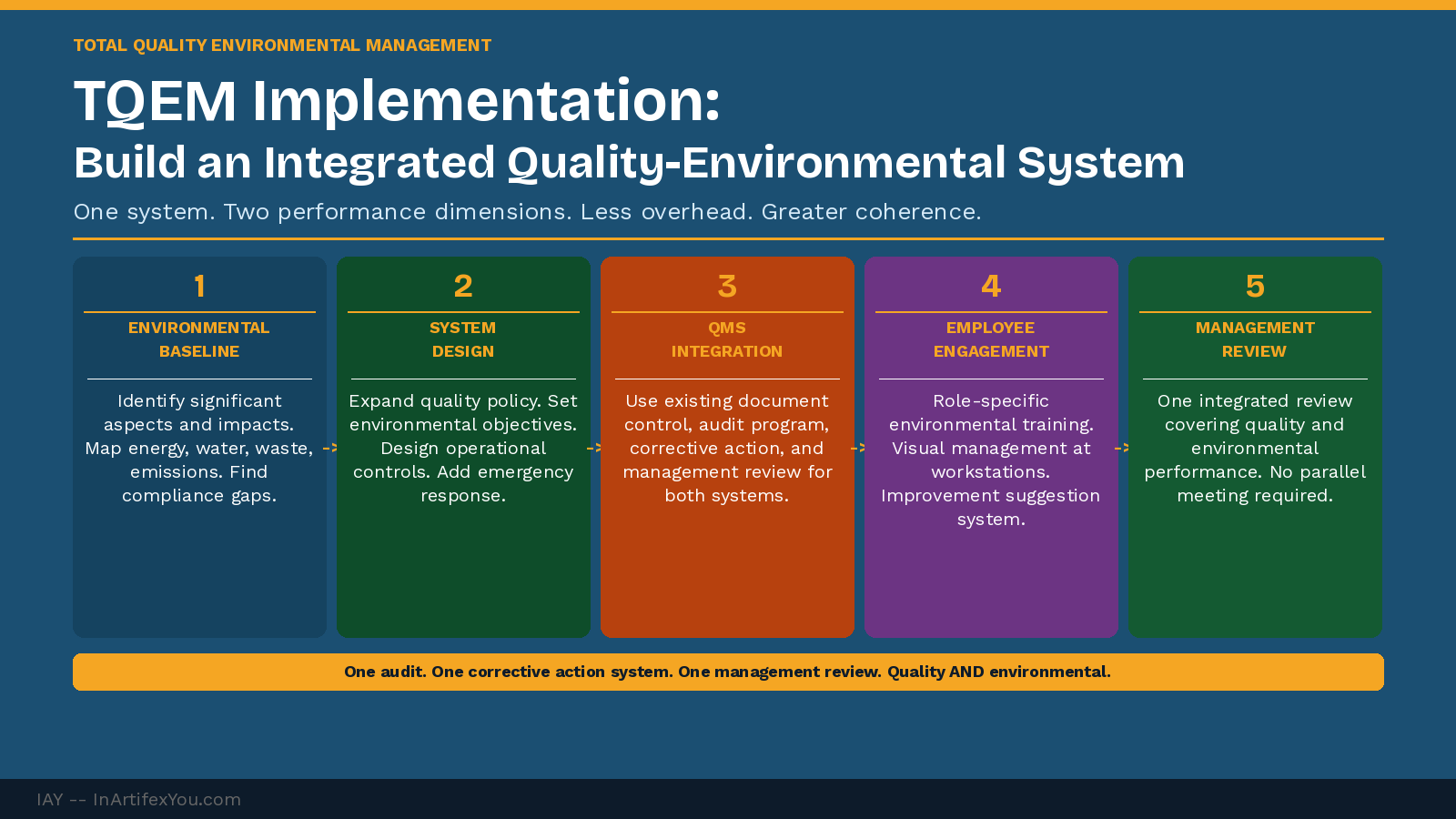
TQEM implementation succeeds when it is treated as an extension of the existing quality management system — not as a separate environmental compliance program bolted alongside it. Organizations that build parallel quality and environmental systems create duplication, confusion, and audit fatigue. Organizations that integrate environmental management into their quality management architecture create a single, coherent system that covers both dimensions with less overhead and greater organizational alignment.
Phase 1: Environmental Baseline Assessment
Before designing any management system, the organization must understand its current environmental footprint. The baseline assessment identifies:
- Significant environmental aspects: activities, products, or services that interact with the environment — energy consumption, water use, air emissions, solid waste generation, chemical use, and land impact.
- Environmental impacts: the actual or potential changes to the environment resulting from each aspect — climate impact, water quality, biodiversity, and local community effects.
- Legal and regulatory requirements: all applicable environmental regulations at local, national, and international levels — understanding compliance gaps is the starting point for objective setting.
- Existing controls: what environmental controls already exist — and where significant impacts have no management control in place.
Phase 2: System Design
System design converts the baseline assessment into a management architecture:
|
System Element |
Design Decision |
Integration Point with QMS |
|
Environmental Policy. |
Expand the Quality Policy to include environmental commitments — or create an integrated Quality and Environmental Policy. |
Clause 5.2 — Policy (ISO 9001 equivalent). |
|
Environmental Objectives. |
Set measurable environmental targets for each significant impact category — energy reduction, waste diversion, water use. |
Clause 6.2 — Objectives (ISO 9001 equivalent). |
|
Operational Controls. |
Define the process controls that prevent or reduce significant environmental impacts during operations. |
Clause 8 — Operations (ISO 9001 equivalent). |
|
Emergency Preparedness. |
Document response procedures for environmental incidents — spills, releases, and equipment failures with environmental consequence. |
ISO 14001 Clause 8.2 — specific requirement. |
Phase 3: QMS Integration
Integration means using existing quality management infrastructure for environmental management wherever possible:
- Document control: use the same document management system for environmental procedures as for quality procedures — same approval process, same revision control.
- Internal audit: extend the existing quality internal audit program to cover environmental performance — train existing internal auditors on environmental requirements.
- Corrective action: use the same corrective action system for environmental nonconformities as for quality nonconformities — same root cause analysis, same closure verification.
- Management review: add environmental performance data as a standing agenda item in the existing quality management review — no separate environmental review meeting required.
Phase 4: Employee Engagement
Environmental management fails at the frontline when employees do not understand how their specific actions connect to significant environmental impacts. The engagement approach mirrors quality culture development:
- Role-specific environmental training: what environmental aspects does this role create, what controls are required, and what to do if an environmental incident occurs.
- Visual management: environmental performance indicators displayed at the point of work alongside quality performance indicators.
- Improvement involvement: environmental improvement suggestions welcomed through the same suggestion system used for quality improvements.
The Integration Principle.
One system. Two performance dimensions.
The organization that manages quality and environmental performance through one integrated system — one audit, one review, one corrective action process — operates with less overhead and greater coherence than the organization running parallel systems.
Back to hub: Total Quality Environmental Management.
| ||||||||||||||||||||||
The Continuous Improvement Certification at InArtifexYou gives you a complete, practical system to map, baseline, improve, and sustain any process — and the verified credential to prove you can lead it.
inartifexyou.com/continuous-improvement-certification-online.html | ||||||||||||||||||||||
|