Food safety audit preparation: how to pass ISO 22000
certification
ISO 22000 food safety audit preparation requires two parallel tracks: documentation readiness for Stage 1 and operational evidence readiness for Stage 2. Stage 1 preparation focuses on ensuring all required documented information exists: food safety policy, HACCP plan, hazard analysis records, PRP documentation, food safety objectives, and the food safety management system scope. Stage 2 preparation focuses on demonstrating that the system is operational — that HACCP monitoring records are complete and current, corrective actions are documented and verified effective, PRPs are being followed, and the food safety team is functioning. The most common ISO 22000 nonconformities are: HACCP plans not validated (critical limits not science-based), monitoring records incomplete or showing gaps, corrective actions closed without root cause analysis, and management reviews not covering all required inputs. Run a complete internal audit cycle before the certification audit — the findings it reveals are exactly what the registrar will find if you do not.
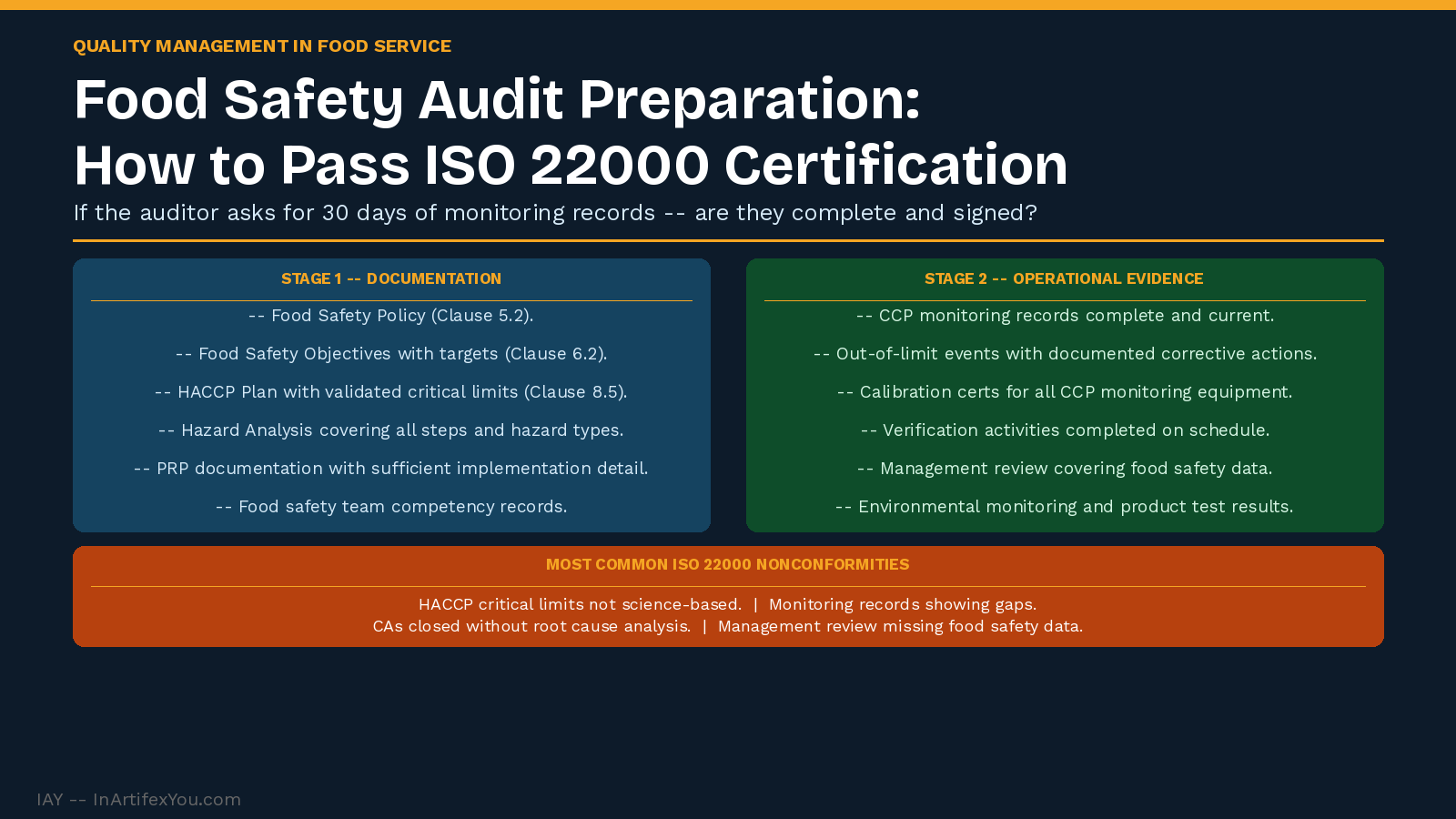
Food safety audit preparation for ISO 22000 certification follows the same two-stage logic as all ISO management system audits — but with significantly higher stakes. A food safety system nonconformity is not just a compliance gap — it is potential evidence that the organization has been producing food without adequate safety controls. The preparation discipline must reflect that stakes level.
Stage 1 Preparation: Documentation
|
Required Document |
ISO 22000 Clause |
Common Finding at Stage 1 |
|
Food Safety Policy. |
5.2. |
Generic statement with no food safety commitment specific to the organization's hazards. |
|
Food Safety Objectives. |
6.2. |
Objectives without measurement methods, targets, or responsible owners. |
|
HACCP Plan. |
8.5. |
CCPs identified without documented scientific basis for critical limits. |
|
Hazard Analysis Records. |
8.5.2. |
Hazard analysis not covering all process steps or all hazard categories. |
|
PRP Documentation. |
8.2. |
PRPs listed but not documented with sufficient detail to verify implementation. |
|
Food Safety Team records. |
8.1. |
No documented evidence of food safety team meetings or competency verification. |
Stage 2 Preparation: Operational Evidence
Stage 2 evidence preparation focuses on demonstrating that the documented system is actually operating. For each HACCP CCP, prepare:
- Monitoring records: complete, current, and signed. No unexplained gaps. Temperature logs showing continuous recording or regular interval checks with no missing entries.
- Out-of-limit events and corrective actions: every instance where a CCP exceeded its critical limit must have a documented corrective action — product disposition decision, process correction, and verification that the correction worked.
- Calibration records: current calibration certificates for all monitoring equipment used at CCPs — thermometers, pH meters, scales, metal detectors.
- Verification records: scheduled verification activities completed on time — CCP audits, environmental monitoring results, finished product test results.
The Most Common ISO 22000 Nonconformities
- HACCP plan not validated: critical limits set based on judgment rather than scientific validation — e.g., cooking temperature established without reference to a validated pathogen reduction study.
- Monitoring records showing gaps or retroactive completion — auditors are trained to identify records completed after the fact rather than in real time.
- Corrective actions closed without root cause analysis: the product was disposed of but the process failure that caused the CCP deviation was not identified and corrected.
- Management review missing food safety performance data — the review covers business performance but not HACCP verification results, customer complaints by food safety category, or PRP audit outcomes.
The Audit Readiness Test
For every CCP in the HACCP plan, ask: 'If the auditor asks to see the last 30 days of monitoring records — are they complete, legible, and signed?'
If the answer is 'mostly' or 'I would need to check' — you have a preparation gap.
Food safety auditors are specifically trained to identify gaps in monitoring records. The gap is the finding.
Back to hub: Quality Management in Food Service.
| ||||||||||||||||||||||
The Continuous Improvement Certification at InArtifexYou gives you a complete, practical system to map, baseline, improve, and sustain any process — and the verified credential to prove you can lead it.
inartifexyou.com/continuous-improvement-certification-online.html | ||||||||||||||||||||||
|