HACCP implementation: how to build a food safety
hazard control plan
HACCP (Hazard Analysis and Critical Control Points) implementation follows seven principles. Principle 1 — Conduct a hazard analysis: identify all biological, chemical, and physical hazards at each step of the food production process that are reasonably likely to cause harm if not controlled. Principle 2 — Identify Critical Control Points (CCPs): the process steps where control can be applied to prevent, eliminate, or reduce a food safety hazard to an acceptable level. Principle 3 — Establish critical limits: the measurable boundary at each CCP that separates acceptable from unacceptable — cooking temperature, pH, water activity. Principle 4 — Establish monitoring procedures: how each CCP will be measured, at what frequency, and by whom. Principle 5 — Establish corrective actions: what happens when monitoring shows a CCP is out of control. Principle 6 — Establish verification procedures: how the organization confirms the HACCP system is working effectively. Principle 7 — Establish recordkeeping: the documented evidence that the system is operating as designed.
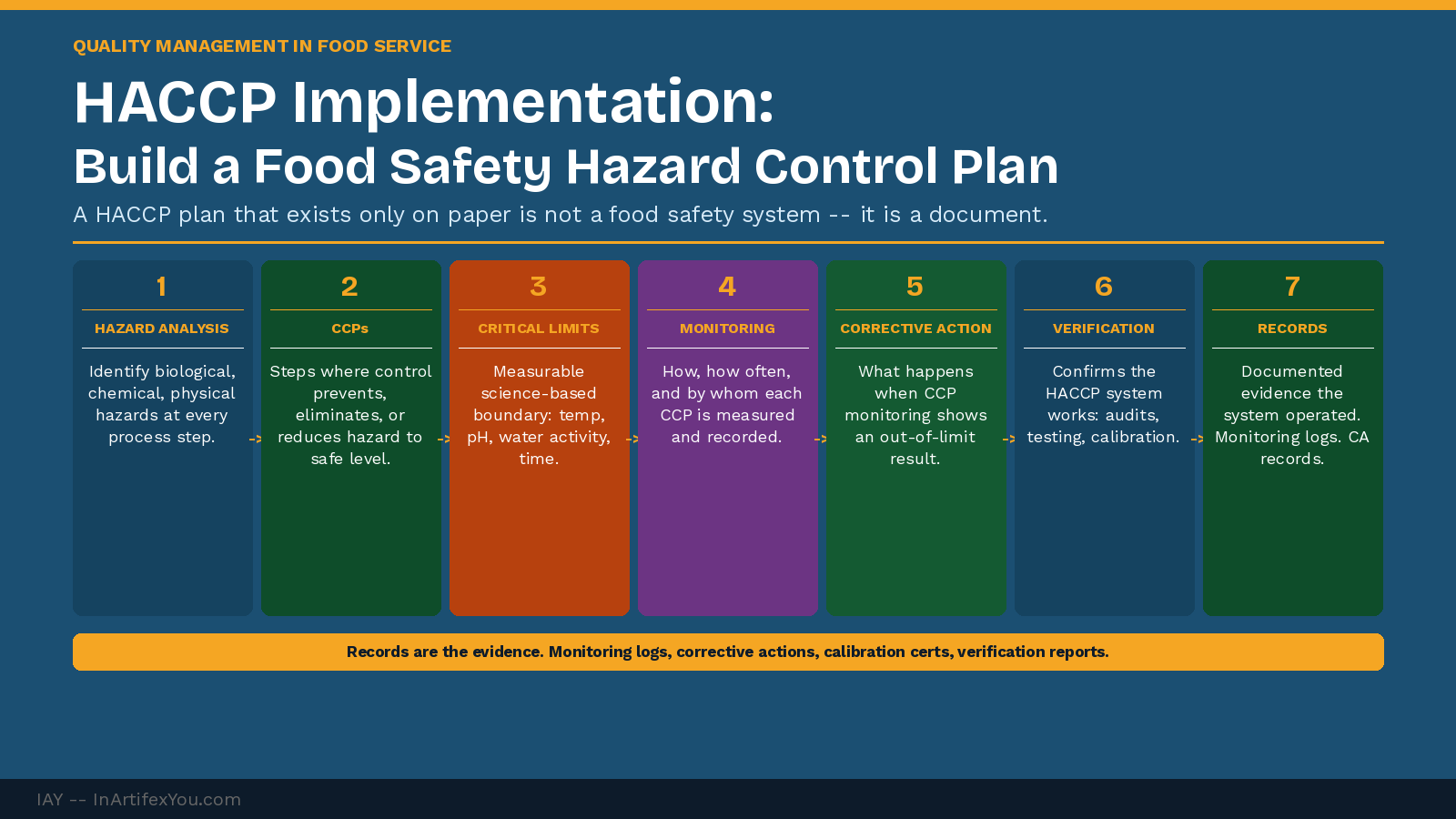
HACCP implementation is the operational foundation of food safety management — it is the systematic approach that converts food safety knowledge into specific, documented controls at every step of the production process where a hazard could harm a consumer. Every major food safety standard — ISO 22000, FSSC 22000, BRC, and IFS — incorporates HACCP as a core requirement. Implementing HACCP correctly is not just a compliance activity — it is the most direct way to protect consumers and prevent the reputational and financial damage of a food safety incident.
Prerequisite Programs: Before HACCP Begins
HACCP cannot function without a foundation of prerequisite programs (PRPs) — the basic hygiene and operational conditions that reduce the likelihood of food safety hazards occurring before HACCP controls are applied:
- Facility design and maintenance: pest control, equipment sanitation, waste management, and separation of raw and ready-to-eat areas.
- Personal hygiene: handwashing protocols, illness reporting, protective clothing, and visitor controls.
- Supplier controls: approved supplier list, incoming material specifications, and receipt inspection procedures.
- Cleaning and sanitation: documented cleaning schedules, chemical concentrations, contact times, and verification testing.
Principle 1 and 2: Hazard Analysis and CCPs
|
Hazard Type |
Examples |
Common CCPs |
Control Measure |
|
Biological. |
Salmonella, E. coli, Listeria, Campylobacter. |
Cooking, pasteurization, chilling. |
Time-temperature control to lethal limits. |
|
Chemical. |
Allergens, cleaning chemical residue, pesticides, mycotoxins. |
Allergen segregation, rinsing verification. |
Allergen management program, rinse testing. |
|
Physical. |
Metal, glass, bone, plastic, stones. |
Metal detection, X-ray inspection, sieving. |
Detection equipment with calibration and rejection verification. |
Principle 3: Critical Limits — The Non-Negotiable Boundary
The critical limit is the most important element of each CCP — it is the measurable value that separates safe from potentially unsafe product. Critical limits must be:
- Science-based: derived from regulatory requirements, published food safety research, or validated process studies — not estimated.
- Measurable in real time: temperature, pH, water activity, time, or concentration — not organoleptic assessments like color or smell that cannot be measured reliably.
- Conservative: the critical limit should include a safety margin — if research shows 70°C for 2 minutes eliminates the target pathogen, the critical limit may be set at 72°C for 2 minutes.
Principles 4–7: Monitoring, Corrective Action, Verification, Records
- Monitoring: define the measurement method, frequency, responsible operator, and recording format for each CCP. Continuous monitoring (e.g., temperature data loggers) is preferred over periodic checks.
- Corrective action: for every CCP, document what happens when the limit is exceeded — product disposition, process correction, and root cause investigation.
- Verification: scheduled activities that confirm the HACCP system is effective — CCP audits, calibration of monitoring equipment, finished product testing, and annual HACCP plan review.
- Records: the documented proof that the system worked — monitoring logs, corrective action records, calibration certificates, and verification reports. Records are the evidence in any food safety investigation.
The HACCP Principle
A HACCP plan that exists only on paper is not a food safety system — it is a document.
The system lives in the monitoring records, the corrective action logs, and the verification results. If those records do not exist, neither does the system.
Back to hub: Quality Management in Food Service.
| ||||||||||||||||||||||
The Continuous Improvement Certification at InArtifexYou gives you a complete, practical system to map, baseline, improve, and sustain any process — and the verified credential to prove you can lead it.
inartifexyou.com/continuous-improvement-certification-online.html | ||||||||||||||||||||||
|