Supplier quality in food service: how to manage
ingredient and vendor risk
Supplier quality management in food service controls the food safety risk entering the operation through purchased ingredients, packaging, and services. Because the majority of food safety hazards in food service originate with incoming materials — contaminated produce, undeclared allergens, adulterated ingredients, or compromised packaging — supplier quality management is the upstream prerequisite for every downstream HACCP control. An effective food service supplier quality system has four components: supplier approval (a structured process for evaluating and approving suppliers before first purchase — food safety certifications, audit results, and reference checks), food safety specifications (documented ingredient specifications covering microbiological limits, allergen status, chemical residue limits, and physical contamination requirements for each ingredient category), incoming material controls (receiving inspection procedures matched to the risk level of each ingredient — visual inspection, temperature verification, and periodic laboratory testing), and ongoing supplier monitoring (regular performance review against food safety KPIs — non-conformance rate, corrective action response time, and audit score trend).
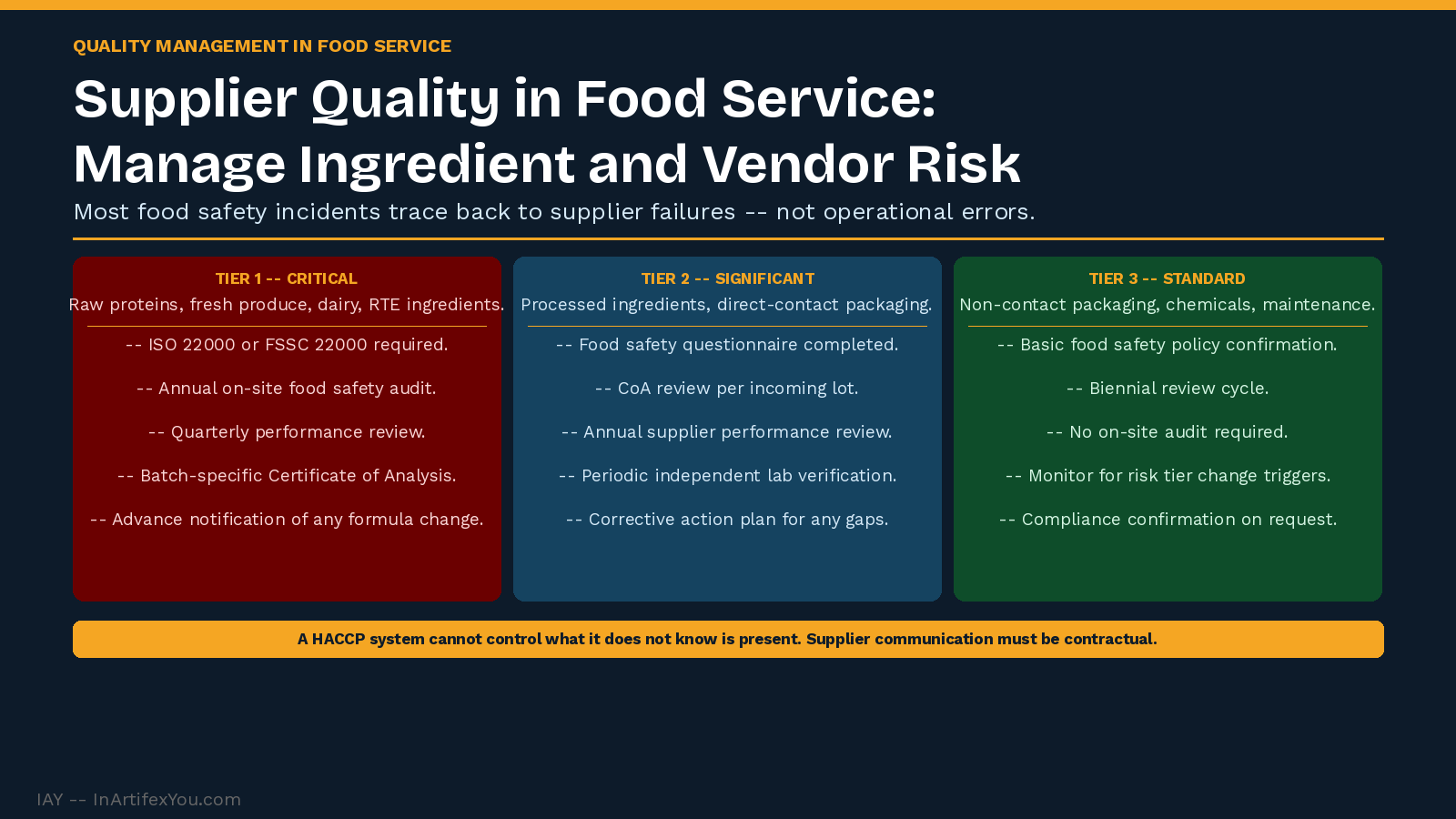
Supplier quality in food service is the most frequently underinvested area of food safety management — and the most consequential. The majority of major food safety incidents trace back to supplier failures: contaminated ingredients that passed receiving inspection because the inspection was inadequate, undeclared allergens from a supplier who changed their formula without notification, or pathogen contamination from a supplier whose food safety system had gaps the purchasing organization never evaluated. Supplier quality management is not a procurement function — it is a food safety function.
Step 1: Supplier Risk Tiering
|
Tier |
Supplier Category |
Food Safety Risk |
Approval Requirements |
|
Tier 1 — Critical. |
Raw proteins, fresh produce, dairy, ready-to-eat ingredients. |
High — direct food safety hazard potential. |
ISO 22000 or FSSC 22000 certification. Annual on-site audit. Quarterly performance review. |
|
Tier 2 — Significant. |
Processed ingredients, packaging in direct food contact. |
Medium — indirect hazard potential. |
Food safety questionnaire. Certificate of Analysis for each lot. Annual review. |
|
Tier 3 — Standard. |
Packaging not in food contact, cleaning chemicals, maintenance supplies. |
Low — no direct food safety impact. |
Basic food safety policy confirmation. Biennial review. |
Step 2: Food Safety Specifications
Every Tier 1 and Tier 2 ingredient must have a documented food safety specification covering:
- Microbiological limits: maximum acceptable levels for relevant pathogens and indicator organisms — specific to the ingredient category and the organization's HACCP plan requirements.
- Allergen status: declared allergens present in the ingredient and cross-contact risk from shared production equipment — required for allergen management in the receiving operation.
- Chemical residue limits: pesticide residue maximums for produce, veterinary drug residue limits for proteins, and permitted additive levels.
- Physical contamination controls: foreign material control measures in the supplier's process — metal detection, sieving, and optical sorting — and acceptable limits for specified contaminants.
Step 3: Incoming Material Controls
- Temperature-sensitive ingredients: verify delivery temperature against specification before acceptance. Document measurement. Reject non-conforming deliveries — do not accept and plan to use quickly.
- Certificate of Analysis review: compare supplier-provided CoA against the ingredient specification before releasing to production. Batch-specific CoA required for Tier 1 ingredients.
- Visual inspection: check for damaged packaging, label accuracy, allergen declaration completeness, and any visible contamination or pest activity.
- Periodic laboratory testing: independent verification of microbiological and chemical limits for Tier 1 ingredients — frequency based on supplier performance history and ingredient risk.
The Supplier Quality Principle
A HACCP system cannot control what it does not know is present.
If a supplier introduces a new allergen, changes a processing aid, or has a contamination event at their facility — and the food service operation is not notified — the HACCP plan cannot account for it.
Supplier communication requirements must be contractual: any change to ingredient formulation, processing, or food safety status requires advance notification.
Back to hub: Quality Management in Food Service.
- HACCP implementation: how to build a food safety hazard control plan.
- Food safety culture: how to build a quality-first team in food service.
- Lean in food service: how to eliminate waste in food production and delivery.
🔗 INTERNAL LINK SUGGESTIONS
| ||||||||||||||||||||||
The Continuous Improvement Certification at InArtifexYou gives you a complete, practical system to map, baseline, improve, and sustain any process — and the verified credential to prove you can lead it.
inartifexyou.com/continuous-improvement-certification-online.html | ||||||||||||||||||||||
|