Food safety culture: how to build a quality-first team
in food service
Food safety culture is the shared values, beliefs, and behaviors that make food safety a natural priority for every person in the organization — not a compliance obligation enforced by supervision. Research by food safety agencies globally consistently shows that food safety incidents are more often caused by culture failures than system failures: an employee who knows the correct procedure but chooses not to follow it when no one is watching is a culture problem that no HACCP plan can solve. Building food safety culture requires four organizational elements: visible leadership commitment (leaders who demonstrate food safety priority through their own behavior, not just their communications), behavior-based training (specific food safety behaviors at specific work situations, not general awareness sessions), psychological safety for reporting (employees who feel safe reporting near-misses, contamination risks, and procedural violations — without fear of punishment), and recognition of food safety behavior (publicly recognizing employees who demonstrate exemplary food safety practice).
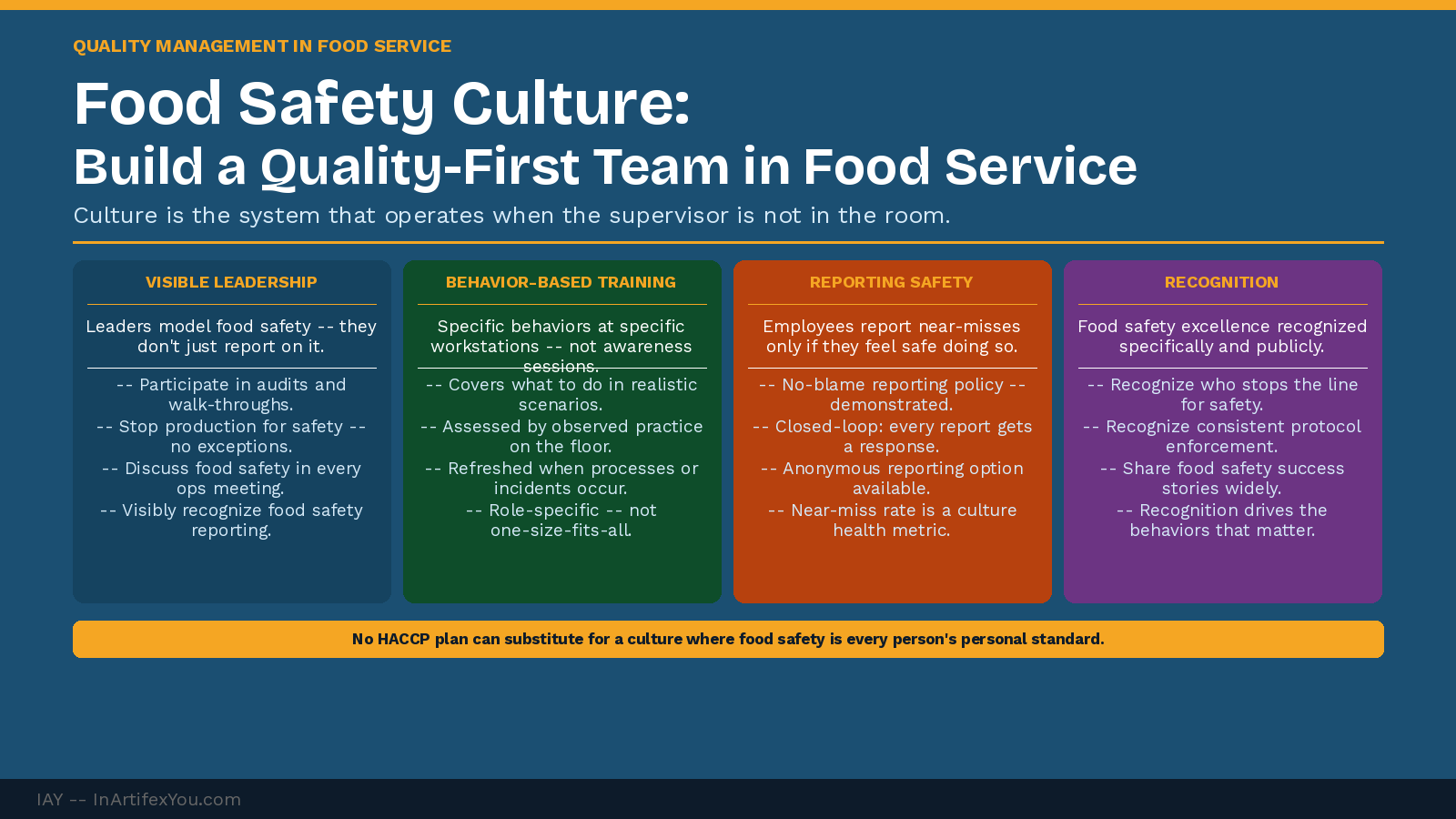
Food safety culture is the condition where every person in the food service organization prioritizes food safety not because they are being watched but because they understand why it matters and believe that doing it right is their personal responsibility. No HACCP plan, no monitoring system, and no audit program can fully compensate for a culture where food safety is treated as a compliance burden rather than a professional standard. Culture is the system that operates when the supervisor is not in the room.
Element 1: Visible Leadership Commitment
Leadership behavior is the most powerful food safety culture driver — because it signals to the entire organization what is truly valued versus what is stated in policy documents. Visible leadership commitment means:
- Leaders participate in food safety audits and walk-throughs — not just review reports of them.
- Leaders stop production for food safety concerns without exception — even under delivery pressure.
- Leaders discuss food safety performance in every operational meeting alongside production and financial metrics.
- Leaders visibly recognize employees who identify and report food safety risks — including those that required stopping production.
Element 2: Behavior-Based Food Safety Training
|
AWARENESS TRAINING (INSUFFICIENT) Covers food safety principles generally. |
BEHAVIOR-BASED TRAINING (EFFECTIVE) Covers specific behaviors at specific workstations. |
Element 3: Psychological Safety for Reporting
The most dangerous food safety culture condition is one where employees witness violations, contamination events, or near-misses but do not report them — because past experience has taught them that reporting leads to punishment rather than problem-solving. Building a reporting culture requires:
- No-blame reporting: establish a clear policy that good-faith food safety reports will not result in disciplinary action — and demonstrate it consistently when reports are made.
- Closed-loop response: every reported near-miss or contamination concern receives a documented response — investigation, corrective action, and communication back to the person who reported it.
- Anonymous reporting option: provide a mechanism for anonymous food safety concern reporting for situations where employees are not yet confident that direct reporting is safe.
Element 4: Recognition of Food Safety Excellence
Food safety culture is sustained by recognizing the behaviors that demonstrate it — specifically, visibly, and regularly:
- Recognize the employee who stops the line when they detect a potential contamination — not just the one who catches a defect after it passes inspection.
- Recognize the supervisor who enforces handwashing protocols consistently even when production is behind schedule.
- Share food safety success stories across the organization — not just food safety incidents and corrective actions.
| ||||||||||||||||||||||
The Continuous Improvement Certification at InArtifexYou gives you a complete, practical system to map, baseline, improve, and sustain any process — and the verified credential to prove you can lead it.
inartifexyou.com/continuous-improvement-certification-online.html | ||||||||||||||||||||||
|