Lean in food service: how to eliminate waste in food
production and delivery
Lean in food service applies the same waste elimination principles used in manufacturing — with adaptations for the perishable, time-sensitive, and food-safety-constrained nature of food production and delivery. The 8 wastes in food service are: Overproduction (preparing food before it is ordered or needed, leading to spoilage and temperature abuse), Waiting (idle time between preparation steps or service bottlenecks), Transportation (unnecessary movement of food between storage, preparation, and service areas), Overprocessing (excessive preparation steps, redundant checks, or more elaborate presentation than the customer values), Inventory (excess stock beyond par levels that increases spoilage, allergen management complexity, and food safety risk), Motion (unnecessary movement of staff during food preparation or service), Defects (food safety failures, quality rejections, and customer complaints), and Non-utilized talent (underusing team members' knowledge of food safety and process improvement opportunities). Lean and food safety are complementary: lean reduces the waste and variation that create food safety risk, while food safety provides the non-negotiable quality standard that lean must respect and protect.
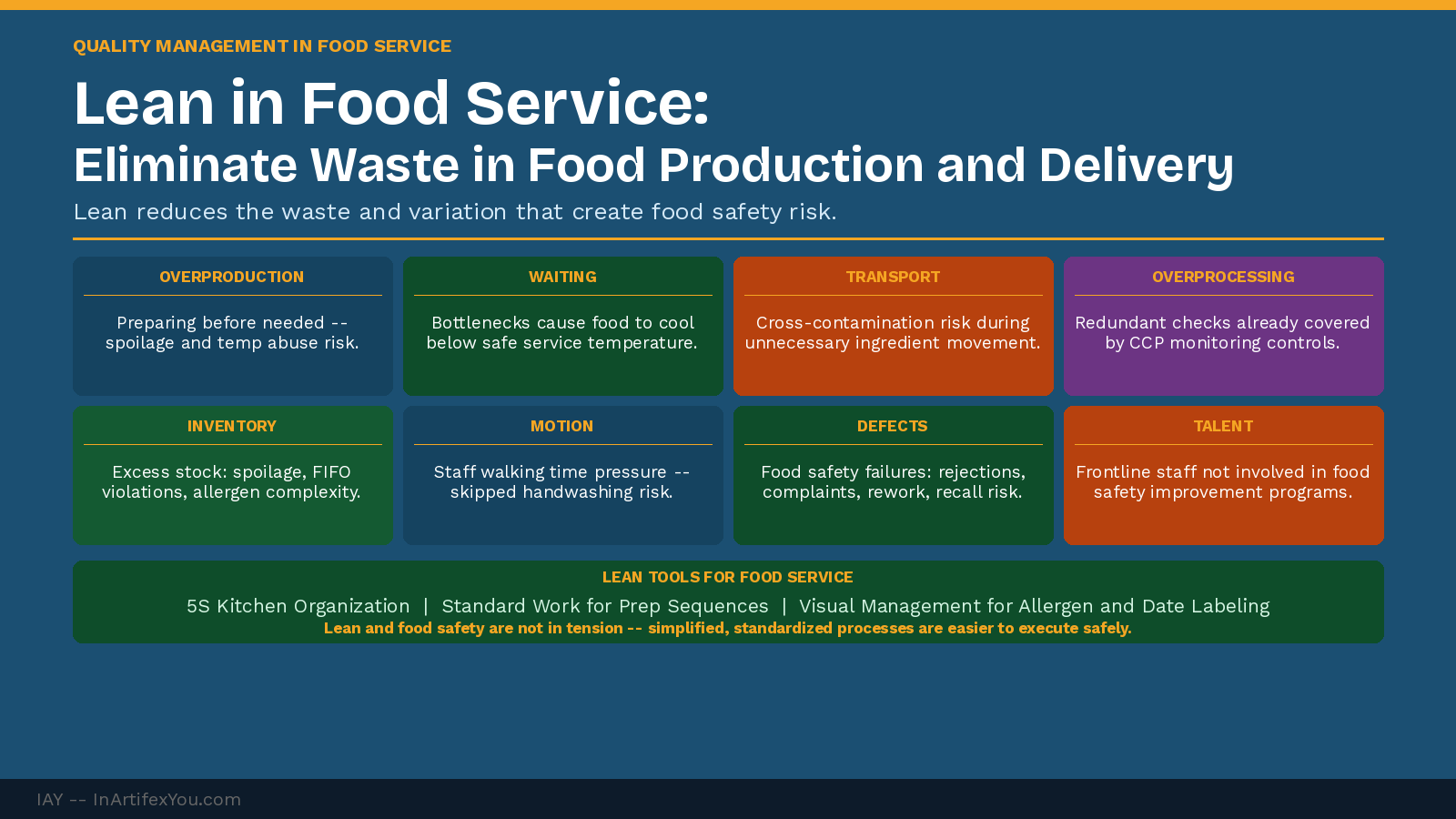
Lean in food service removes the operational friction that makes food safety harder to maintain and food quality harder to deliver consistently. Overproduction creates temperature abuse risk. Excessive inventory creates allergen management complexity and spoilage. Waiting creates holding time violations. Every form of waste in food service either directly creates a food safety hazard or makes the conditions for food safety failure more likely. Lean is not in tension with food safety — it supports it.
The 8 Wastes Mapped to Food Service
|
Waste |
Food Service Example |
Food Safety Impact |
Lean Tool |
|
Overproduction. |
Preparing 200 portions for 150 expected covers. |
Excess product held beyond safe temperature time limits. |
Par level system based on historical demand data. |
|
Waiting. |
Plated food waiting while sauce is prepared separately. |
Hot food cooling below safe service temperature. |
Process sequence redesign — parallel prep scheduling. |
|
Transportation. |
Moving ingredients from storage to prep to cooking across multiple rooms. |
Cross-contamination risk during transport. Temperature loss. |
Kitchen layout redesign — minimize distance between process steps. |
|
Overprocessing. |
Double-checking temperatures already monitored by CCP controls. |
No food safety benefit — time and resource waste. |
CCP monitoring system replacement of redundant checks. |
|
Inventory. |
Excess ingredient stock beyond 3-day par level. |
Spoilage, FIFO violation risk, allergen management complexity. |
FIFO enforcement + demand-based ordering system. |
|
Motion. |
Staff walking to remote storage for frequently used ingredients. |
Time pressure increases risk of skipping handwashing. |
Workstation redesign — frequently used items within arm's reach. |
|
Defects. |
Food safety rejections, customer complaints, rework. |
Direct food safety failures with potential consumer harm. |
Root cause analysis + HACCP CCP tightening. |
|
Non-utilized talent. |
Frontline staff not involved in food safety improvement. |
Missed near-miss reports. No ownership of food safety quality. |
Quality circles + food safety suggestion system. |
Lean Tools That Work in Food Service
- 5S for kitchen organization: Sort (remove unnecessary items), Set in Order (a place for every utensil and ingredient within FIFO and allergen segregation requirements), Shine (cleaning is inspection), Standardize (visual standards for every workstation), Sustain (daily audit checklist).
- Standard work for food preparation: documented preparation sequences that standardize both quality and food safety controls — portion size, temperature checkpoints, allergen handling steps — eliminating the variation that creates defects and food safety risk.
- Visual management: clear labeling of all containers with product identity, allergen status, preparation date, and use-by date — making food safety information visible at the point of use without requiring memory or reference.
The Lean-Food Safety Principle
In food service, waste elimination and food safety improvement are the same work.
Every process that is simplified, standardized, and made visual is a process that is easier to execute correctly — and food safety execution is the standard that cannot be compromised regardless of how lean the operation becomes.
Back to hub: Quality Management in Food Service.
| ||||||||||||||||||||||
The Continuous Improvement Certification at InArtifexYou gives you a complete, practical system to map, baseline, improve, and sustain any process — and the verified credential to prove you can lead it.
inartifexyou.com/continuous-improvement-certification-online.html | ||||||||||||||||||||||
|