How to implement TQM step by step
Implementing Total Quality Management requires five sequential phases: leadership commitment (establishing quality as a strategic priority with visible executive involvement), assessment (measuring current quality performance and identifying the highest-impact improvement opportunities), planning (building the improvement roadmap, assigning ownership, and allocating resources), execution (deploying TQM tools, training practitioners, and running initial improvement projects), and sustaining (embedding quality practices into standard management routines so they persist without constant executive attention). The most common implementation failure occurs between phases two and three — organizations complete the assessment and understand their quality gaps, but fail to build the structured plan that converts insight into action. A TQM implementation without a documented improvement roadmap with named owners and deadlines is a quality awareness program, not a quality management system.
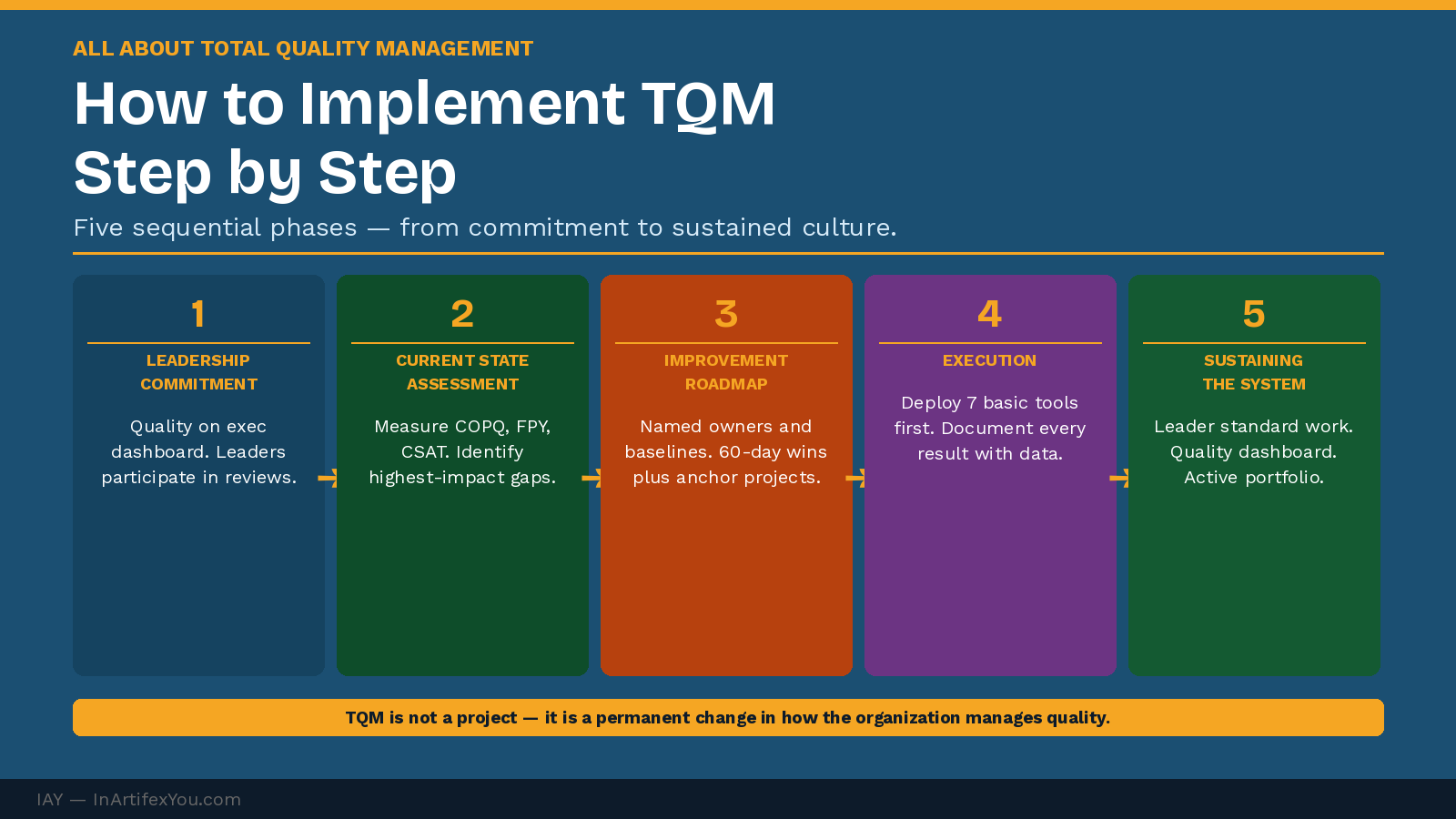
TQM implementation is not a project — it is a transformation. Projects have end dates. TQM is a permanent change in how the organization manages quality. That distinction matters because it changes how you plan, sequence, and sustain the work.
Phase 1: Leadership Commitment
TQM implementation begins and ends with leadership behavior. Before any training, assessment, or tool deployment, leadership must make three visible commitments:
- Quality metrics appear on the executive dashboard alongside financial metrics.
- Leadership participates in quality reviews — not just quality reports.
- The first improvement projects are resourced with real people and real time, not added onto existing workloads.
Without these three commitments, TQM becomes a middle-management initiative that the organization can safely ignore.
Phase 2: Current State Assessment
Before improving, measure. A TQM assessment covers four areas:
- Customer satisfaction: what do customers actually experience, and where do they experience failure?
- Process performance: which processes have the highest defect rates, longest lead times, or most rework?
- Cost of Poor Quality (COPQ): what is the total financial cost of non-conformance — internal failures plus external failures?
- Quality culture: do employees understand their role in quality outcomes, and do they have the tools and authority to improve?
Phase 3: Planning the Improvement Roadmap
The Improvement Roadmap Must Include
Top 3–5 quality improvement priorities ranked by COPQ impact.
Named project owner for each priority.
Baseline metric and target for each project.
Timeline: 60-day quick win + 90–180-day anchor projects.
Resource allocation: protected time for improvement work.
Phase 4: Execution
TQM execution deploys tools in order of complexity — start with the seven basic quality tools before introducing statistical process control or Design of Experiments. Train practitioners in the tools they will use in their first project, not the full TQM curriculum.
- Deploy the Pareto chart and cause-and-effect diagram in every first project.
- Run at least one Kaizen event in the first 90 days to demonstrate visible, rapid improvement.
- Document every improvement with before-and-after data — build the evidence base from day one.
Phase 5: Sustaining the System
Sustaining TQM requires three structural mechanisms that keep quality discipline alive after the initial energy fades:
- Leader standard work that includes quality observation and coaching in every manager's weekly routine.
- A visible quality dashboard updated at least monthly and reviewed in leadership meetings.
- A running improvement portfolio with active projects at all times — never a period with zero active improvement work.
TQM is sustained by discipline, not enthusiasm. The organizations that sustain it are those that have embedded quality into their management system — not those that rely on their improvement practitioners to keep the energy alive.
Back to hub: All About Total Quality Management.
|
||||||||||||||||||||||
The Continuous Improvement Certification at InArtifexYou gives you a complete, practical system to map, baseline, improve, and sustain any process — and the verified credential to prove you can lead it.
inartifexyou.com/continuous-improvement-certification-online.html |
||||||||||||||||||||||
|