TQM tools: the seven basic quality tools every
practitioner needs
The seven basic quality tools of TQM are: the check sheet (structured data collection), the histogram (distribution visualization), the Pareto chart (frequency-ranked defect analysis), the cause-and-effect diagram (root cause identification), the scatter diagram (correlation analysis), the control chart (process stability monitoring), and the flowchart (process visualization and mapping). These tools were codified by Kaoru Ishikawa in the 1960s as the foundational set that every quality practitioner — not just statisticians — should be able to apply. Together they cover the full improvement cycle: define the problem, collect data, identify causes, verify relationships, and monitor results. The most used in practice are the Pareto chart (problem prioritization), the cause-and-effect diagram (root cause analysis), and the control chart (sustained monitoring).
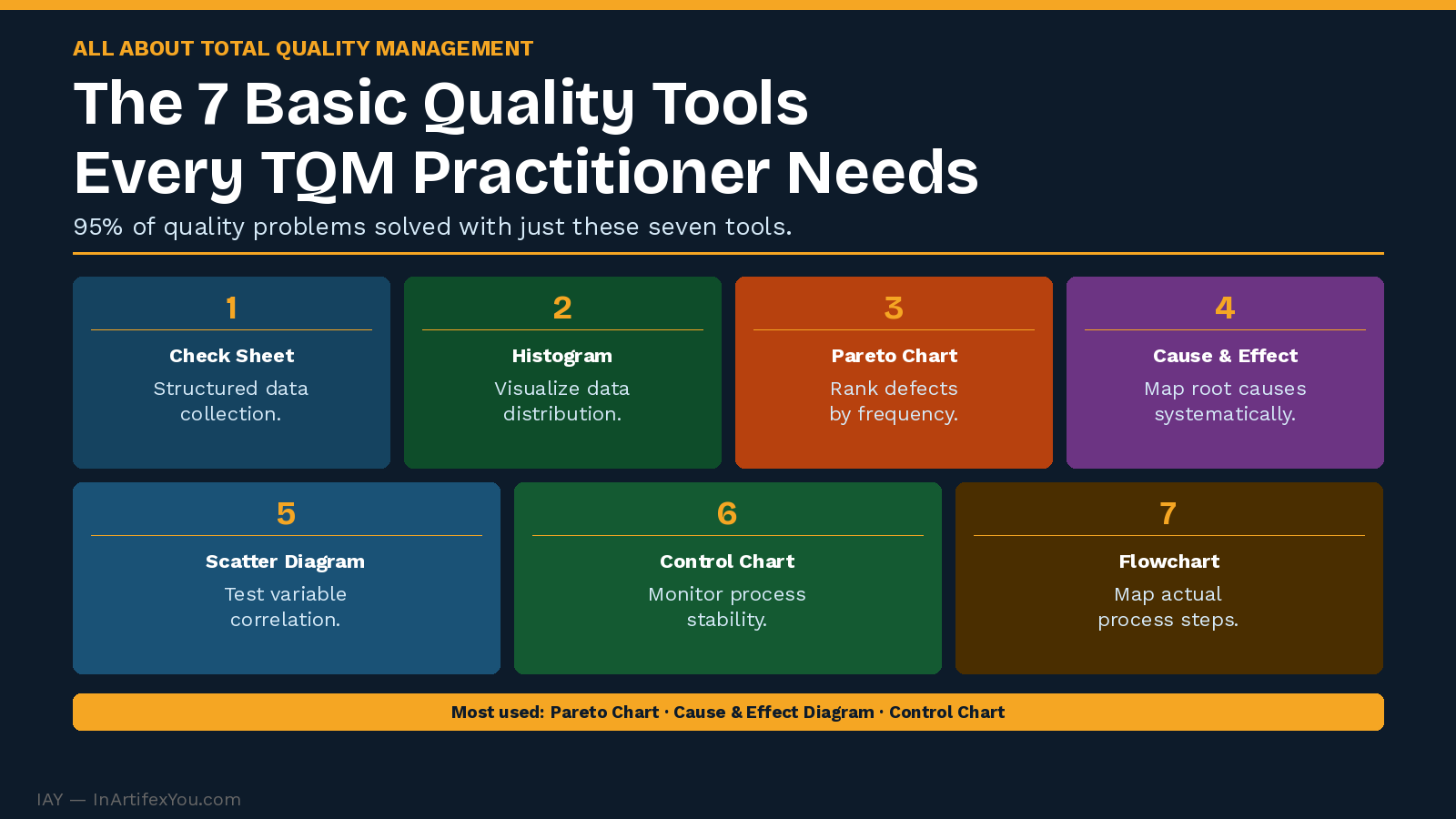
Kaoru Ishikawa, one of the pioneers of TQM in Japan, argued that 95% of quality problems in any organization could be solved using just seven basic statistical tools — tools simple enough for any employee to apply without advanced statistical training. That claim has held up across decades of quality practice.
The Seven Basic Quality Tools
|
Tool |
Primary Purpose |
When to Use It |
|
1. Check Sheet. |
Structured data collection in real time. |
Measuring defect frequency, types, or timing over a defined period. |
|
2. Histogram. |
Visualizes data distribution and spread. |
Understanding the shape of variation in a process output. |
|
3. Pareto Chart. |
Ranks defect types by frequency or impact. |
Prioritizing which defect to attack first — the 80/20 rule in action. |
|
4. Cause-and-Effect Diagram. |
Organizes potential root causes systematically. |
Brainstorming and structuring hypotheses about what is causing a defect. |
|
5. Scatter Diagram. |
Tests correlation between two variables. |
Verifying whether a suspected cause is actually related to the effect. |
|
6. Control Chart. |
Monitors process stability over time. |
Distinguishing special cause variation from common cause variation. |
|
7. Flowchart. |
Maps process steps and decision points. |
Understanding how work actually flows — versus how it is supposed to flow. |
The Three Most Used in Practice:
Pareto Chart: The Prioritization Engine
The Pareto chart applies the 80/20 principle to quality data — in most processes, 80% of defects are caused by 20% of the causes. The chart ranks defect types by frequency from highest to lowest, with a cumulative percentage line overlay. The first one or two bars typically account for the majority of the problem — telling you exactly where to focus improvement energy.
Cause-and-Effect Diagram: The Root Cause Map
Also called the fishbone or Ishikawa diagram, this tool organizes potential causes into six standard categories — Man, Machine, Material, Method, Measurement, and Environment (the 6Ms). It is used in the Analyze phase of DMAIC to structure team brainstorming around a specific defect or problem statement. The discipline of organizing causes into categories prevents the analysis from becoming a free-for-all and surfaces causes that would otherwise be overlooked.
Control Chart: The Sustained Monitoring Tool
A control chart plots process output over time against statistically calculated upper and lower control limits. Any point outside the control limits — or any non-random pattern within them — signals a special cause that requires investigation. Control charts are the primary tool for distinguishing between variation that requires action (special cause) and variation that is inherent to the process (common cause). Acting on common cause variation as if it were special cause is one of the most common — and most costly — mistakes in quality management.
The 95% Rule
Ishikawa's original claim: these seven tools can solve 95% of quality problems.
The practitioner implication: master these seven before adding more complex statistical tools. Most quality problems do not require advanced statistics — they require disciplined application of the basics.
Back to hub: All About Total Quality Management.
|
||||||||||||||||||||||
The Continuous Improvement Certification at InArtifexYou gives you a complete, practical system to map, baseline, improve, and sustain any process — and the verified credential to prove you can lead it.
inartifexyou.com/continuous-improvement-certification-online.html |
||||||||||||||||||||||
|