Interdepartmental communication in TQM: breaking down
quality silos
Quality silos in TQM occur when departments manage quality as a local responsibility — optimizing their own metrics without regard for how their outputs affect the quality of the next process in the chain. The result is a series of locally optimized processes that produce a globally suboptimal result: each department meets its own targets while the end customer receives a product or service that reflects the cumulative effect of inter-departmental handoff failures. Breaking down quality silos requires four structural interventions: shared quality objectives (metrics that require cross-functional cooperation to achieve — not department-specific targets that can be met independently), cross-functional quality teams (regular forums where representatives from each department review quality issues that cross departmental boundaries), handoff quality protocols (defined standards for what constitutes an acceptable handoff between departments — including information completeness requirements and defect acceptance criteria), and shared visibility of end-to-end quality metrics (every department sees the customer-facing quality outcome, not just their own process metric).
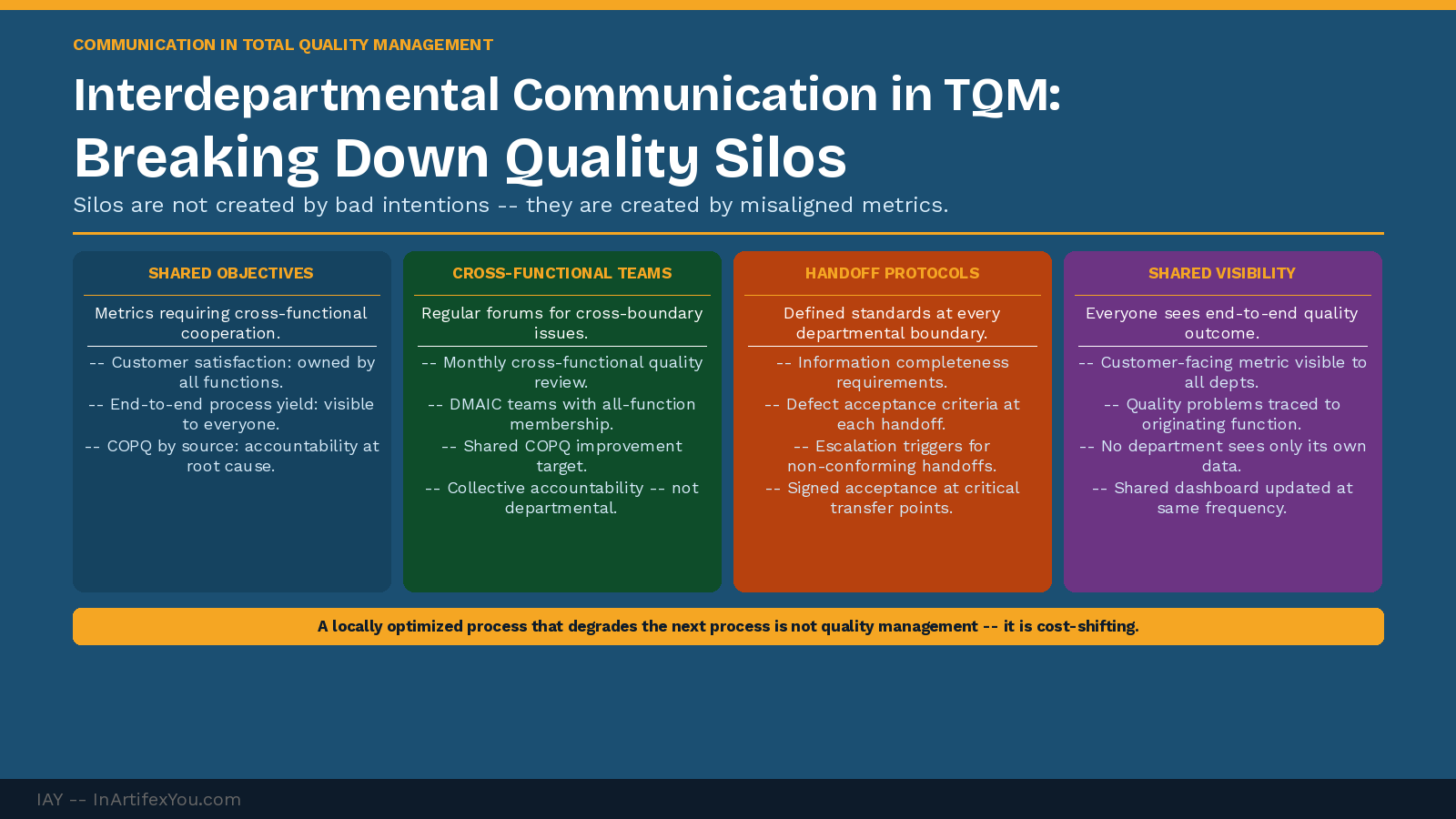
Interdepartmental communication in TQM addresses one of the most persistent and damaging quality failure modes in organizations: the quality silo. A quality silo is a department that manages its own quality metrics with no accountability for the quality impact its outputs have on downstream departments or on the end customer. Silos are not created by bad intentions — they are created by measurement systems that reward local optimization and by organizational structures that create boundaries between the functions that together produce the customer's experience.
The Four Causes of Quality Silos
- Misaligned metrics: each department has a KPI that can be met without regard for downstream impact — a purchasing department that meets cost targets by accepting borderline-specification material that causes production defects.
- Absent handoff standards: no defined criteria for what constitutes an acceptable handoff between departments — each department defines quality at its boundary differently.
- No shared visibility: each department sees only its own quality data — no one sees the end-to-end picture of how quality problems propagate across departmental boundaries.
- No cross-functional forum: quality problems that span departments have no structural venue for resolution — they escalate to senior management or remain unresolved.
Structural Intervention 1: Shared Quality Objectives
Replace department-specific quality targets with shared objectives that require cross-functional cooperation:
- Customer satisfaction score: owned jointly by every function that touches the customer experience — not by customer service alone.
- End-to-end process yield: the percentage of units or transactions that pass through the entire process without rework — visible to every department that contributes to the flow.
- Cost of poor quality (COPQ) by source: tracks where quality failures originate, regardless of where they are detected — creates accountability at the root cause rather than at the detection point.
Structural Intervention 2: Cross-Functional Quality Teams
- Monthly cross-functional quality review: representatives from each department review quality issues that crossed departmental boundaries — root cause, owner, and corrective action.
- Quality improvement projects with cross-functional membership: DMAIC or Kaizen teams include representation from every function affected by the problem — ensures that fixes address the full system, not just the department where the symptom appears.
- Shared quality improvement target: the cross-functional team has a collective target — e.g., reduce end-to-end COPQ by 20% — that creates mutual accountability.
Structural Intervention 3: Handoff Quality Protocols
|
Handoff Point |
Information Required |
Defect Acceptance Criterion |
Escalation Trigger |
|
Purchasing to Production. |
Certificate of Analysis. Supplier audit status. Material specification compliance. |
Zero material outside specification accepted into production. |
Any incoming material outside spec triggers hold and purchasing notification. |
|
Production to Quality. |
Batch records. In-process inspection results. Deviation reports. |
No batch released without completed batch record and QA sign-off. |
Any batch with unexplained deviation triggers QA review before release. |
|
Quality to Customer Service. Product release status. Known issue register. |
Certificate of conformance. |
No product shipped without QA release. |
Customer complaint about known issue triggers immediate cross-functional review. |
Back to hub: Communication in Total Quality Management.
| ||||||||||||||||||||||
The Continuous Improvement Certification at InArtifexYou gives you a complete, practical system to map, baseline, improve, and sustain any process — and the verified credential to prove you can lead it.
inartifexyou.com/continuous-improvement-certification-online.html | ||||||||||||||||||||||
|