Management review communication: how to present
quality data to leadership
Management review communication in TQM follows the ISO 9001:2015 Clause 9.3 structure, which requires that leadership reviews the quality management system at planned intervals using a defined set of inputs — and produces documented outputs in the form of decisions and action items. The required inputs for the management review are: status of actions from previous reviews, changes in external and internal issues relevant to the QMS, quality performance data (KPIs, audit results, customer satisfaction, supplier performance, process performance), adequacy of resources, effectiveness of actions taken to address risks and opportunities, and opportunities for improvement. The management review is not a reporting exercise — it is a decision-making exercise. Its purpose is to ensure that the quality management system remains suitable, adequate, and effective. A management review that ends without documented decisions and action items has not met its ISO 9001 purpose.
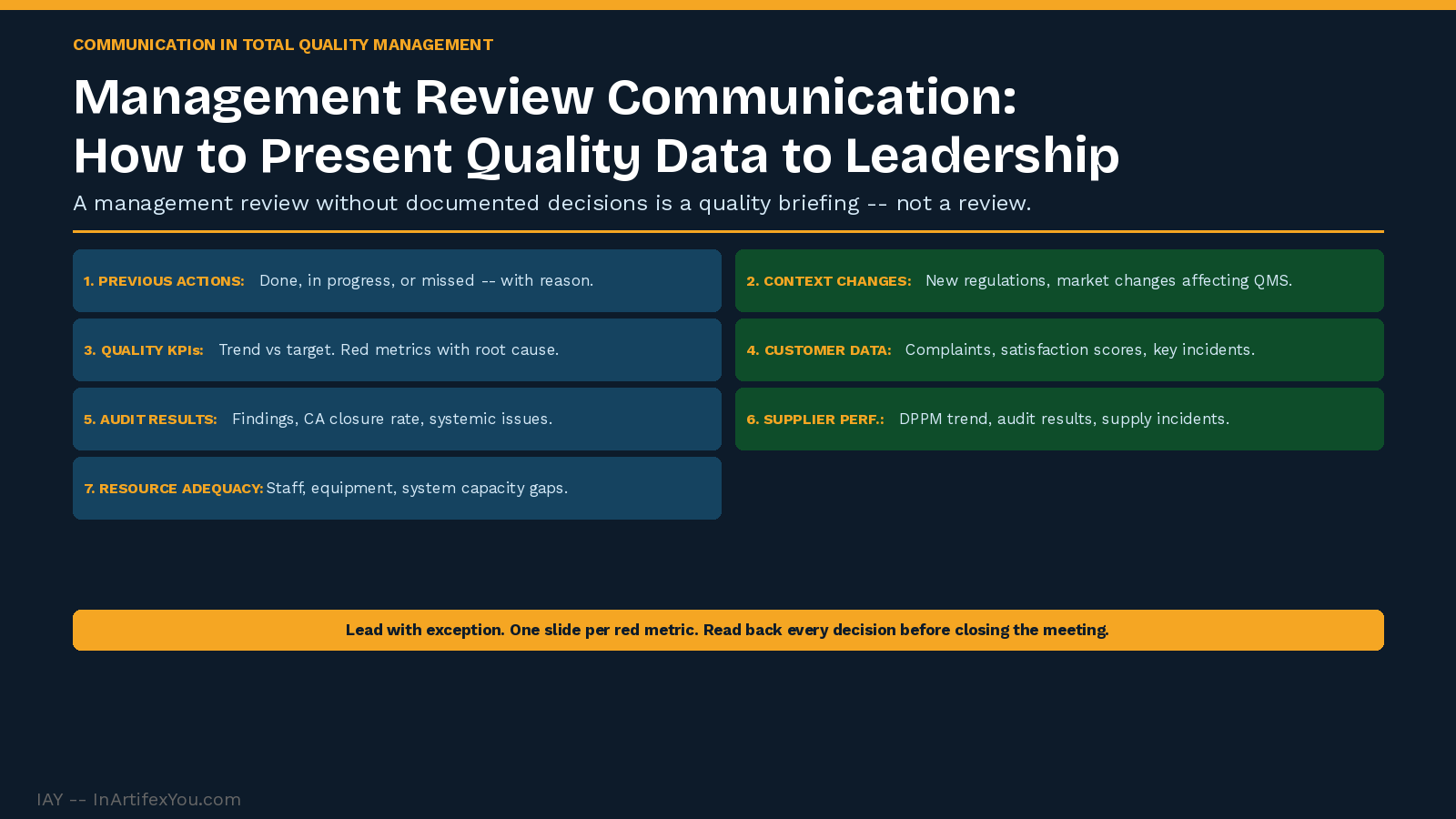
Management review communication determines whether quality data reaches leadership in a form that drives decisions — or in a form that produces acknowledgment without action. The two most common management review failures are: presenting too much data without priority (leadership cannot identify what requires a decision from what merely provides context), and presenting data without connecting it to the decisions leadership is being asked to make. The framework below structures the management review so that every agenda item ends with a decision.
The ISO 9001:2015 Required Inputs
|
Required Input |
What to Present |
Decision It Should Drive |
|
Previous action status. |
Actions committed at last review: done, in progress, or missed — with reason. |
Close completed actions. Re-assign or escalate missed actions. |
|
External and internal context changes. |
New regulatory requirements, market changes, or organizational changes that affect quality. |
Update QMS scope or policy if context has changed materially. |
|
Quality KPI performance. |
Trend for each KPI vs target. Red metrics with root cause and corrective action status. |
Approve corrective actions. Allocate resources for persistent red metrics. |
|
Customer satisfaction data. |
Complaint volume trend, satisfaction scores, significant individual complaints. |
Authorize customer recovery actions. Fund improvement projects. |
|
Audit results. |
Internal and external audit findings. Corrective action closure rate. |
Approve resources for open corrective actions. Address systemic findings. |
|
Supplier performance. |
Supplier DPPM trend. Supplier audit results. Supply chain quality incidents. |
Approve supplier development actions or supplier changes. |
|
Resource adequacy. |
Staff, equipment, and system capacity vs quality management requirements. |
Approve resource additions or reallocation if gaps identified. |
Presentation Principles for Management Review
- Lead with the exception: present the metrics that are below target first — not in the order they appear on the dashboard. Leadership attention is limited — direct it to where decisions are needed.
- One slide per red metric: for each metric requiring a management decision, present the trend, the root cause analysis finding, the proposed corrective action, the resources required, and the expected outcome.
- Separate reporting from decisions: distinguish clearly between items being reported for awareness and items requiring a decision or approval — this prevents discussion consuming the time available for decisions.
- End with the action list: before closing the review, read back every decision made and action assigned — owner, deliverable, and date. This is the documented output of the review.
The Management Review Principle
A management review that produces no documented decisions is not a management review — it is a quality briefing.
ISO 9001 requires outputs: decisions and actions related to improvement opportunities, QMS changes needed, and resource needs.
If the meeting ends without these, the ISO 9001 requirement has not been met — regardless of how much data was presented.
Back to hub: Communication in Total Quality Management.
| ||||||||||||||||||||||
The Continuous Improvement Certification at InArtifexYou gives you a complete, practical system to map, baseline, improve, and sustain any process — and the verified credential to prove you can lead it.
inartifexyou.com/continuous-improvement-certification-online.html | ||||||||||||||||||||||
|