ISO 9001 clause 7 communication: how to implement the
requirements
ISO 9001:2015 Clause 7.4 requires the organization to determine what communication relevant to the quality management system will occur, including what will be communicated, when it will be communicated, with whom it will be communicated, how it will be communicated, and who will communicate it. The clause does not prescribe specific communication methods or frequencies — it requires that the organization has deliberately planned its quality-related communications rather than allowing them to happen informally and inconsistently. Implementation means building a communication plan that documents each required quality communication: the subject matter, the audience (internal and external), the frequency, the channel, and the responsible owner. Common quality communications covered by Clause 7.4 include: quality policy communication to all employees, quality objectives communication to relevant functions, management review outputs to relevant process owners, customer requirement communication to production, and supplier quality requirement communication to approved suppliers.
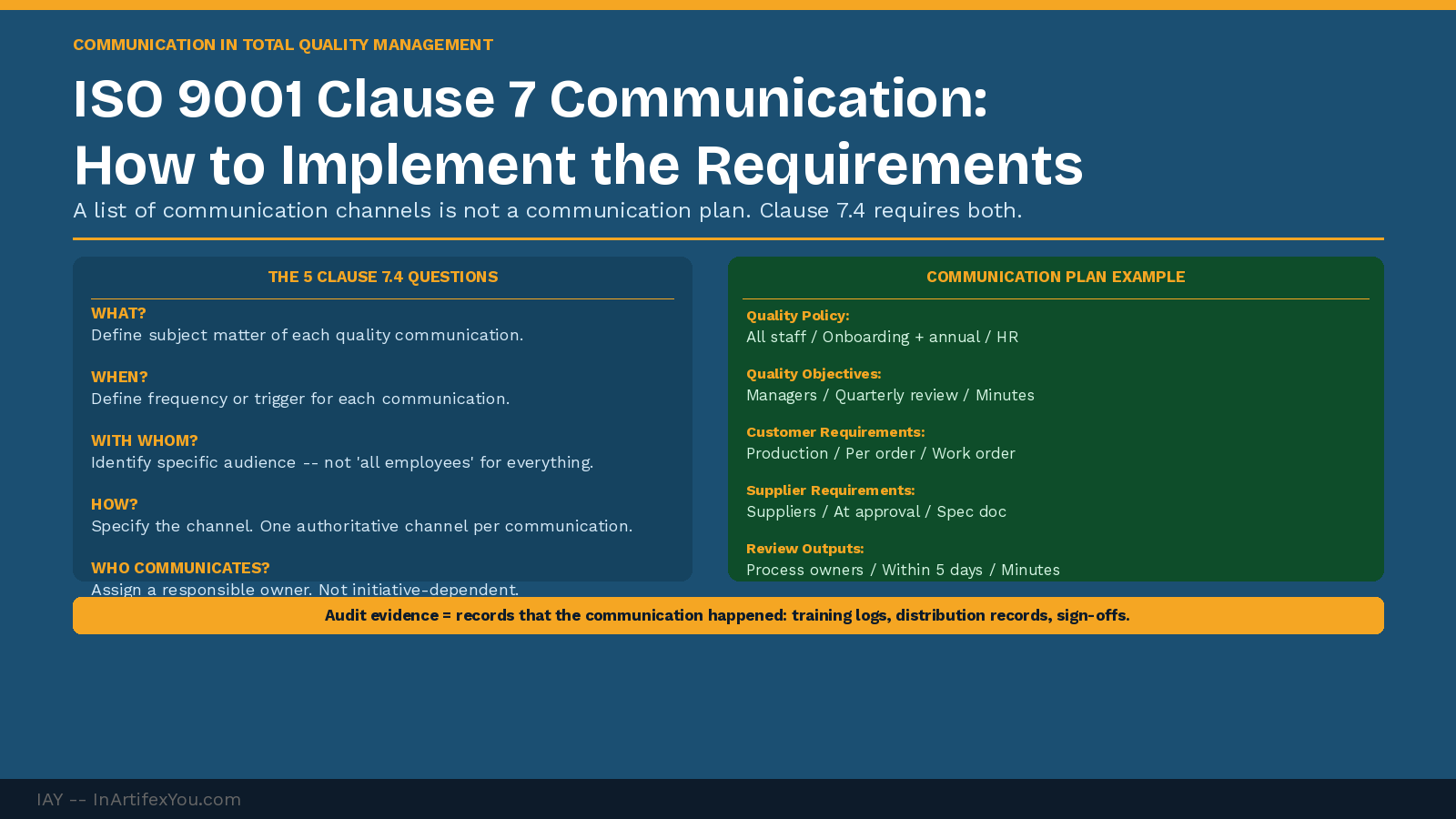
ISO 9001 clause 7 communication requirements are among the most frequently misunderstood in the standard — because they appear straightforward but are commonly implemented as a list of communication channels rather than as a deliberate communication plan. The distinction matters: a list of channels tells auditors what tools exist; a communication plan demonstrates that the organization has consciously determined what quality information needs to reach whom, when, and through what mechanism.
The Five Communication Questions — Clause 7.4
|
Question |
What It Requires |
Common Implementation Failure |
|
What? |
Define the subject matter of each required quality communication. |
Generic statement: 'quality performance information' — too broad to verify. |
|
When? |
Define the frequency or trigger for each communication. |
No defined frequency — communication happens 'as needed' without consistency. |
|
With whom? |
Identify the specific audience for each communication. |
'All employees' for everything — undifferentiated by role or relevance. |
|
How? |
Specify the channel for each communication. |
Multiple channels listed with no clarity on which is authoritative. |
|
Who communicates? |
Assign a responsible owner for each communication. |
No owner assigned — communication depends on individual initiative. |
Building the ISO 9001 Communication Plan
A communication plan that satisfies Clause 7.4 and provides audit evidence documents each quality communication in a simple register:
|
Communication Subject |
Audience |
Frequency |
Channel |
Owner |
Audit Evidence |
|
Quality Policy. |
All employees. |
At onboarding + annually. |
Training session + intranet. |
HR + QM. |
Training records. Intranet access log. |
|
Quality Objectives. |
Department managers and process owners. |
Quarterly review. Management review meeting + email. |
Quality Manager. |
Meeting minutes. |
Email distribution list. |
|
Customer Requirements. |
Production and QC teams. |
Per new order or change. |
Work order + pre-production brief. |
Production Manager. |
Work order records. Brief attendance log. |
|
Supplier Requirements. |
Approved suppliers. |
At approval + when requirements change. |
Supplier specification document. |
Procurement. |
Signed supplier agreements. Specification issue records. |
|
Management Review Outputs. |
All process owners. |
Within 5 days of review. |
Meeting minutes distribution. |
Quality Manager. |
Minutes distribution records. Confirmation of receipt. |
Internal vs External Communication
|
INTERNAL COMMUNICATION Quality policy and objectives to all staff. |
EXTERNAL COMMUNICATION Quality requirements to suppliers. |
Back to hub: Communication in Total Quality Management.
| ||||||||||||||||||||||
The Continuous Improvement Certification at InArtifexYou gives you a complete, practical system to map, baseline, improve, and sustain any process — and the verified credential to prove you can lead it.
inartifexyou.com/continuous-improvement-certification-online.html | ||||||||||||||||||||||
|