Kaizen in manufacturing vs services: what actually
changes
Kaizen applies in both manufacturing and service environments, but three things change significantly. First, waste visibility: in manufacturing, Kaizen targets physical waste — excess inventory, unnecessary motion, defective parts. In services, Kaizen targets transactional waste — approval delays, rework loops, redundant process steps that are invisible until mapped. Second, the observation method: in manufacturing, the team walks the floor and watches the process. In services, the team sits with knowledge workers and maps information flow. Third, the implementation: manufacturing Kaizen often involves moving equipment, redesigning layouts, or creating pull systems. Service Kaizen involves redesigning decision rules, simplifying approval workflows, and standardizing handoff protocols. The Kaizen event structure — five days, cross-functional team, immediate implementation — works identically in both environments. What changes is the object of improvement.
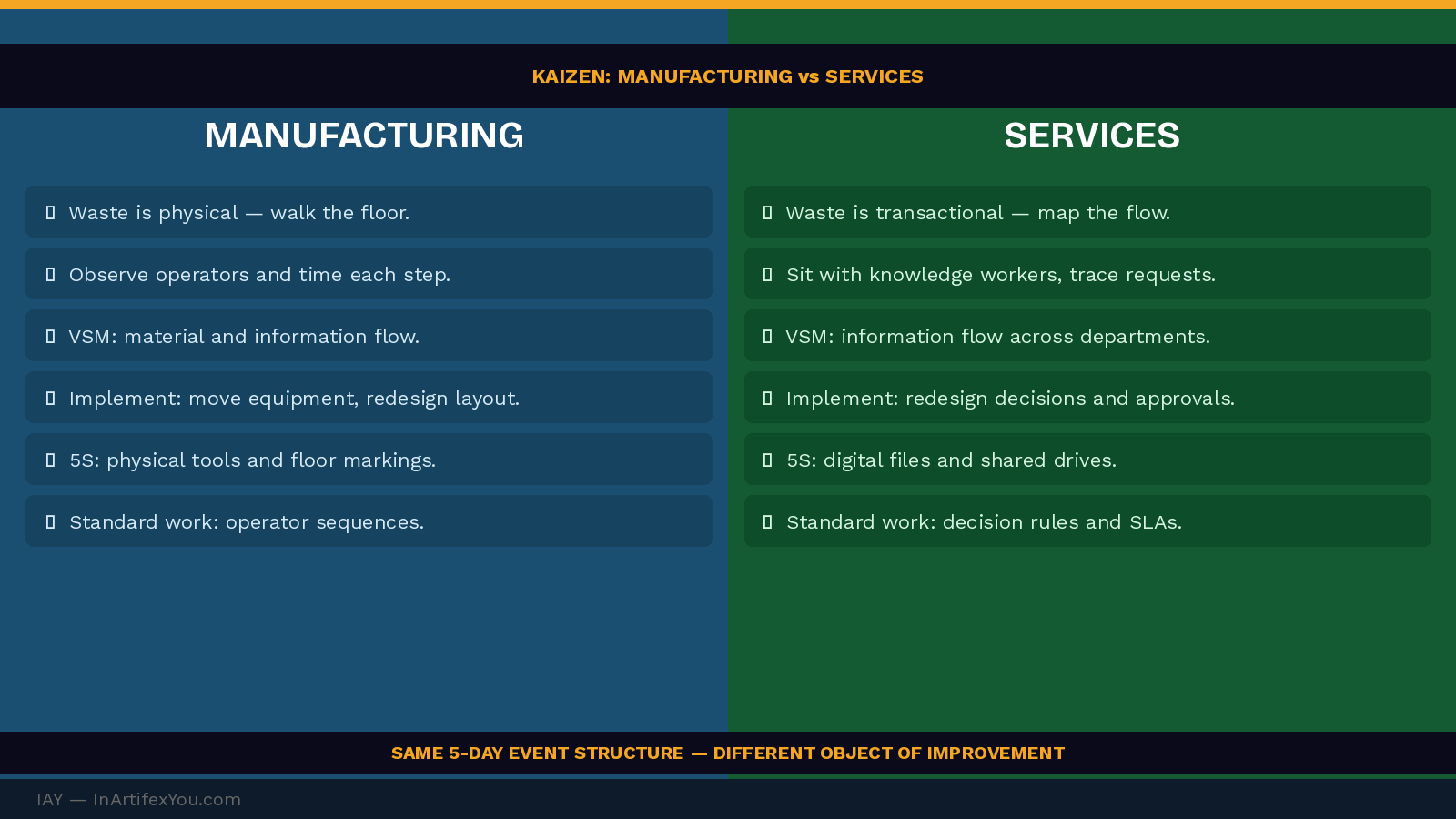
Kaizen was born on the manufacturing floor. Its tools — the spaghetti diagram, the layout redesign, the kanban card — have obvious physical analogs in a production environment. Translating them into a service context requires understanding what stays the same and what must be adapted.
What Changes: The Three Key Differences
|
MANUFACTURING KAIZEN |
SERVICE KAIZEN |
Making Waste Visible in Service Environments
The greatest challenge in service Kaizen is that waste is embedded in workflows nobody has ever drawn. An invoice approval that passes through four people before a decision is made has waiting waste, transportation waste, and over-processing waste embedded in it — but none of it appears on any official process diagram.
The service Kaizen team's first task is always the same: draw what actually happens, not what the procedure manual says should happen. The gap between the two is where most of the waste lives.
The Kaizen Event Structure in Service Environments
- Day 1: Map the current state information flow — use swim lanes, one per department, with handoffs marked.
- Day 2: Identify waste at each handoff and decision point — waiting, rework, redundant approvals, unclear ownership.
- Day 3: Redesign the workflow — consolidate approvals, eliminate redundant steps, clarify decision rules.
- Day 4: Document the new standard work — process map, decision rules, SLA expectations, and escalation criteria.
- Day 5: Present results — before-and-after lead time, error rate reduction, and handoff simplification documented.
Results You Can Expect from Service Kaizen
Service Kaizen events consistently produce three types of measurable results: lead time reduction (typically 30–60% in the first event on a given process), error rate reduction (from eliminating rework loops and unclear handoffs), and team clarity (people know exactly what they own and what happens next).
The Most Valuable Service Kaizen Target
The highest-value service Kaizen target is always the process with the longest lead time and the most handoffs.
Every handoff is a waiting point. Every waiting point is waste. Eliminating one unnecessary handoff often produces more lead time reduction than any other single improvement.
Back to hub: KAIZEN.
|
||||||||||||||||||||||
The Continuous Improvement Certification at InArtifexYou gives you a complete, practical system to map, baseline, improve, and sustain any process — and the verified credential to prove you can lead it.
inartifexyou.com/continuous-improvement-certification-online.html |
||||||||||||||||||||||
|