Kanban in manufacturing vs services: what actually
changes
Kanban in manufacturing and services share the same core principle — pull work based on downstream demand, limit WIP, and make flow visible — but differ in three key ways. First, the pull signal: in manufacturing, Kanban uses physical signals — cards, bins, or electronic triggers — to authorize production of a specific quantity. In services, the pull signal is a team member taking the next item from the Ready column when they have capacity. Second, the replenishment trigger: manufacturing Kanban replenishes physical inventory to a defined level. Service Kanban replenishes a digital queue with prioritized work items. Third, the visual management tool: manufacturing uses physical boards, card racks, or two-bin systems. Services use digital boards — Jira, Trello, Azure DevOps — that make information flow visible across distributed teams. The WIP limit discipline and flow metrics are identical in both contexts.
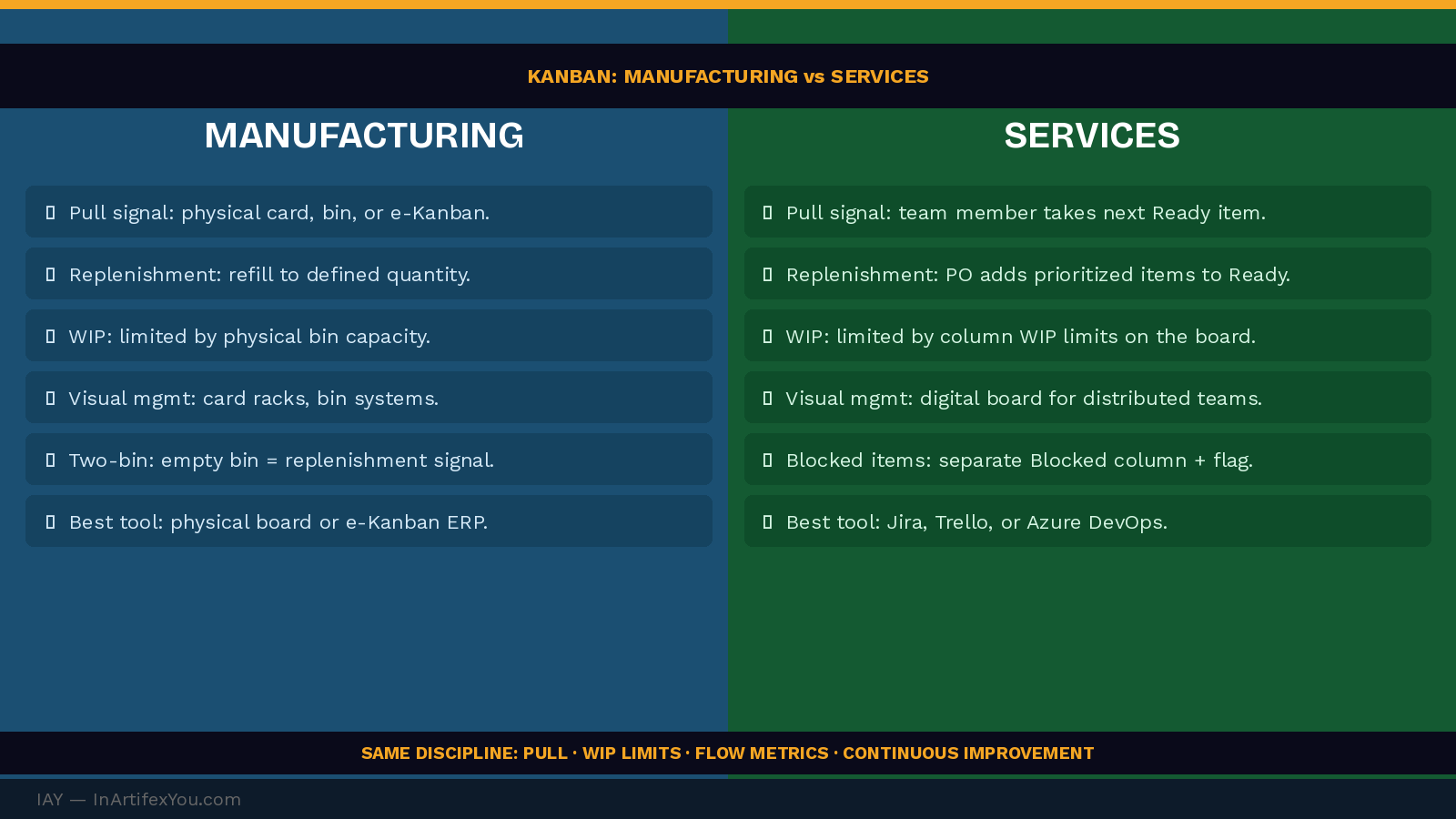
Kanban originated in manufacturing — specifically in Toyota's production system in the 1950s, where physical cards authorized the production and movement of parts. Its adoption in knowledge work and service environments over the past two decades has required deliberate translation of the physical pull system into an information pull system. Understanding both contexts makes the practitioner more effective in each.
The Manufacturing Kanban System
In manufacturing, Kanban is a physical pull system with three components: the signal (a card, bin, or light), the quantity (a defined replenishment amount), and the trigger point (the inventory level that initiates replenishment).
- Two-bin system: when the first bin is empty, it becomes the replenishment signal — the second bin provides supply while the first is refilled.
- Card system: each container of parts has a Kanban card specifying part number, quantity, and source. When the container is consumed, the card is returned to the supplying process as a production authorization.
- Electronic Kanban (e-Kanban): digital signals replace physical cards — consumption at one point automatically triggers replenishment from the upstream process.
The Service Kanban System
In services, Kanban is a digital pull system where work items replace physical parts. The board columns replace physical locations, and the WIP limits replace physical bin quantities.
- Pull signal: a team member completing an item in In Progress pulls the next Ready item — no manager assignment required.
- Replenishment: the Product Owner or team lead adds prioritized items to the Ready column as capacity is freed — maintaining a ready queue of 2–5 items.
- Blocked items: items that cannot progress due to external dependencies are flagged with a blocker label and moved to a Blocked column — tracked separately from active WIP.
What Stays the Same
|
MANUFACTURING KANBAN Pull — nothing produced without a downstream signal. |
SERVICE KANBAN Pull — nothing started without available capacity. |
Choosing the Right Tool
For manufacturing Kanban: physical cards and bins for low-tech environments; e-Kanban systems integrated with ERP for high-volume, high-variety production. For service Kanban: digital boards for any team — especially essential for remote or hybrid teams where a physical board is not visible to everyone.
The Practitioner's Translation Rule
Every manufacturing Kanban concept has a service equivalent.
Physical card → Digital work item. Bin quantity → WIP limit. Two-bin system → Ready + In Progress columns. Replenishment signal → Team member pulling next item.
The discipline is identical. The medium changes.
Back to hub: KANBAN.
| ||||||||||||||||||||||
The Continuous Improvement Certification at InArtifexYou gives you a complete, practical system to map, baseline, improve, and sustain any process — and the verified credential to prove you can lead it.
inartifexyou.com/continuous-improvement-certification-online.html | ||||||||||||||||||||||
|