Kanban vs Scrum: when to use which
Kanban and Scrum are both agile frameworks but differ in four key ways. Cadence: Scrum uses fixed-length sprints (1–4 weeks); Kanban uses continuous flow with no sprint boundaries. Planning: Scrum plans sprint content in advance; Kanban pulls work from the backlog continuously as capacity allows. Roles: Scrum defines three roles (Product Owner, Scrum Master, Development Team); Kanban prescribes no specific roles. Metrics: Scrum uses velocity (story points per sprint); Kanban uses cycle time and throughput. Use Scrum when work can be planned in advance, the team benefits from structured sprint ceremonies, and delivery in defined increments is valuable. Use Kanban when work arrives unpredictably, priorities change frequently, or the team needs to manage multiple work types simultaneously. Many teams use a hybrid — Scrumban — combining sprint planning with continuous flow and WIP limits.
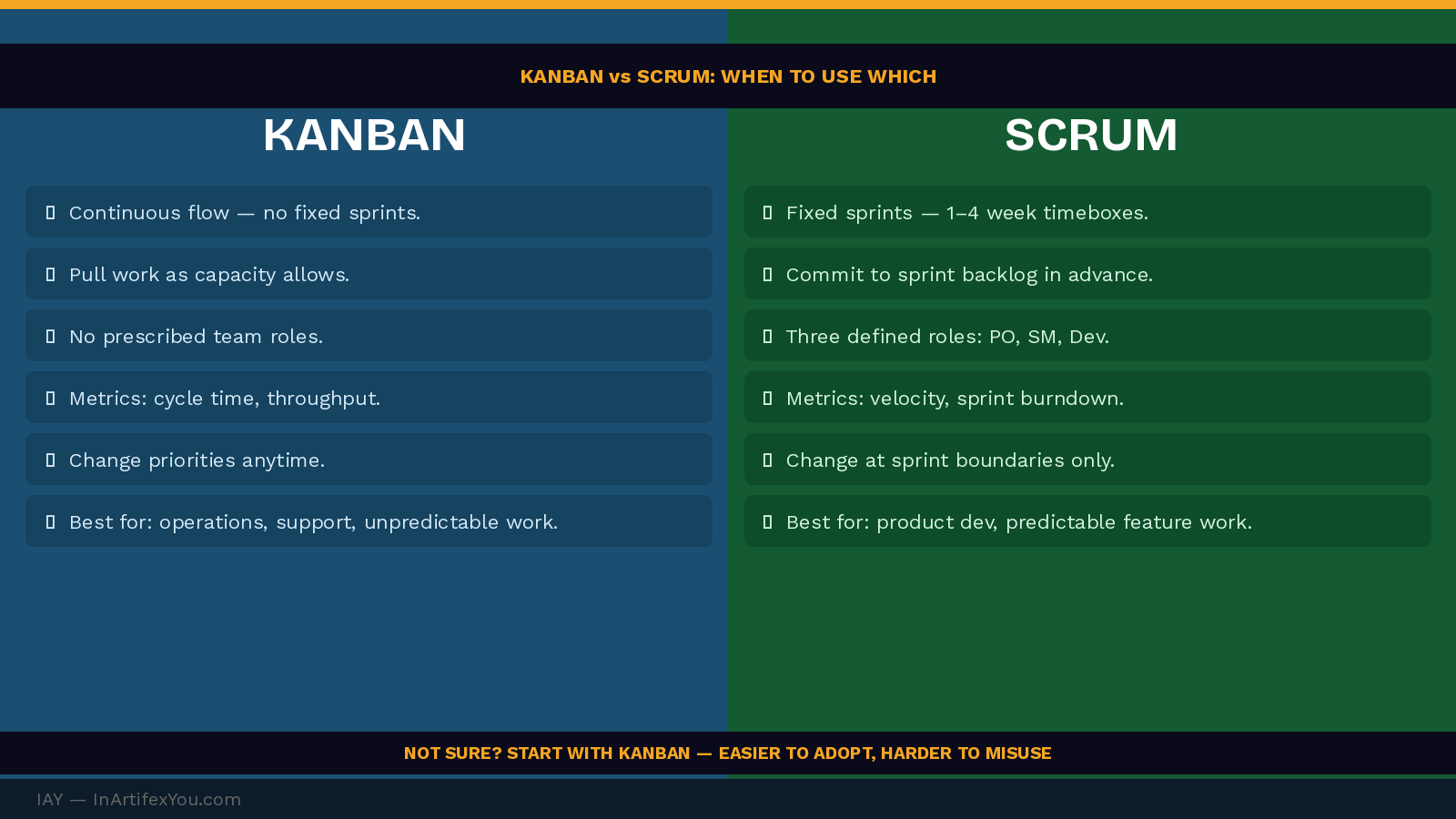
The Kanban vs. Scrum choice is one of the most common questions in agile adoption — and one of the most frequently answered incorrectly. Both frameworks improve team performance. The choice depends on the nature of the work, not on which framework sounds more appealing.
The Four Key Differences
|
KANBAN Continuous flow — no sprints, no fixed timeboxes. |
SCRUM Fixed sprints — typically 1–4 weeks. |
When to Choose Kanban
- Work arrives continuously and unpredictably — support tickets, maintenance requests, operations tasks.
- Priorities change faster than sprint boundaries allow — a two-week commitment would be violated every week.
- The team manages multiple work types simultaneously — features, bugs, urgent requests, and technical debt.
- The team is new to flow metrics and needs a lightweight starting framework before adopting Scrum ceremonies.
When to Choose Scrum
- Work can be planned in 1–4 week increments — product features with defined requirements.
- The team benefits from the accountability structure of sprint commitments and retrospectives.
- Stakeholders need predictable delivery cadence — 'we ship every two weeks' is a meaningful commitment.
- The team is building a product with a roadmap — Scrum's sprint goal structure keeps work aligned to objectives.
Scrumban: The Hybrid Approach
Many teams find that neither pure Kanban nor pure Scrum fits perfectly — and adopt Scrumban, a hybrid that combines elements of both. Common Scrumban patterns:
- Sprint planning combined with continuous flow — the team plans weekly but pulls work as capacity allows rather than committing to a fixed sprint backlog.
- WIP limits applied within a Scrum board — the In Progress column has a hard limit even though the team works in sprints.
- Kanban metrics alongside Scrum ceremonies — cycle time and throughput tracked alongside velocity and burndown.
The Decision Rule
If your work is mostly planned and predictable: start with Scrum.
If your work is mostly reactive and unpredictable: start with Kanban.
If you are not sure: start with Kanban — it is easier to adopt and harder to misuse.
Back to hub:KANBAN.
| ||||||||||||||||||||||
The Continuous Improvement Certification at InArtifexYou gives you a complete, practical system to map, baseline, improve, and sustain any process — and the verified credential to prove you can lead it.
inartifexyou.com/continuous-improvement-certification-online.html | ||||||||||||||||||||||
|