Measurement system analysis: how to validate your
quality data
Measurement System Analysis (MSA) is the process of evaluating whether a measurement system — the gage, the operator, and the measurement method — produces data reliable enough to make quality decisions. The primary MSA tool is Gage R&R (Repeatability and Reproducibility). Repeatability measures the variation produced by the same operator measuring the same part multiple times with the same gage — pure gage variation. Reproducibility measures the variation produced by different operators measuring the same part — operator-to-operator variation. MSA acceptance criteria: if the combined Gage R&R variation is less than 10% of the total process variation, the measurement system is acceptable. Between 10% and 30% requires engineering judgment. Above 30%, the measurement system is inadequate — quality decisions made with this data are unreliable and the gage or method must be improved before process improvement data is collected.
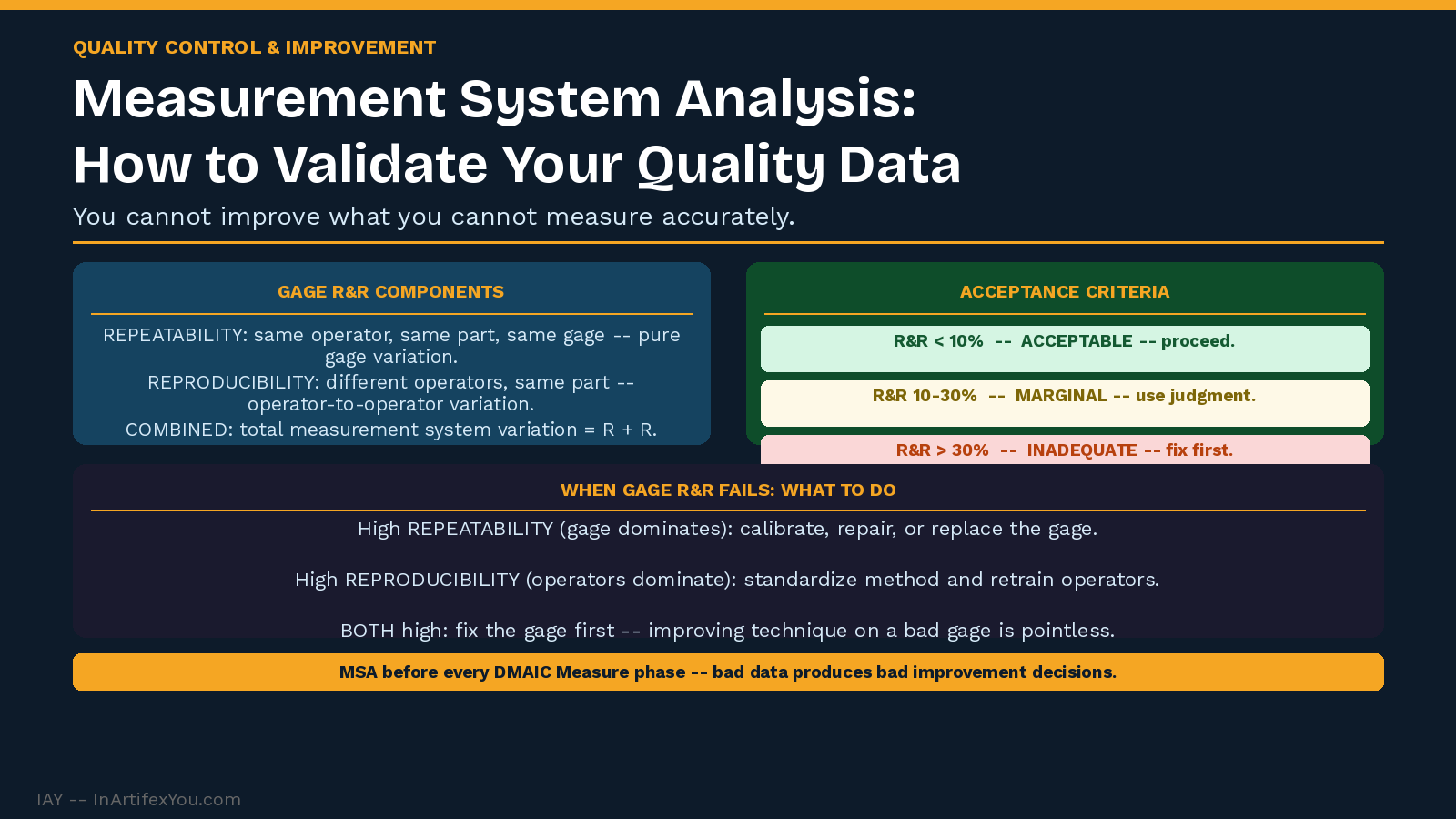
The most underappreciated problem in quality management is this: improvement decisions based on bad data produce worse outcomes than no improvement at all. When a measurement system has significant variation, the data it produces misclassifies good parts as defective, defective parts as good, and masks real process signals with measurement noise. MSA is the discipline that validates data before decisions are made from it.
The Five Components of a Measurement System
- Gage (instrument): the physical or digital tool used to take measurements — its precision and calibration status.
- Standard: the reference against which measurements are calibrated — traceability to national or international standards.
- Workpiece: the part or item being measured — its surface condition, handling, and presentation affect measurement results.
- Personnel: the operator — their technique, training, and consistency affect reproducibility.
- Procedure: the measurement method — how the gage is applied, the measurement location, and the environmental conditions.
Gage R&R: The Primary MSA Tool
Gage R&R quantifies two sources of measurement variation: repeatability (the gage) and reproducibility (the operators). The standard Gage R&R study uses multiple operators, multiple parts, and multiple replications per combination to separate these two variation sources statistically.
|
Gage R&R Result |
What It Means |
Action Required |
|
R&R < 10% of total variation. |
Measurement system is acceptable. |
Proceed with data collection and analysis. |
|
R&R 10%–30% of total variation. |
Marginal — acceptable with engineering judgment. |
Investigate dominant source (repeatability vs. reproducibility) and improve if possible. |
|
R&R > 30% of total variation. |
Measurement system is inadequate. |
Do not make quality decisions with this data. Repair or replace the gage, retrain operators, or redesign the measurement method. |
What to Do When MSA Fails
When Gage R&R results exceed 30%, the source of the problem determines the fix:
- High repeatability (gage variation dominates): the gage itself is the problem — calibrate, repair, or replace it. Check fixturing and environmental conditions.
- High reproducibility (operator variation dominates): the measurement procedure is unclear — standardize the method, retrain operators, and add measurement fixtures that reduce technique variation.
- Both high: start with the gage — fixing operator variation on top of an unreliable gage is pointless.
MSA Before Improvement Projects
Every Six Sigma DMAIC project requires MSA before data collection begins — specifically in the Measure phase. This is not bureaucratic compliance. It is insurance against the most expensive mistake in improvement work: spending three months analyzing data that was never reliable to begin with.
The MSA Principle
You cannot improve what you cannot measure accurately.
A process that looks stable on a control chart may be unstable — and the instability is being hidden by measurement variation. MSA separates what the process is doing from what the measurement system is adding.
Back to hub: Quality and Control Improvement.
| ||||||||||||||||||||||
The Continuous Improvement Certification at InArtifexYou gives you a complete, practical system to map, baseline, improve, and sustain any process — and the verified credential to prove you can lead it.
inartifexyou.com/continuous-improvement-certification-online.html | ||||||||||||||||||||||
|