Root cause analysis methods: 5 Whys, fishbone, and
fault tree
The three most widely used root cause analysis methods are the 5 Whys, the fishbone (Ishikawa) diagram, and fault tree analysis (FTA). The 5 Whys is best for simple, linear problems with a clear cause-and-effect chain — ask why five times in succession to move from symptom to root cause. The fishbone diagram is best for complex problems with multiple potential causes organized across six categories: Man, Machine, Material, Method, Measurement, and Environment (the 6Ms). Use it when brainstorming all possible causes with a team before narrowing to the most likely root cause. Fault tree analysis is best for safety-critical and high-complexity problems where multiple failure modes can combine to produce an outcome — it maps failures in a logic tree using AND and OR gates. The choice depends on problem complexity: 5 Whys for simple, fishbone for moderate, fault tree for complex safety-critical scenarios.
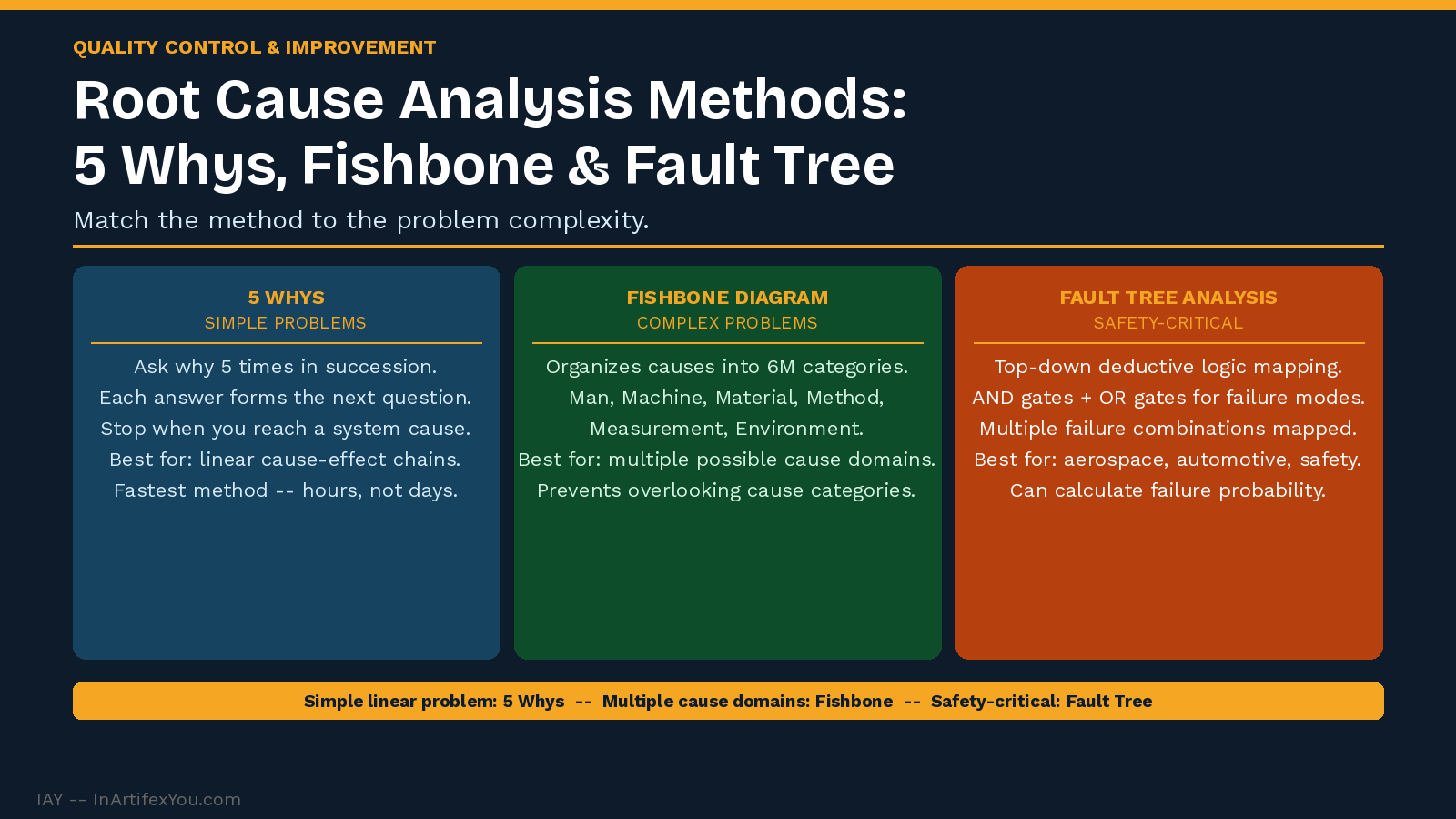
Root cause analysis is the discipline of moving from the visible symptom of a problem to the underlying system condition that made the problem possible. The choice of method matters — applying a complex method to a simple problem wastes time, and applying a simple method to a complex problem produces incomplete analysis.
Method 1: The 5 Whys
The 5 Whys is the simplest and fastest root cause analysis tool. It works by asking 'why' iteratively — each answer forms the basis of the next question — until the team reaches a cause that can be directly addressed through a countermeasure.
5 Whys Best Practices
Use when: the problem has a clear, linear cause-and-effect chain.
Use when: the team can answer each 'why' with direct observation or data — not speculation.
Stop when: the answer to 'why' is a system or policy that can be changed — that is the root cause.
Avoid when: the problem has multiple independent causes that branch — use a fishbone instead.
Method 2: The Fishbone (Ishikawa) Diagram
The fishbone diagram organizes potential causes into six standard categories — the 6Ms — which ensures that the team considers all possible cause domains rather than focusing only on the most obvious ones.
|
Category |
Examples of Causes in This Category |
|
Man (People). |
Training gaps, fatigue, misunderstanding of instructions, skill variation between operators. |
|
Machine (Equipment). |
Wear, calibration drift, setup variation, tooling condition, maintenance gaps. |
|
Material. |
Incoming material variation, supplier quality, storage conditions, material substitutions. |
|
Method (Process). |
Unclear work instructions, process sequence errors, missing steps, decision rule ambiguity. |
|
Measurement. |
Gage error, measurement system variation, calibration frequency, inspector-to-inspector variation. |
|
Environment. |
Temperature, humidity, vibration, lighting, contamination, seasonal variation. |
Method 3: Fault Tree Analysis
Fault tree analysis (FTA) is a top-down, deductive method that maps all possible failure paths that could lead to an undesired event. Unlike the 5 Whys and fishbone — which are inductive (evidence up to cause) — FTA starts with the outcome and works backward to identify every combination of events that could produce it.
- Use FTA for: safety-critical systems, aerospace and automotive quality systems, and any problem where multiple simultaneous failures can combine to produce a catastrophic outcome.
- AND gates: the outcome only occurs when all input events occur simultaneously — higher threshold.
- OR gates: the outcome occurs when any one of the input events occurs — lower threshold, more common.
- FTA produces a visual logic map that can be analyzed mathematically to calculate failure probabilities when event frequencies are known.
The Selection Rule
Simple, linear problem with one cause chain: use 5 Whys.
Complex problem with multiple possible cause domains: use fishbone.
Safety-critical problem with multiple failure mode combinations: use fault tree analysis.
Back to hub: Quality Control and Improvement.
| ||||||||||||||||||||||
The Continuous Improvement Certification at InArtifexYou gives you a complete, practical system to map, baseline, improve, and sustain any process — and the verified credential to prove you can lead it.
inartifexyou.com/continuous-improvement-certification-online.html | ||||||||||||||||||||||
|