Quality control vs quality improvement: what is the
difference?
Quality control (QC) and quality improvement (QI) are distinct but complementary activities. Quality control is a reactive process: it detects and removes defects after they occur, ensuring that non-conforming products or services do not reach the customer. It operates through inspection, testing, and acceptance sampling. Quality improvement is a proactive process: it changes the system that produces defects, reducing the rate of non-conformance permanently. It operates through root cause analysis, process redesign, and statistical methods. The critical distinction: QC finds defects — QI eliminates the causes of defects. An organization that only does QC gets better at catching problems. An organization that does both QC and QI gets better at not having problems. ISO 9001, Six Sigma, and TQM all require both — QC as the baseline and QI as the continuous activity that raises the baseline over time.
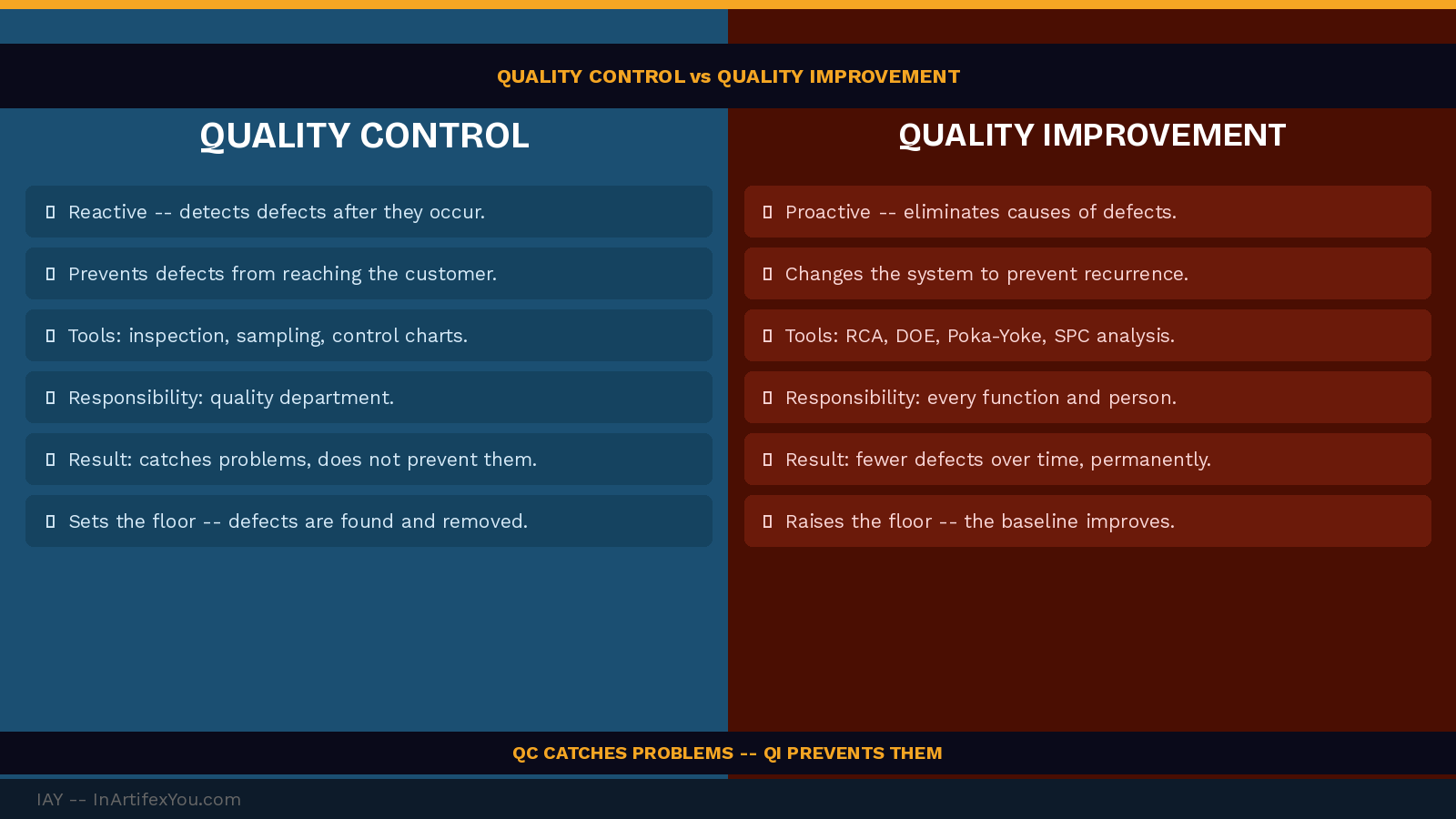
The confusion between quality control and quality improvement is one of the most common conceptual errors in quality management. Many organizations that believe they have a quality improvement program actually have a quality control program — one that finds and removes defects efficiently but never addresses why the defects are occurring in the first place.
Quality Control: Detection and Containment
Quality control encompasses all activities designed to detect non-conforming outputs and prevent them from reaching the customer. The key word is detect — QC does not prevent defects from occurring, it prevents them from escaping.
- Incoming inspection: checking materials and components from suppliers before they enter production.
- In-process inspection: checking work at defined points during production or service delivery.
- Final inspection: checking the finished output before delivery to the customer.
- Acceptance sampling: statistically sampling a lot to make a pass/fail decision about the entire lot.
- Control charts: monitoring process output over time to detect when a process goes out of control.
Quality Improvement: Prevention and Elimination
Quality improvement encompasses all activities designed to change the system so that fewer defects occur. The key word is change — QI modifies processes, materials, methods, or designs to make the system less likely to produce non-conformances.
- Root cause analysis: identifying the true cause of a defect pattern, not just the immediate trigger.
- Process redesign: changing workflow steps, sequences, or decision rules to eliminate defect opportunities.
- Design of Experiments (DOE): systematically testing process variables to find the optimal settings.
- Mistake-proofing (Poka-Yoke): designing processes so that certain errors are physically impossible.
- Statistical Process Control (SPC): using control charts not just to detect problems but to understand process behavior and reduce variation.
Why Both Are Necessary
| |||
|
The Integration Rule Quality control sets the floor — it ensures non-conforming outputs do not reach customers. Quality improvement raises the floor — it reduces the rate of non-conformance so that less inspection is needed over time. A mature quality system does both simultaneously: QC prevents escapes today while QI reduces the need for QC tomorrow. |
Back to hub: Quality Control and Improvement.
| ||||||||||||||||||||||
The Continuous Improvement Certification at InArtifexYou gives you a complete, practical system to map, baseline, improve, and sustain any process — and the verified credential to prove you can lead it.
inartifexyou.com/continuous-improvement-certification-online.html | ||||||||||||||||||||||
|