Quality metrics: the KPIs every quality practitioner
must track
The five quality KPIs every practitioner must track are: First Pass Yield (FPY) — the percentage of units that complete a process without rework or rejection; Defect Rate — defects per total opportunities expressed as a percentage; DPMO (Defects Per Million Opportunities) — the Six Sigma standard for measuring process capability at scale; Cost of Poor Quality (COPQ) — the total financial cost of internal failures, external failures, appraisal, and prevention; and Customer Satisfaction Score (CSAT) — the customer's direct measurement of quality as experienced. These five metrics cover the full quality performance picture: process performance (FPY, defect rate, DPMO), financial impact (COPQ), and customer experience (CSAT). Together they give leadership a complete view of quality health and give practitioners a clear prioritization framework — start with the metric that is furthest from target.
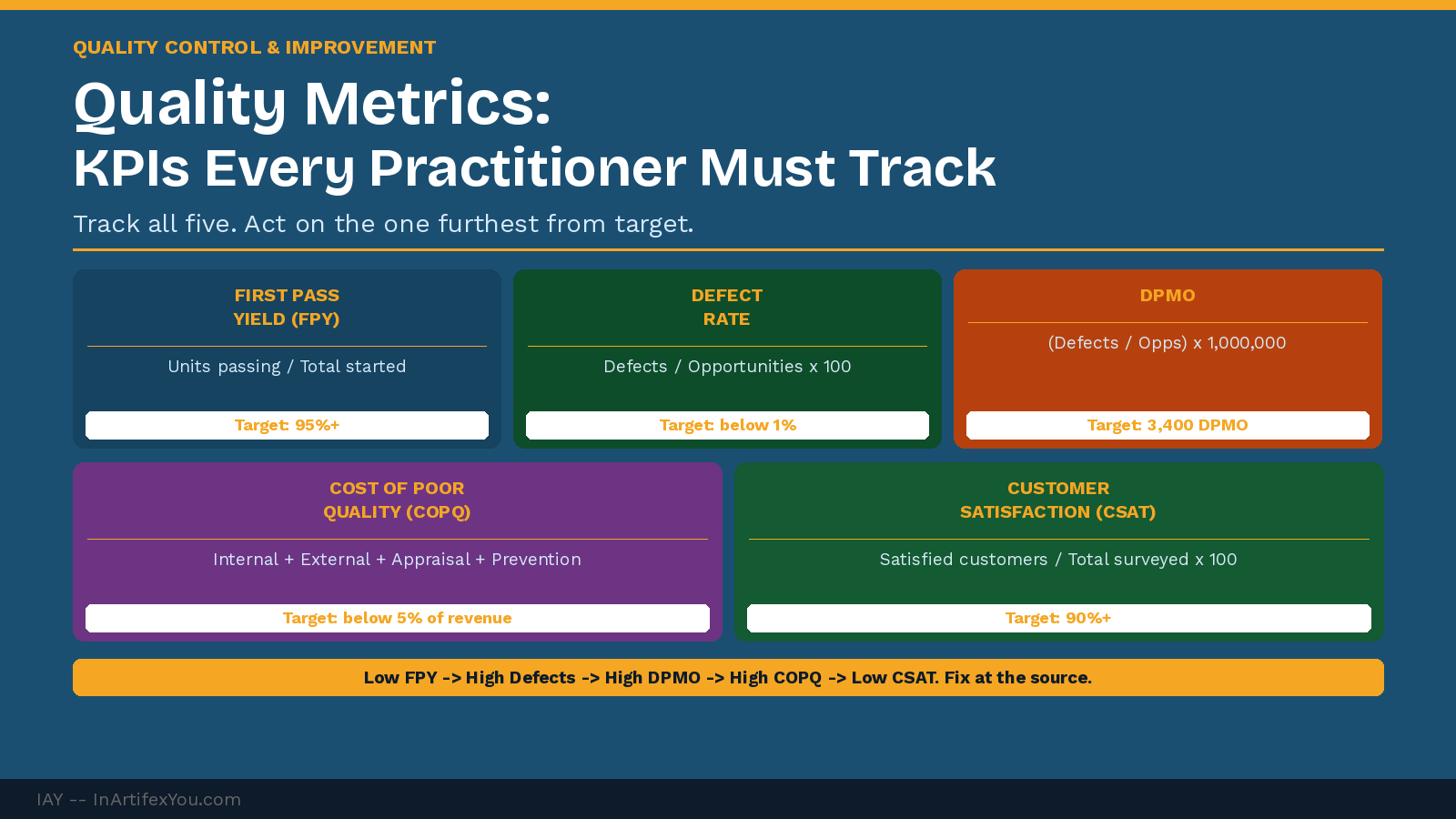
Quality metrics are only useful when they drive decisions. A dashboard full of numbers that nobody acts on is worse than no dashboard at all — it creates the illusion of quality management without the substance. The five metrics below are the ones that, when tracked and acted upon, consistently produce quality improvement.
The Five Essential Quality KPIs
|
KPI |
Formula |
World-Class Target |
What It Tells You |
|
First Pass Yield (FPY). |
Units passing without rework / Total units started. |
95%+. |
How often the process gets it right the first time — the most direct measure of process quality. |
|
Defect Rate. |
Total defects / Total opportunities x 100. |
Below 1%. |
The percentage of outputs that fail to meet specification — the baseline quality signal. |
|
DPMO. |
(Defects / Opportunities) x 1,000,000. |
3,400 DPMO (Six Sigma). |
Process capability normalized for comparison across different processes and industries. |
|
Cost of Poor Quality (COPQ). |
Internal + External failures + Appraisal + Prevention costs. |
Below 5% of revenue. |
The total financial cost of not doing things right — the business case for quality investment. |
|
Customer Satisfaction (CSAT). |
Satisfied customers / Total surveyed x 100. |
90%+. |
How quality is experienced by the customer — the ultimate measure of quality system effectiveness. |
The Relationship Between the Five Metrics
These five metrics are not independent — they form a performance chain. Low FPY produces high defect rates. High defect rates produce high DPMO. High DPMO produces high COPQ. High COPQ eventually produces low CSAT when failures escape to the customer. The chain runs in both directions: improving FPY reduces defect rates, which reduces DPMO, which reduces COPQ, which improves CSAT.
How to Use Them for Prioritization
- Calculate all five metrics for your current process.
- Identify which metric is furthest from its world-class target.
- That metric is your first improvement priority — it identifies where the system is failing most significantly.
- Apply the appropriate improvement tool: SPC for defect rate and DPMO problems, root cause analysis for FPY problems, COPQ analysis for financial prioritization.
The Practitioner's Dashboard Rule
Track all five. Act on the one furthest from target.
A quality dashboard that tracks everything equally is a reporting tool. A quality dashboard that drives improvement prioritization is a management tool. The difference is whether the data triggers decisions — not just reviews.
Back to hub: Quality and Control Improvement.
| ||||||||||||||||||||||
The Continuous Improvement Certification at InArtifexYou gives you a complete, practical system to map, baseline, improve, and sustain any process — and the verified credential to prove you can lead it.
inartifexyou.com/continuous-improvement-certification-online.html | ||||||||||||||||||||||
|