Statistical process control: how to build and read
control charts
Statistical Process Control (SPC) uses control charts to distinguish between two types of process variation: common cause variation (inherent to the process — normal, expected, random) and special cause variation (caused by a specific, identifiable event — abnormal, unexpected, actionable). A control chart plots process measurements over time against a center line (the process average) and upper and lower control limits (UCL and LCL) set at three standard deviations from the center line. A point outside the control limits signals a special cause requiring investigation. Eight decision rules — the Nelson Rules — identify non-random patterns within the control limits that also signal special causes: two of three consecutive points beyond two sigma, eight consecutive points on one side of the center line, and six consecutive points trending in one direction are the most commonly applied. Reacting to common cause variation as if it were special cause — called tampering — makes the process worse, not better.
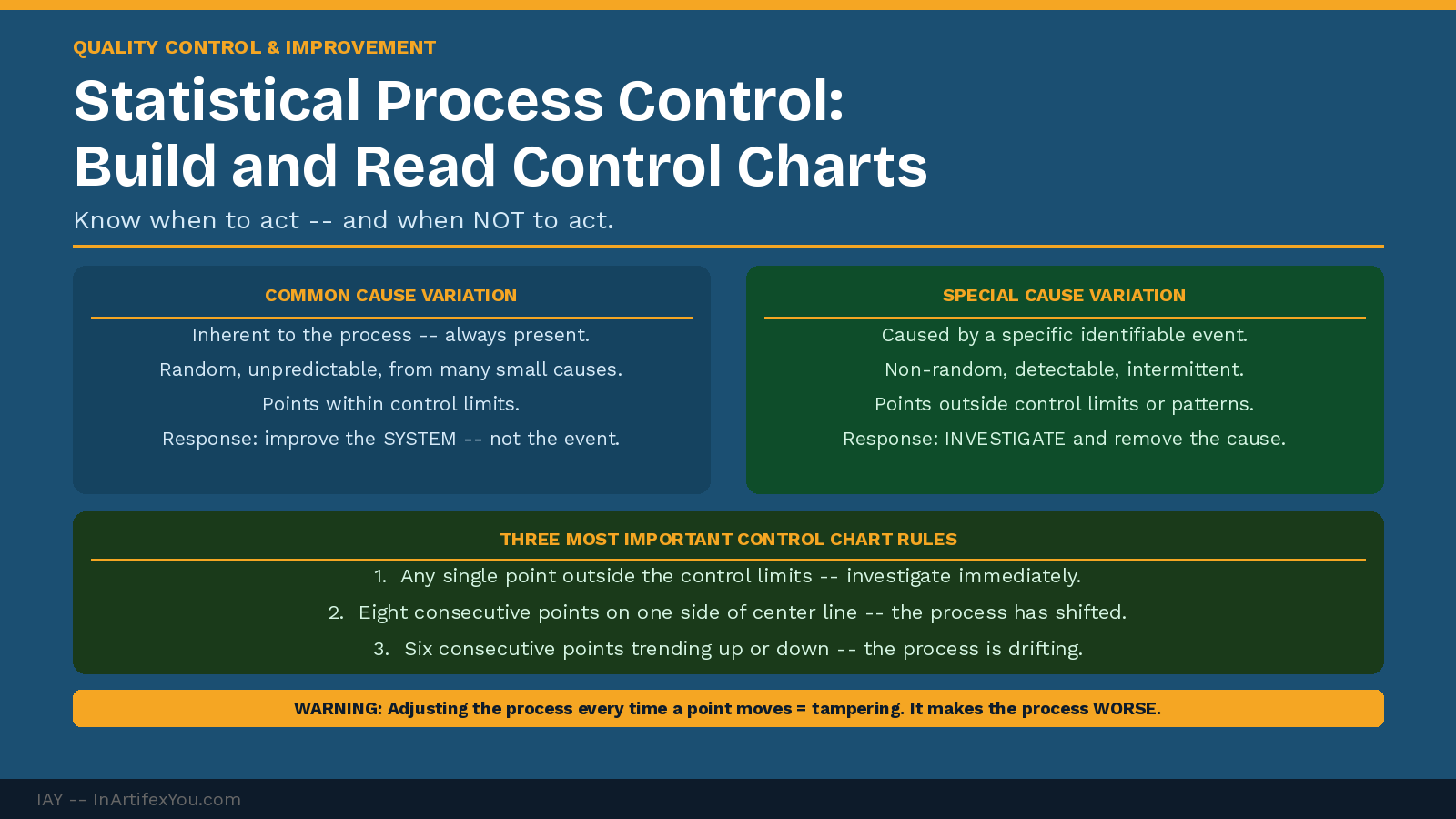
The most important concept in statistical process control is one that most practitioners learn last: not every data point that looks unusual actually requires action. Reacting to common cause variation — the normal, random fluctuation inherent in any process — makes the process less stable, not more. SPC gives practitioners the statistical framework to distinguish signals that require action from noise that does not.
The Two Types of Process Variation
|
COMMON CAUSE VARIATION Inherent to the process as designed. |
SPECIAL CAUSE VARIATION Caused by a specific, identifiable event. |
Choosing the Right Control Chart
|
Data Type |
Situation |
Chart Type |
|
Variable (continuous). |
Individual measurements — one per subgroup. |
I-MR (Individuals and Moving Range). |
|
Variable (continuous). |
Subgroups of 2–10 measurements. |
X-bar and R chart. |
|
Variable (continuous). |
Subgroups larger than 10. |
X-bar and S chart. |
|
Attribute (count). |
Defective items — constant sample size. |
p-chart (proportion defective). |
|
Attribute (count). |
Defective items — variable sample size. |
np-chart (number defective). |
|
Attribute (count). |
Defects per unit — constant sample size. |
c-chart (count of defects). |
|
Attribute (count). |
Defects per unit — variable sample size. |
u-chart (defects per unit). |
The Three Most Important Control Chart Rules
- Any single point outside the control limits — investigate immediately. The probability of a common cause point exceeding three sigma is 0.27% — rare enough to treat as a signal.
- Eight consecutive points on one side of the center line — the process has shifted. Even though all points are within limits, the pattern is non-random.
- Six consecutive points trending up or down — the process is drifting. Investigate before a point exits the control limits.
The Tampering Warning
The most damaging misuse of control charts is adjusting the process every time a data point moves away from the center line.
This is called tampering. It treats common cause variation as if it were a signal — and the adjustments themselves introduce new variation, making the process less stable.
The discipline of SPC is knowing when NOT to act as much as knowing when to act.
Back to hub: Quality Control and Improvement.
- Quality control vs quality improvement: what is the difference?
- Root cause analysis methods: 5 Whys, fishbone, and fault tree.
- Quality metrics: the KPIs every quality practitioner must track.
🔗 INTERNAL LINK SUGGESTIONS
| ||||||||||||||||||||||
The Continuous Improvement Certification at InArtifexYou gives you a complete, practical system to map, baseline, improve, and sustain any process — and the verified credential to prove you can lead it.
inartifexyou.com/continuous-improvement-certification-online.html | ||||||||||||||||||||||
|