Quality management in global supply chains
Quality management in global supply chains requires four interconnected capabilities: supplier qualification (verifying that suppliers have the process capability and management systems to consistently meet specifications before they enter the supply base), incoming quality control (inspecting or verifying incoming materials and components to detect non-conformances before they enter production), supply chain risk management (identifying, assessing, and mitigating the quality risks associated with geographic concentration, single-source dependencies, and regulatory variation), and supplier performance monitoring (tracking supplier quality KPIs over time to drive continuous improvement and make data-driven sourcing decisions). The most common failure in global supply chain quality is managing supplier relationships primarily through price negotiation while treating quality as a secondary concern — a practice that systematically transfers defect risk from the supplier to the customer-facing process.
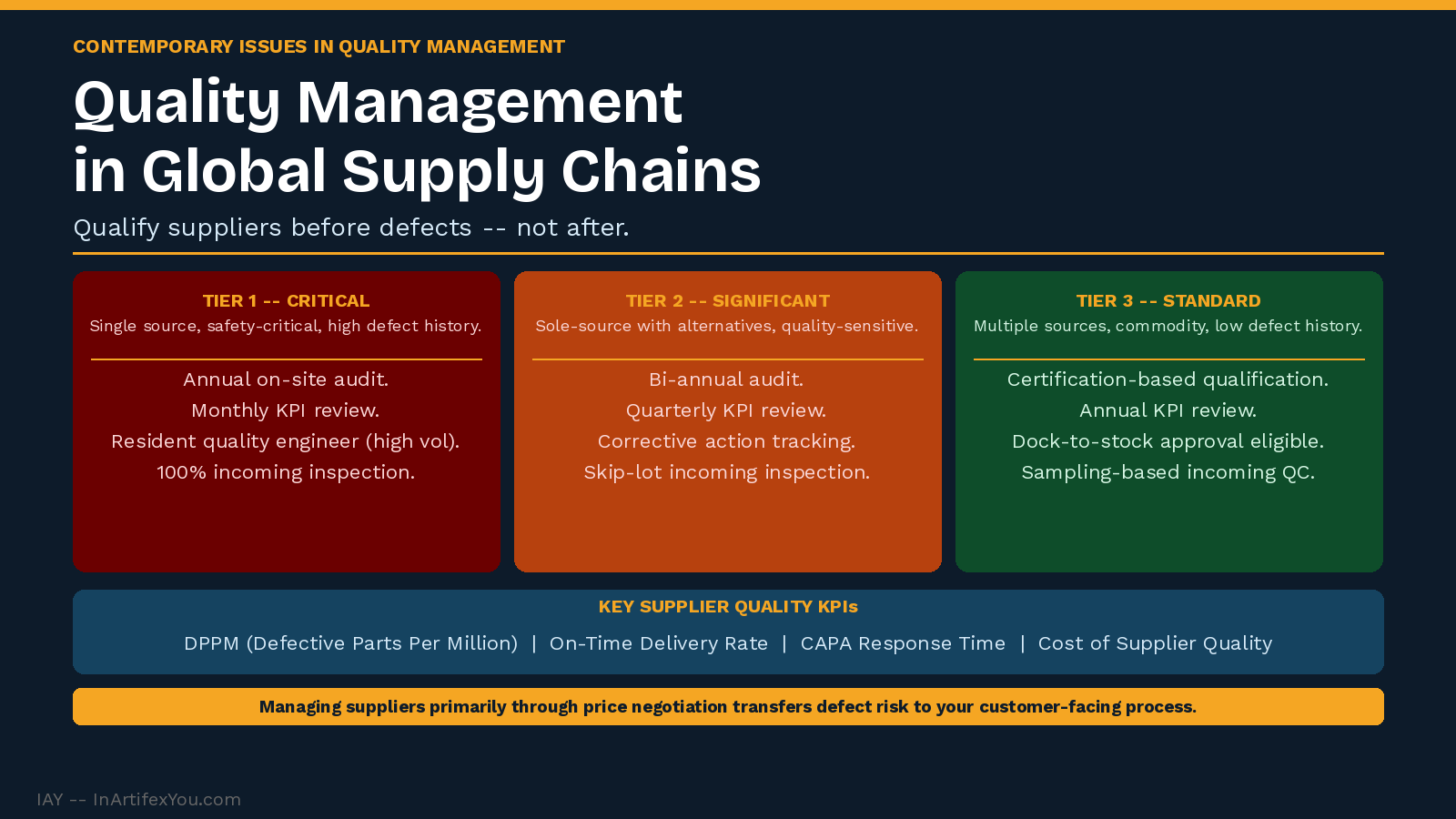
Global supply chains multiply every quality management challenge. A defect-producing supplier 8,000 miles away takes weeks to audit and months to correct. A geopolitical disruption can eliminate a single-source component overnight. A regulatory change in one country can render an entire product non-compliant in another. Quality management in global supply chains requires a systematic approach to risk that goes far beyond the incoming inspection practices that work for local suppliers.
Supplier Qualification: The Prevention Stage
Supplier qualification is the most important quality investment in supply chain management — it prevents defective suppliers from entering the supply base rather than managing their defects after the fact.
- Process capability assessment: verify that the supplier's key processes have Cpk values that meet specification requirements before placing the first production order.
- Quality management system audit: verify ISO 9001 certification or conduct an equivalent management system audit — document control, CAPA, internal audit, and management review maturity.
- Reference checks and production history: review quality performance data from other customers and assess the supplier's track record on similar product types.
- First Article Inspection (FAI): require a complete dimensional and functional inspection of first-production parts before volume production approval.
Risk Tiering: Prioritizing Supplier Management Intensity
|
Risk Tier |
Criteria |
Management Approach |
|
Tier 1 — Critical. |
Single source, safety-critical parts, or high defect history. |
Annual on-site audit, monthly KPI review, resident quality engineer for high volume. |
|
Tier 2 — Significant. |
Sole-source with alternatives available, quality-sensitive parts. |
Bi-annual audit, quarterly KPI review, corrective action tracking. |
|
Tier 3 — Standard. |
Multiple qualified sources, commodity parts, low defect history. |
Certification-based qualification, annual KPI review, incoming sampling. |
Incoming Quality Control
Incoming quality control strategy should be differentiated by supplier risk tier and incoming quality performance history — not applied uniformly to all incoming materials.
- Dock-to-stock approval: high-performing Tier 3 suppliers with consistent quality records ship directly to production storage without incoming inspection — based on statistical evidence, not assumption.
- Skip-lot inspection: Tier 2 suppliers are inspected on a sampling basis — frequency determined by recent quality performance.
- 100% incoming inspection: reserved for Tier 1 critical suppliers with quality concerns, new suppliers in qualification, or any supplier with a recent escape.
Supplier Performance Monitoring
- Defective Parts Per Million (DPPM): the primary incoming quality metric — track monthly by supplier and by part number.
- On-time delivery rate: quality and delivery are connected — suppliers under delivery pressure cut quality corners.
- Corrective action response time: how quickly the supplier investigates and responds to quality escapes — a leading indicator of management system maturity.
- Cost of supplier quality: total cost of incoming inspection, returned materials, line stops caused by supplier defects, and warranty claims attributable to supplier parts.
Back to hub: Contemporary Issues in Quality Management.
- AI in quality management: how artificial intelligence is changing QM.
- Digital transformation in quality management: tools and approaches.
- Agile quality management: applying agile principles to quality systems.
🔗 INTERNAL LINK SUGGESTIONS
| ||||||||||||||||||||||
The Continuous Improvement Certification at InArtifexYou gives you a complete, practical system to map, baseline, improve, and sustain any process — and the verified credential to prove you can lead it.
inartifexyou.com/continuous-improvement-certification-online.html | ||||||||||||||||||||||
|