Service recovery: how to turn service failures into
loyalty opportunities
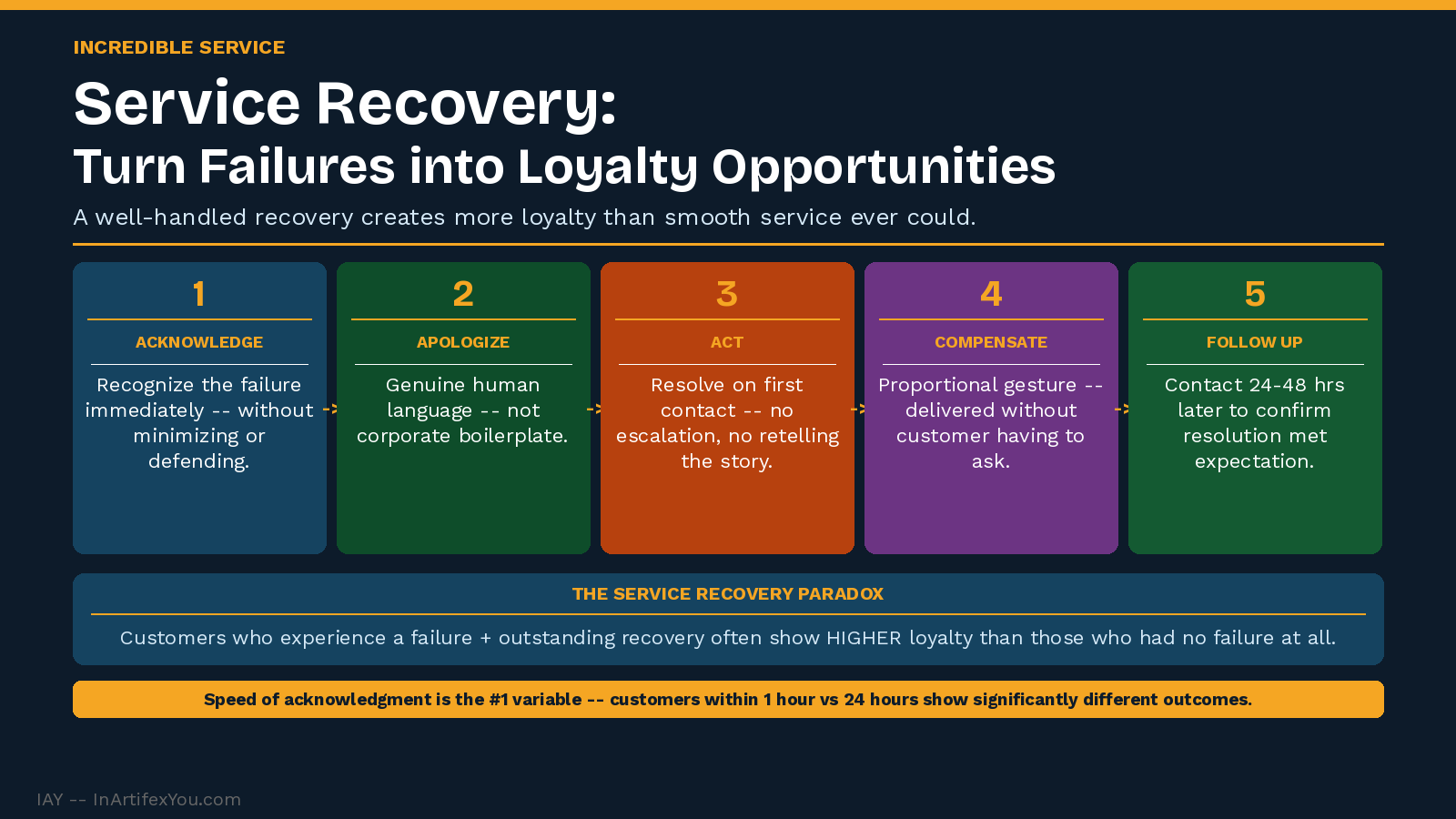
Service recovery is the process of responding to a service failure in a way that restores — and potentially exceeds — the customer's original satisfaction level. The service recovery paradox is a well-documented phenomenon: customers who experience a service failure and receive an outstanding recovery often report higher satisfaction and loyalty than customers who experienced no failure at all. This paradox occurs because a well-handled recovery creates a personal, memorable interaction that a routine service delivery rarely produces. Effective service recovery follows five steps: Acknowledge the failure immediately and without defensiveness. Apologize sincerely — not with corporate language but with genuine recognition of the customer's experience. Act decisively to resolve the problem on the first contact. Compensate appropriately — the recovery gesture should be proportional to the failure's impact. Follow up to confirm the resolution met the customer's expectation.
Every service organization has failures. The organizations that build legendary service reputations are not the ones that never fail — they are the ones that recover so well that customers remember the recovery more vividly than they remember the failure. Service recovery, executed correctly, is the most cost-effective loyalty investment available.
The Service Recovery Paradox
Research consistently shows that customers who experience a failure and receive an outstanding recovery score higher on loyalty and satisfaction measures than customers who experienced smooth service throughout. The explanation: a service recovery is a high-engagement interaction. The customer's expectation has been violated — they are paying close attention. When the organization responds with speed, sincerity, and genuine resolution, it creates a memorable contrast that routine service delivery never produces.
The Paradox Caveat
The service recovery paradox only operates once.
A customer who experiences multiple failures — even with good recoveries — does not experience the paradox effect. They experience a pattern of unreliability that erodes trust regardless of recovery quality.
The paradox is not a license to fail. It is an argument for investing in recovery capability as a loyalty tool.
The Five-Step Recovery Framework
- Acknowledge: recognize the failure immediately and completely — without minimizing, explaining, or defending. The customer needs to know they have been heard before they can receive a solution.
- Apologize: a genuine apology in human language — not corporate boilerplate. 'I understand how frustrating this must have been' is more effective than 'We apologize for any inconvenience caused.'.
- Act: resolve the problem on the first contact — immediately, without escalation, without requiring the customer to repeat their story. This is where empowerment makes or breaks the recovery.
- Compensate: offer something that acknowledges the customer's loss — time, inconvenience, or financial impact. The compensation should be proportional to the failure's impact and delivered without the customer having to ask for it.
- Follow up: contact the customer 24–48 hours after resolution to confirm the problem is fully resolved and the customer is satisfied. This step alone significantly increases post-recovery loyalty scores.
Recovery Speed: The Most Critical Variable
Speed of recovery acknowledgment is the single most important variable in service recovery outcomes. Research consistently shows that customers who receive an acknowledgment within one hour of reporting a failure rate their recovery experience significantly higher than customers who wait 24 hours — even when the final resolution is identical.
- Set a recovery acknowledgment standard: every reported failure receives a personal acknowledgment within one hour.
- Separate acknowledgment from resolution: acknowledge immediately even if the resolution will take longer.
- Track time-to-acknowledgment as a service quality metric alongside time-to-resolution.
Converting Recovery Data into Prevention
Service recovery data is the most valuable quality improvement input available — because it represents real failures that real customers experienced. A monthly analysis of recovery cases by failure category, root cause, and resolution cost produces the priority list for service process improvement.
Back to hub: Lean Manufacturing Management.
| ||||||||||||||||||||||
The Continuous Improvement Certification at InArtifexYou gives you a complete, practical system to map, baseline, improve, and sustain any process — and the verified credential to prove you can lead it.
inartifexyou.com/continuous-improvement-certification-online.html | ||||||||||||||||||||||
|