How to deliver incredible service: a practical
framework
Delivering incredible service consistently requires four organizational elements working together. First, a defined service standard: a specific, written description of what incredible service looks like at every customer touchpoint — not general values but observable behaviors and measurable outcomes. Second, the right people: incredible service cannot be trained into people who do not naturally care about others — selection for attitude and service orientation is more important than selection for technical skill. Third, empowerment: frontline staff must have the authority to make decisions that benefit the customer without escalation — a service recovery that requires three levels of manager approval is not a service recovery. Fourth, a measurement system: service quality must be measured at the touchpoint level with customer-defined metrics — not just overall satisfaction scores that mask touchpoint-level failures.
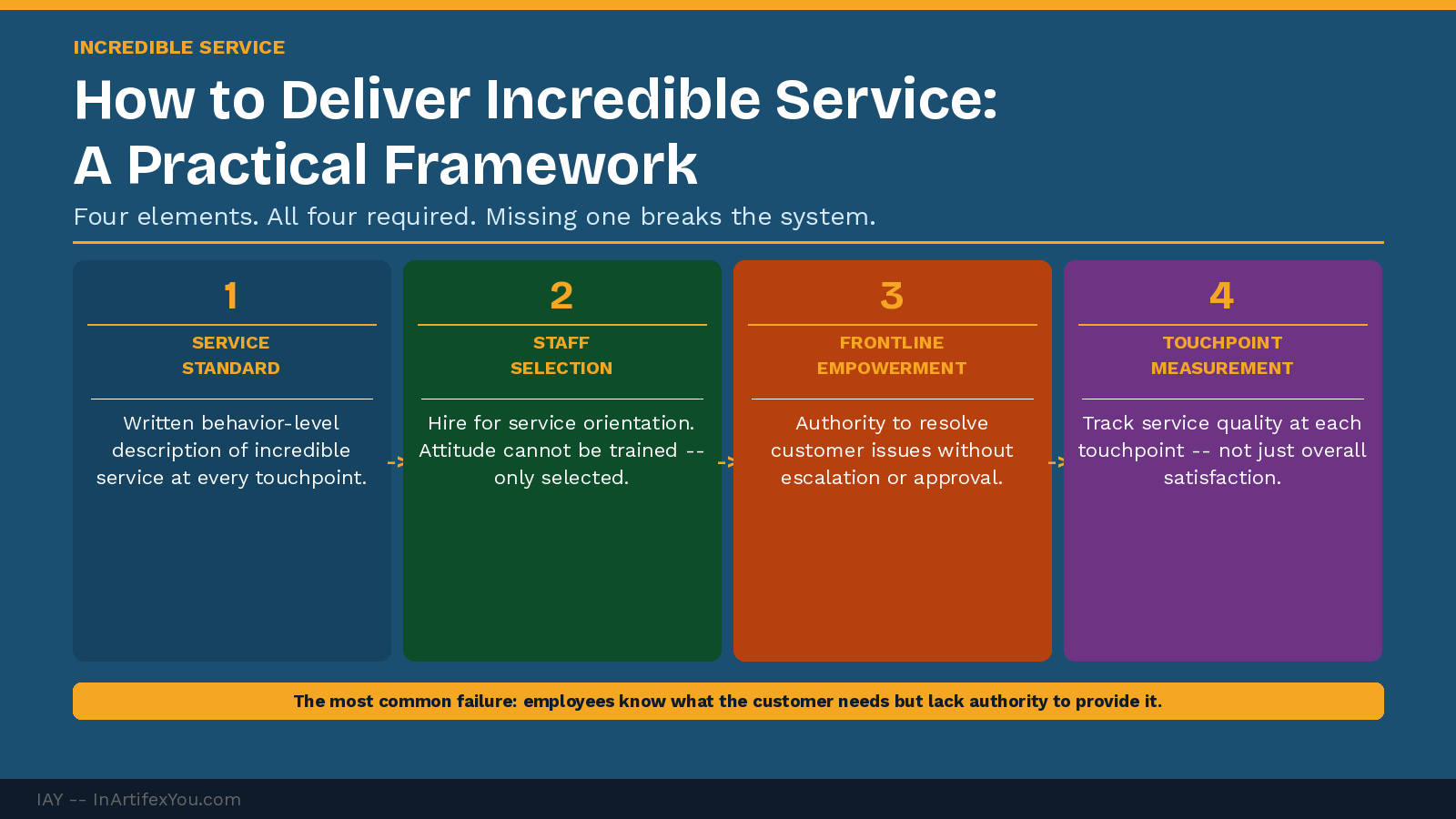
Incredible service does not happen by accident — and it does not happen from a values poster on the wall. It happens when an organization makes four specific design decisions: what the service standard is, who delivers it, how much authority they have to deliver it, and how performance against it is measured. Most service quality problems trace back to a failure in one of these four elements.
Element 1: The Service Standard
A service standard is a specific, written description of what incredible service looks like at each customer touchpoint. Effective service standards are:
- Observable: any team member watching an interaction can determine whether the standard was met.
- Measurable: the outcome of meeting the standard can be tracked over time — response time, resolution time, customer effort score.
- Customer-defined: the standard is derived from VoC research — what do customers describe as ideal, not what the organization finds convenient to deliver.
- Specific to each touchpoint: the service standard for an initial inquiry is different from the standard for a complaint resolution, which is different from the standard for a follow-up call.
Element 2: Staff Selection
Technical skills can be trained. Service orientation — the genuine desire to help people and take personal ownership of their experience — cannot be reliably installed. Organizations that deliver incredible service consistently select for attitude first and train for skill second.
The Selection Principle
Hire for attitude. Train for skill.
A technically skilled employee who does not genuinely care about customers will consistently deliver minimum-spec service — because they are optimizing for task completion, not customer experience.
A service-oriented employee with gaps in technical knowledge will find ways to help — and will improve faster because they are motivated by customer outcomes.
Element 3: Frontline Empowerment
Incredible service requires frontline staff to make real-time decisions that benefit the customer — without waiting for approval. The most common service quality failures happen when an employee knows what the customer needs but does not have the authority to provide it.
- Set a decision threshold: define the maximum financial value of a service recovery decision a frontline employee can make without manager approval.
- Remove friction from the recovery path: the employee who wants to help a customer should face zero bureaucratic barriers to doing so.
- Reward service initiative: when a frontline employee makes a bold service recovery decision, recognize it publicly to signal that service ownership is valued.
Element 4: Measurement at the Touchpoint
Overall satisfaction scores hide touchpoint-level failures. An organization with a 4.2/5 overall satisfaction rating may have a specific touchpoint — billing, complaint resolution, or onboarding — that consistently scores 2.5/5. Without touchpoint-level measurement, this failure is invisible.
|
Touchpoint |
Measurement Method |
Key Metric |
|
Initial inquiry response. |
Post-contact survey (24 hrs). |
Response time + first-contact resolution rate. |
|
Order/service delivery. |
Delivery confirmation survey. |
On-time delivery rate + accuracy rate. |
|
Complaint resolution. |
Post-resolution survey. |
CES (Customer Effort Score) + resolution time. |
|
Follow-up communication. |
NPS survey (30 days post). |
NPS score + unprompted recommendation rate. |
Back to hub: Incredible Service.
| ||||||||||||||||||||||
The Continuous Improvement Certification at InArtifexYou gives you a complete, practical system to map, baseline, improve, and sustain any process — and the verified credential to prove you can lead it.
inartifexyou.com/continuous-improvement-certification-online.html | ||||||||||||||||||||||
|