Incredible
service standards: how to define and document your service promise
A service standard is a specific, written description of what incredible service looks like at a defined customer touchpoint — written in observable, measurable terms that any team member can evaluate in real time. Effective service standards have four characteristics: they are observable (any trained observer can determine whether the standard was met), measurable (the outcome can be tracked and trended over time), customer-defined (derived from VoC research — what customers describe as ideal, not what the organization finds convenient), and touchpoint-specific (the standard for an initial inquiry differs from the standard for complaint resolution). The most common service standard failure is writing standards at the values level — 'we treat every customer with respect' — rather than the behavior level. A behavior-level standard reads: 'every customer inquiry receives a personal response within one hour during business hours, and within four hours outside business hours.'
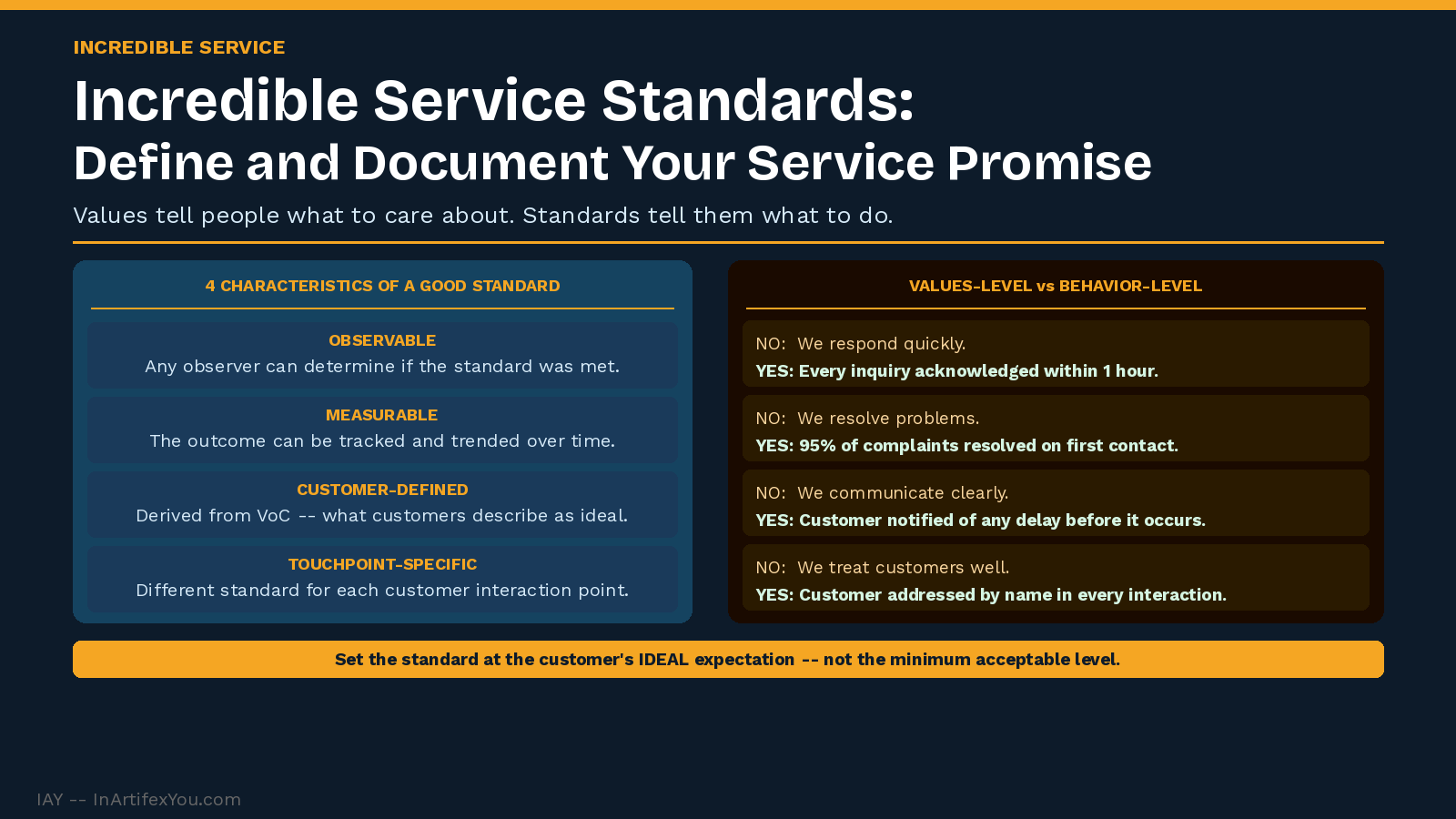
Most organizations have service values — statements about caring for customers, going the extra mile, treating people with respect. Values are important, but they are not service standards. A value tells people what to care about. A service standard tells people exactly what to do at a specific moment in a specific customer interaction. The difference between organizations that consistently deliver incredible service and those that occasionally deliver it is almost always the presence or absence of written, behavior-level service standards at every customer touchpoint.
Step 1: Map Every Customer Touchpoint
Before writing any service standard, map every point at which a customer interacts with the organization — from first contact through post-delivery follow-up. Each touchpoint is a moment of truth where the service promise is either kept or broken.
|
Touchpoint |
Customer Action |
Organization Response Required |
Standard Type |
|
First inquiry. |
Customer contacts with a question or request. |
Personal acknowledgment and response. |
Response time + content quality standard. |
|
Quotation or proposal. |
Customer requests pricing or solution. |
Tailored, accurate proposal delivered promptly. |
Turnaround time + accuracy standard. |
|
Order confirmation. |
Customer places an order. |
Confirmation with complete detail and timeline. |
Completeness + timing standard. |
|
Delivery or fulfillment. |
Customer receives product or service. |
On-time, complete, and accurate delivery. |
On-time rate + accuracy standard. |
|
Complaint or issue. |
Customer reports a problem. |
Immediate acknowledgment and resolution. |
Response time + FCR standard. |
|
Follow-up. |
Post-delivery check-in. |
Proactive contact to confirm satisfaction. |
Timing + personalization standard. |
Step 2: Write Behavior-Level Standards
For each touchpoint, write the standard at the behavior level — specific enough that there is no ambiguity about whether it was met. The test: could two independent observers watch the same interaction and agree on whether the standard was met?
|
VALUES-LEVEL (INSUFFICIENT) We respond to customers quickly. |
BEHAVIOR-LEVEL (CORRECT) Every inquiry acknowledged within 1 hour. |
Step 3: Set the Standard at the Ideal Level
Incredible service standards are set at the customer's ideal expectation — not at the minimum acceptable level. The minimum acceptable level prevents complaints. The ideal level creates loyalty. When setting the standard, ask: what would a customer describe as a perfect experience at this touchpoint? That description is the standard.
The Standard-Setting Question
Do not ask: 'what is the fastest we can realistically respond?'
Ask: 'what response time would make a customer say this organization is exceptional?'
Set the standard there. Then design the process to meet it consistently.
Step 4: Embed Standards in Operations
A written service standard has no value unless it is embedded in how work is done:
- Train every team member on the standard for their touchpoints — not as a one-time event but as part of onboarding and regular performance review.
- Include standard compliance in performance measurement — track adherence rates at each touchpoint monthly.
- Make standards visible at the point of work — service standard cards at workstations, standard summaries in CRM systems, prompt cards for frontline staff.
- Review and update standards annually using VoC data — customer expectations change and standards must evolve with them.
Back to hub: Incredible Service.
| ||||||||||||||||||||||
The Continuous Improvement Certification at InArtifexYou gives you a complete, practical system to map, baseline, improve, and sustain any process — and the verified credential to prove you can lead it.
inartifexyou.com/continuous-improvement-certification-online.html | ||||||||||||||||||||||
|