Incredible service in B2B: how it differs from
consumer service
Incredible service in B2B environments differs from consumer service in four fundamental ways. First, the relationship is multi-stakeholder: B2B service quality is judged by multiple people — the buyer, the user, the technical evaluator, and the executive sponsor — each with different expectations and quality criteria. Second, the stakes are higher: a B2B service failure can disrupt the customer's production, damage their own customer relationships, and create financial losses far exceeding the contract value. Third, technical expertise is a primary service quality dimension: B2B customers expect their service provider to understand their business and offer expert guidance — not just process transactions. Fourth, proactive communication is not optional: B2B customers expect to be informed before problems escalate, not after. The B2B service standard is not just 'did you do what you said?' but 'did you help us succeed?'
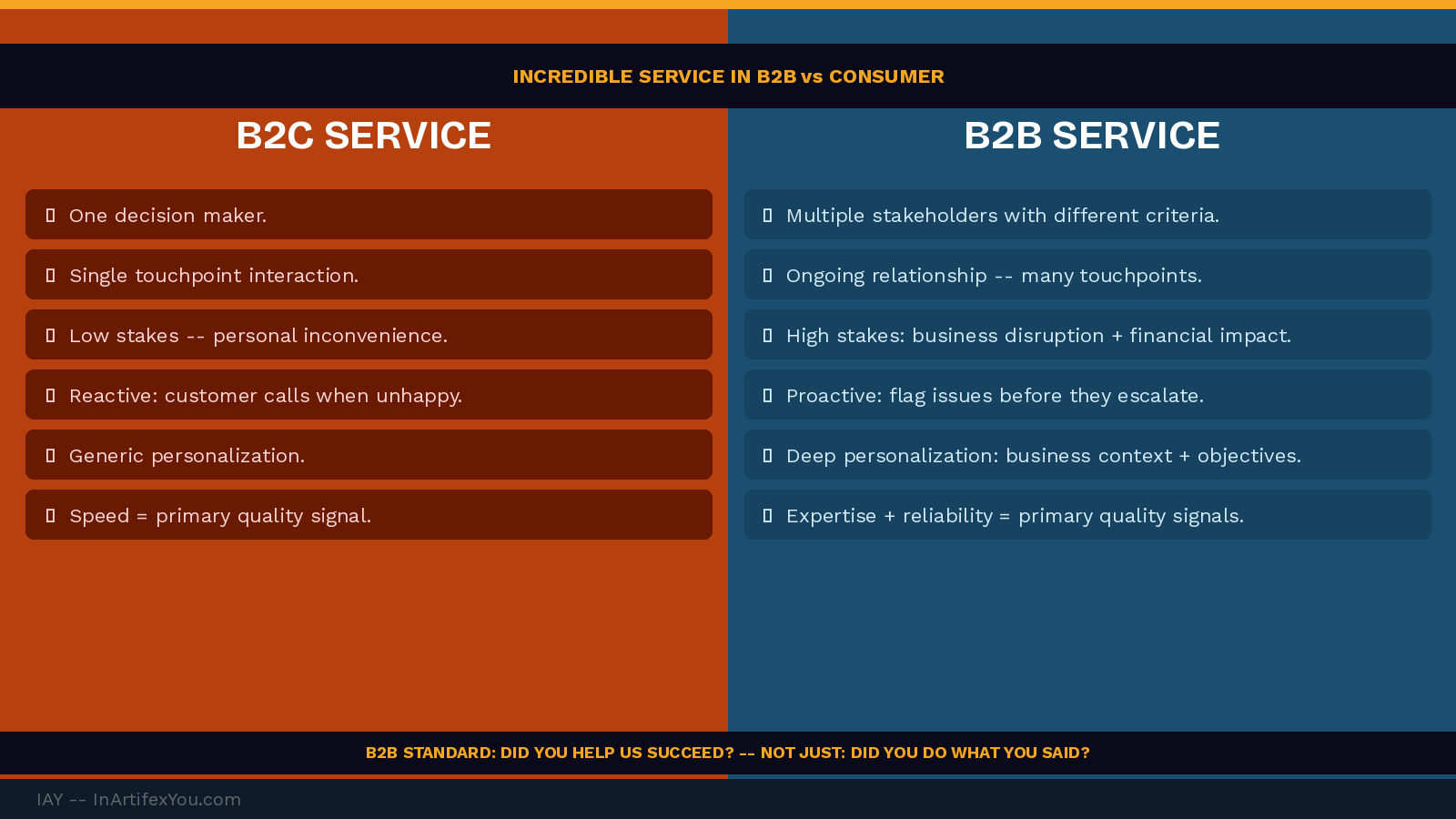
The principles of incredible service apply equally in B2B and B2C environments — but the application differs significantly. B2B service relationships are more complex, higher-stakes, and more dependent on technical expertise and proactive communication than consumer service relationships. An organization that delivers incredible consumer service cannot simply apply the same service model to B2B customers and expect the same results.
The Four B2B Service Differences
|
B2C SERVICE One decision maker: the individual customer. |
B2B SERVICE Multiple stakeholders with different criteria. |
The Multi-Stakeholder Service Challenge
In a B2B relationship, the person who uses the service is often not the person who evaluates and renews the contract. This creates a service quality measurement challenge: the user's day-to-day experience and the executive sponsor's perception of value may be completely different — and both matter for contract renewal.
- Map all stakeholders at each B2B customer account: who uses the service, who evaluates it, who approves renewal, and who champions it internally.
- Measure satisfaction at each stakeholder level separately — user satisfaction surveys, executive business reviews, and technical evaluator assessments produce different quality signals.
- Ensure the executive sponsor is informed of quality performance proactively — they should hear about improvements and issues from you before they hear about them from their own team.
Technical Expertise as a Service Quality Dimension
In B2B service, the customer's question is rarely 'did you complete the transaction?' — it is 'do you understand my business well enough to help me succeed?' Technical expertise is a service quality dimension that has no direct equivalent in consumer service. The B2B service provider who can anticipate the customer's technical challenges, offer expert guidance proactively, and connect the service to the customer's business outcomes is delivering incredible service.
Proactive Communication: The B2B Standard
B2B customers have businesses to run. A service failure that the customer discovers first — before the provider — damages trust disproportionately. Proactive communication means:
- Flagging potential delivery issues before they become actual failures.
- Providing regular performance reports without being asked.
- Notifying customers of changes — product, policy, personnel — before they experience the impact.
- Following up after major deliveries or projects to confirm the outcome met business expectations.
The B2B Service Standard
In B2B, incredible service means helping the customer succeed at their business — not just completing the transaction correctly.
The customer's business outcome is the quality standard. Everything else is a process metric.
Back to hub: Incredible Service.
| ||||||||||||||||||||||
The Continuous Improvement Certification at InArtifexYou gives you a complete, practical system to map, baseline, improve, and sustain any process — and the verified credential to prove you can lead it.
inartifexyou.com/continuous-improvement-certification-online.html | ||||||||||||||||||||||
|