Service culture: how to build a team that delivers
incredible service consistently
A service culture is the organizational environment in which incredible service is the natural, consistent output of how people are selected, trained, empowered, recognized, and led — not the occasional result of exceptional individual effort. Building a service culture requires five organizational decisions made consistently over time: hire for service orientation (attitude toward helping others cannot be reliably trained — it must be selected), train on behaviors not values (specific service behaviors at specific touchpoints, not general customer service principles), empower frontline staff to act (incredible service cannot be delivered by employees who must escalate every non-standard situation), recognize service excellence visibly (the behaviors that get recognized get repeated), and model the standard from leadership (teams deliver the service quality they observe their leaders demonstrating — not the standard written in the handbook).
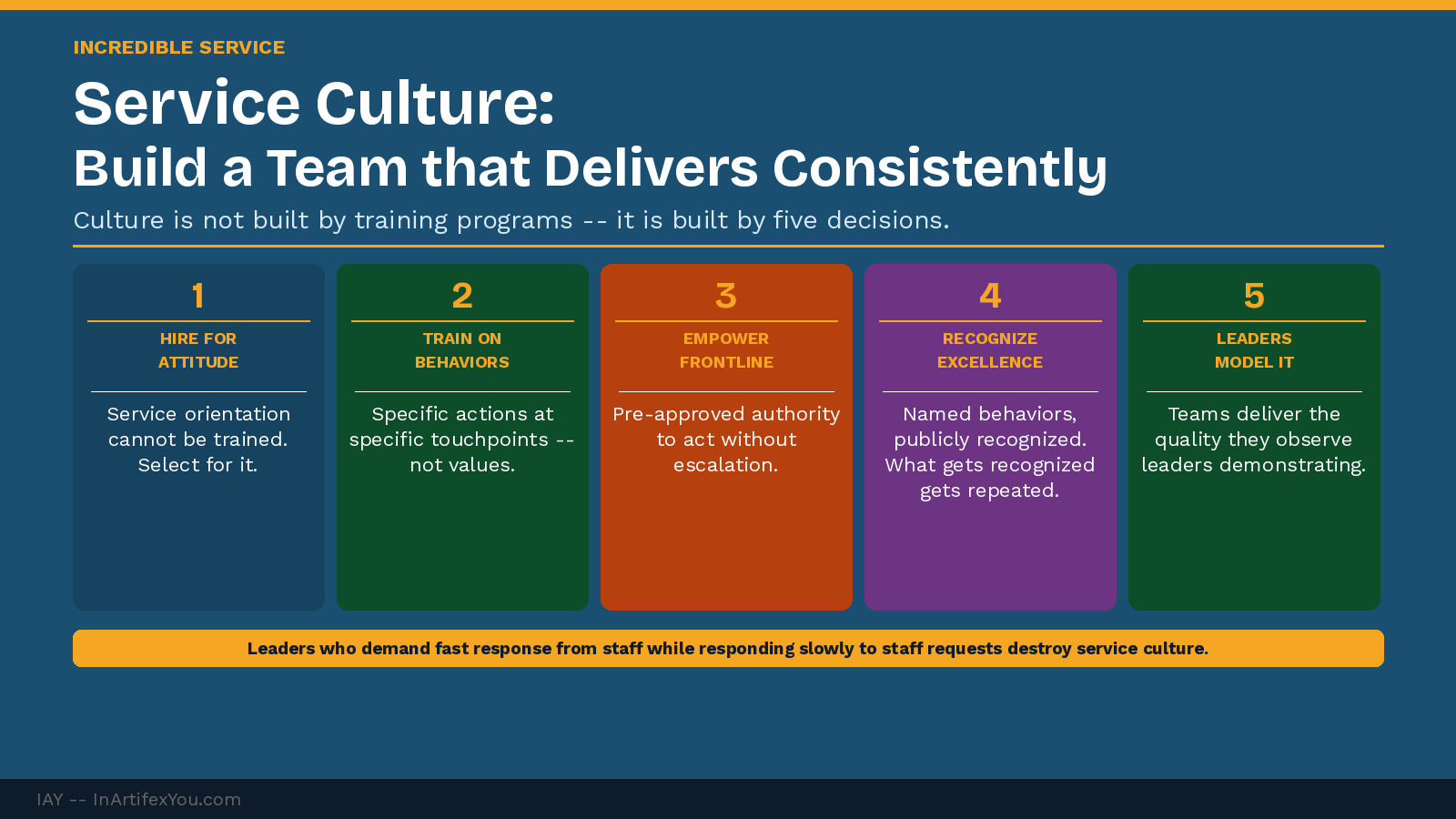
Service culture is not built by a customer service training program. It is built by five organizational decisions made consistently over years — decisions about who is hired, how they are developed, what authority they have, what gets recognized, and how leaders behave. Organizations that achieve legendary service reputations — Ritz-Carlton, Zappos, Southwest Airlines — did not get there through training programs. They got there through systematic cultural architecture.
Element 1: Hire for Service Orientation
Service orientation — the genuine desire to help people and take personal ownership of their experience — is not reliably trainable. It is a disposition. The hiring process for service-critical roles must assess it directly:
- Behavioral interview questions: 'Tell me about a time you went significantly out of your way to help someone — not because it was required but because you wanted to.' The answer reveals whether service orientation is intrinsic or performed.
- Scenario testing: present real service situations and assess the instinctive response — not the trained response the candidate thinks you want to hear.
- Reference checks focused on service behavior: ask previous managers specifically whether the candidate took personal ownership of customer outcomes or limited themselves to their defined role.
Element 2: Train on Behaviors, Not Values
Service training that focuses on values — 'we put the customer first, we go the extra mile' — produces employees who can recite the values and continue delivering average service. Service training that focuses on specific behaviors at specific touchpoints produces employees who know exactly what to do when a customer is in front of them.
Behavior-Based Training Example
Values training: 'Always make the customer feel valued and important.'
Behavior training: 'Address the customer by name in the first sentence of every interaction. Summarize what they told you before offering a solution. Confirm at the end that the resolution met their expectation.'
One tells people what to care about. The other tells them exactly what to do.
Element 3: Empowerment With Clear Boundaries
Frontline empowerment means the authority to make real-time decisions that benefit the customer without escalation. Without it, service culture fails at the moment of truth — when the customer needs something non-standard and the employee knows what to do but cannot do it.
- Define a financial empowerment threshold: the maximum a frontline employee can spend or waive to resolve a customer issue without manager approval.
- Define service recovery actions that require no approval: replacement, refund, upgrade, complimentary add-on — specify which actions are pre-approved at each level.
- Communicate empowerment boundaries clearly during onboarding — employees who do not know their boundaries default to inaction.
Element 4: Recognize Service Excellence Visibly
The behaviors that get recognized get repeated — and the behaviors that go unrecognized fade. Service culture requires a systematic recognition practice, not occasional praise:
- Peer recognition systems: team members nominate colleagues for specific service behaviors they observed — not general 'great attitude' recognition but named behaviors at named touchpoints.
- Leadership callouts: leaders reference specific service excellence examples in team meetings — naming the behavior, the outcome, and why it represents the standard.
- Customer feedback sharing: when a customer provides unsolicited positive feedback about a team member, share it with the entire team — it makes the service standard tangible.
Element 5: Leadership Modeling
Teams deliver the service quality they observe their leaders demonstrating — not the standard written in the handbook. Leadership modeling means:
|
LEADERSHIP BEHAVIORS THAT BUILD CULTURE Leaders respond to internal requests with the same speed expected of
frontline staff. |
LEADERSHIP BEHAVIORS THAT ERODE CULTURE Leaders respond slowly to team requests while demanding fast customer
response. |
Back to hub: Incredible Service.
| ||||||||||||||||||||||
The Continuous Improvement Certification at InArtifexYou gives you a complete, practical system to map, baseline, improve, and sustain any process — and the verified credential to prove you can lead it.
inartifexyou.com/continuous-improvement-certification-online.html | ||||||||||||||||||||||
|