Staff participation in TQM: how to design meaningful
employee involvement
Meaningful staff participation in TQM requires four organizational design decisions. First, structured participation mechanisms: quality circles, cross-functional improvement teams, and Kaizen events give employees formal channels to contribute to quality improvement — without these structures, participation remains informal and inconsistent. Second, management enablement: employees can only participate meaningfully when they have the time, tools, training, and authority to act on quality problems. Third, closed-loop response systems: every employee contribution must receive a documented response within a defined timeframe — suggestion systems that collect ideas but never implement them actively destroy engagement. Fourth, visible recognition: improvement contributions must be recognized publicly and specifically — naming the behavior, the outcome, and the impact.
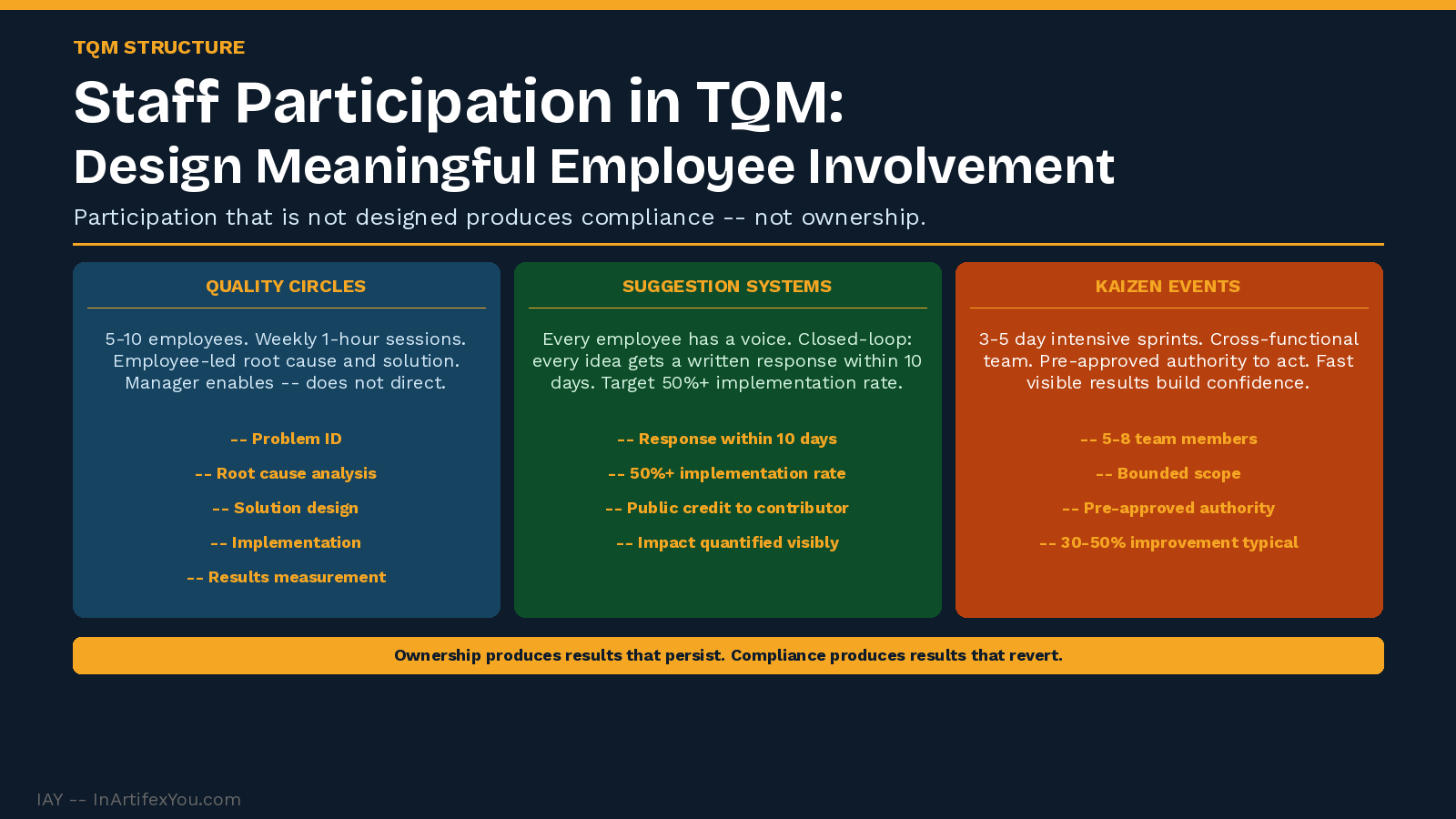
Staff participation in TQM is one of the three structural pillars of the system — alongside customer satisfaction and continuous improvement. But participation that is not designed produces compliance rather than engagement: employees attend the quality meeting, fill in the suggestion form, and go back to working exactly as they did before. Meaningful staff participation in TQM requires organizational design — structures, systems, and management practices that make employee involvement in quality improvement a natural part of how work is done.
Participation Mechanism 1: Quality Circles
A quality circle is a small group of employees (typically 5–10) from the same work area who meet regularly — usually weekly for one hour — to identify, analyze, and solve quality problems in their own processes. Quality circles are employee-led and focused on problems within the participants' direct sphere of influence.
- Meeting structure: problem identification → root cause analysis → solution design → implementation → results measurement → presentation to management.
- Facilitator role: a trained facilitator guides the process without directing the content — the team owns the problem and the solution.
- Management role: provide resources, remove obstacles, approve implementation, and recognize results — not direct the analysis or pre-determine the solution.
Participation Mechanism 2: Suggestion Systems
A suggestion system provides a formal channel for every employee to submit quality improvement ideas. Effective suggestion systems have three characteristics that distinguish them from suggestion boxes that employees ignore:
|
Characteristic |
Poor Practice |
Effective Practice |
|
Response time. |
Ideas reviewed quarterly or when management gets to it. |
Every idea receives a written response within 10 business days. |
|
Implementation rate. |
Ideas acknowledged but rarely implemented. |
Target 50%+ implementation rate — low implementation destroys participation. |
|
Recognition. |
Ideas disappear with no visible outcome. |
Implemented ideas credited to the contributor publicly, with impact quantified. |
Participation Mechanism 3: Kaizen Events
Kaizen events are intensive 3–5 day improvement sprints where a cross-functional team focuses exclusively on a defined improvement problem. Unlike quality circles (ongoing) and suggestion systems (individual), Kaizen events produce rapid, visible results that demonstrate the power of employee-led improvement to the broader organization.
- Team composition: 5–8 people including operators, supervisors, and support functions — the people who actually do the work in the target area.
- Scope: a specific, bounded problem that the team can analyze and implement a solution for within the event timeframe.
- Authority: the team has pre-approved authority to implement changes within the event scope.
The Participation Design Principle
Participation programs that tell employees what to improve produce compliance.
Participation programs that ask employees to opidentify and solve problems in their own work produce ownership.
Ownership produces results that persist. Compliance produces results that revert.
Back to hub: TQM Structure.
| ||||||||||||||||||||||
The Continuous Improvement Certification at InArtifexYou gives you a complete, practical system to map, baseline, improve, and sustain any process — and the verified credential to prove you can lead it.
inartifexyou.com/continuous-improvement-certification-online.html | ||||||||||||||||||||||
|