TQM decision making: how to build a fact-based
management system
Fact-based decision making in TQM means that quality improvement priorities, resource allocation decisions, and process change decisions are driven by data rather than opinion, experience, or hierarchy. Building a fact-based management system requires four elements: a defined measurement system (what data is collected, at what frequency, with what precision, and validated through MSA), a quality dashboard (the five essential quality KPIs displayed visibly and reviewed at every management meeting), decision protocols (rules that define which data thresholds trigger which management responses — eliminating the discretion that allows opinion to override data), and a review cadence (weekly operational reviews, monthly quality KPI reviews, and quarterly strategic quality reviews). The most common failure in fact-based decision making is collecting the data without building the decision protocols that make the data actionable.
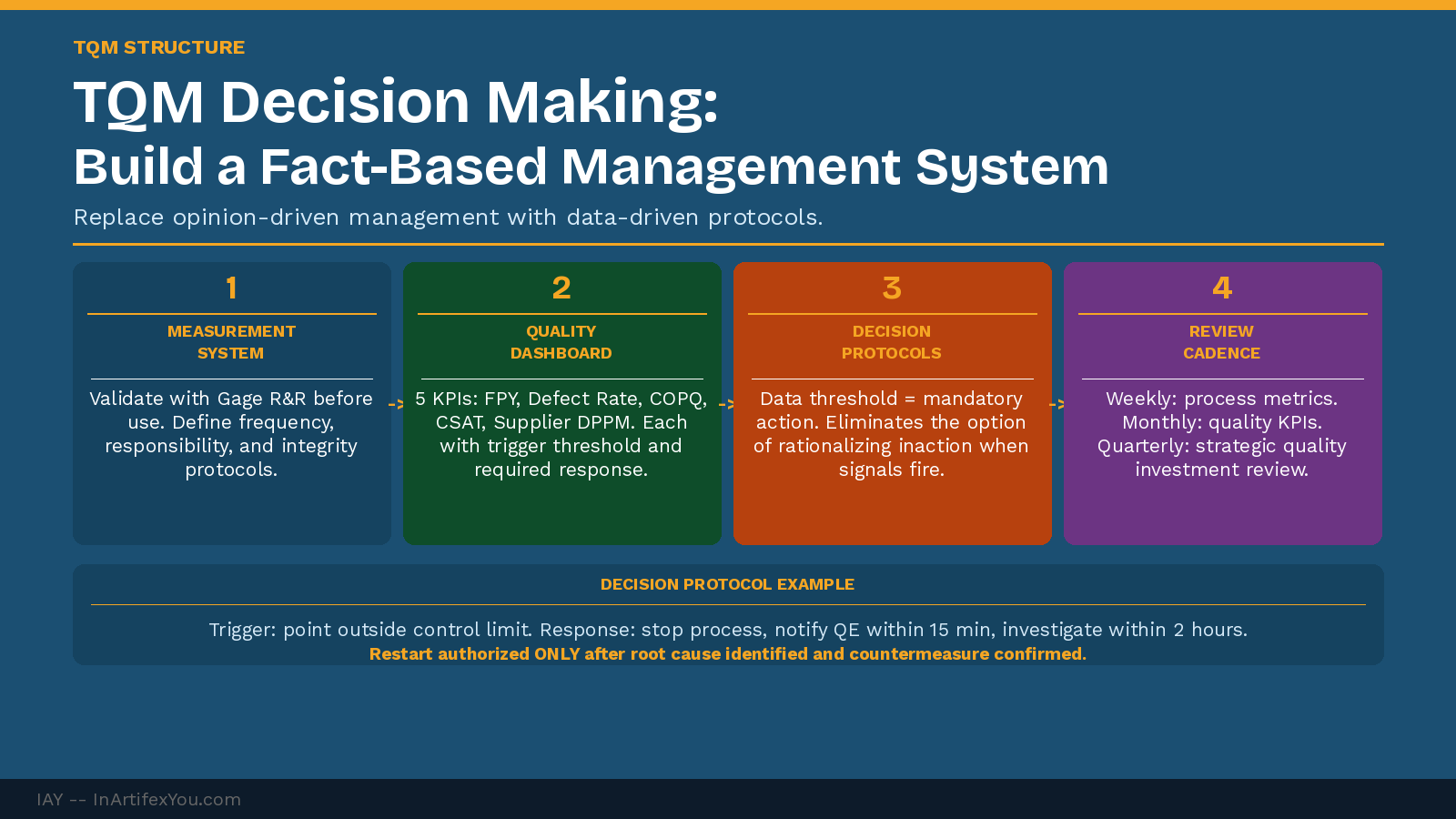
TQM decision making based on fact rather than opinion is one of the eight principles of TQM — and one of the most consistently violated in practice. Opinion-based management produces inconsistent quality outcomes because the quality of the decision depends entirely on the quality of the individual manager's judgment, which varies by person, by day, and by circumstance. Fact-based TQM decision making removes this variability by establishing data-driven protocols that produce consistent management responses to defined conditions.
Element 1: The Measurement System
Before any data-driven decision can be made, the measurement system must be validated. Data from an unreliable measurement system produces worse decisions than no data — because it creates false confidence in incorrect information.
- Validate the measurement system using Gage R&R before using data for improvement decisions.
- Define data collection frequency and responsibility: who collects which data, at what intervals, using which method.
- Establish data integrity protocols: how data is recorded, stored, and protected from transcription errors.
Element 2: The Quality Dashboard
|
Metric |
Review Frequency |
Decision Trigger |
Management Response |
|
First Pass Yield. |
Daily. |
FPY drops below 95%. |
Immediate investigation — root cause analysis initiated within 24 hours. |
|
Defect Rate. |
Weekly. |
Defect rate exceeds 1%. |
Kaizen event scheduled within 30 days targeting top defect category. |
|
COPQ. |
Monthly. |
COPQ exceeds 5% of revenue. |
Strategic quality review — improvement program resource allocation reviewed. |
|
Customer Satisfaction. |
Monthly. |
CSAT drops below 80% or NPS below 40. |
Customer experience improvement project initiated within 60 days. |
|
Supplier DPPM. |
Monthly. |
Tier 1 supplier DPPM exceeds 500. |
Supplier corrective action request issued within 5 business days. |
Element 3: Decision Protocols
A decision protocol converts a data threshold into a mandatory management action — eliminating the discretion that allows managers to rationalize inaction when data indicates a problem.
Decision Protocol Example
Trigger: control chart shows a point outside the upper control limit on the main machining center.
Required response: operator stops the process and notifies the quality engineer within 15 minutes.
Quality engineer response: investigates root cause within 2 hours. Authorizes process restart only after root cause is identified and countermeasure is in place.
This protocol removes the option of 'let it run and see if it happens again' — the most common opinion-based response to a control chart signal.
Element 4: The Management Review Cadence
- Weekly operational review: process performance metrics — FPY, defect rate, downtime. Focus: immediate response to this week's signals.
- Monthly quality KPI review: all five quality KPIs plus COPQ trend. Focus: improvement project status and resource allocation.
- Quarterly strategic quality review: KPI trends, COPQ as percentage of revenue, customer satisfaction trends, and improvement program ROI. Focus: strategic quality investment decisions.
Back to hub: TQM Structure.
| ||||||||||||||||||||||
The Continuous Improvement Certification at InArtifexYou gives you a complete, practical system to map, baseline, improve, and sustain any process — and the verified credential to prove you can lead it.
inartifexyou.com/continuous-improvement-certification-online.html | ||||||||||||||||||||||
|