TQM tools for quality management: statistical and
analytical methods
The TQM toolkit divides into two categories: the seven basic quality tools — accessible to all employees without statistical training — and statistical methods — requiring practitioner-level expertise. The seven basic tools are: check sheet (structured data collection), Pareto chart (ranks defect categories by frequency), fishbone diagram (organizes potential causes into six categories), histogram (frequency distribution of process measurements), control chart (monitors process stability over time), scatter diagram (tests cause-and-effect relationships between two variables), and flowchart (maps process sequence to identify waste and unnecessary steps). These seven tools, used systematically, solve the majority of quality problems that do not require advanced statistical analysis.
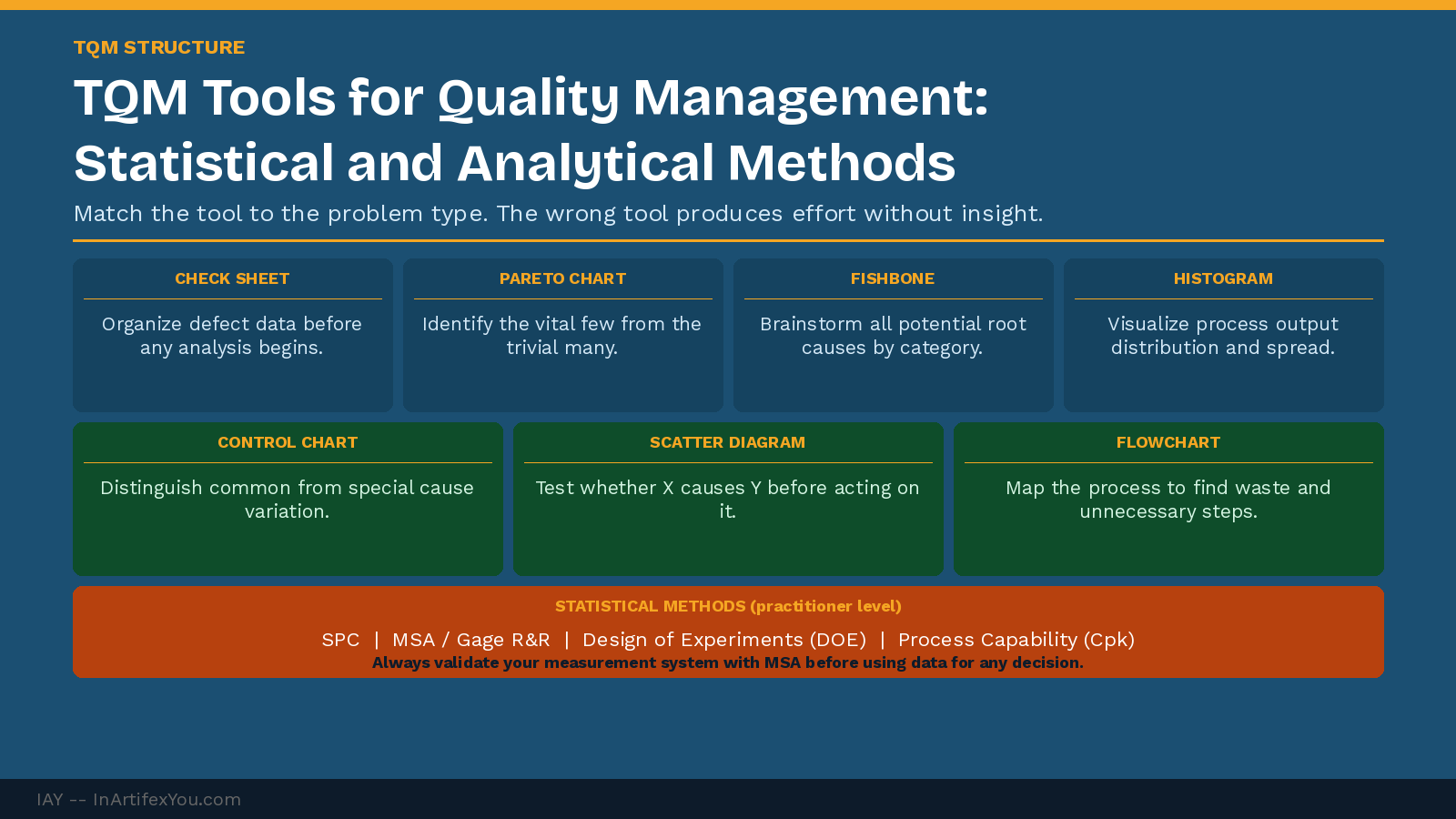
TQM tools for quality management are only as valuable as the discipline applied in selecting and using them — each tool is designed for a specific type of quality problem, and applying the wrong tool produces effort without insight. The most common failure in tool selection is applying a sophisticated statistical method to a problem that a basic quality tool would solve more quickly and more clearly.
The Seven Basic Quality Tools
|
Tool |
Problem It Solves |
When to Use It |
|
Check Sheet. |
Structured data collection — tracking defect frequency by category, location, or time. |
Before analysis — whenever you need organized defect data to work with. |
|
Pareto Chart. |
Identifying the vital few causes responsible for the majority of defects. |
When you have multiple defect categories and need to prioritize where to focus. |
|
Fishbone Diagram. |
Organizing potential root causes into six M categories for structured analysis. |
When root cause is unknown and the team needs to brainstorm all possible causes. |
|
Histogram. |
Visualizing the distribution and spread of process measurements. |
When assessing process capability or understanding the shape of process output. |
|
Control Chart. |
Distinguishing common cause from special cause variation over time. |
When monitoring process stability and detecting signals that require investigation. |
|
Scatter Diagram. |
Testing whether two variables have a relationship — is X causing Y? |
When testing a root cause hypothesis before implementing a countermeasure. |
|
Flowchart. |
Mapping the process sequence to identify waste, loops, and unnecessary steps. |
When analyzing a process for improvement opportunities or documenting the current state. |
Statistical Methods for Advanced Analysis
- Statistical Process Control (SPC): control charts applied systematically across multiple process variables — requires understanding of chart selection, control limit calculation, and the Nelson Rules.
- Measurement System Analysis (MSA / Gage R&R): validates that measurement systems are reliable before using their data for decisions — required before any DMAIC Measure phase.
- Design of Experiments (DOE): tests multiple process variables simultaneously to identify the optimal combination — far more efficient than one-factor-at-a-time experimentation.
- Process Capability Analysis (Cpk): quantifies how well a process performs relative to its specification limits — the language for communicating process quality to customers and leadership.
Tool Selection Framework
Match the Tool to the Problem Type
Need
to organize defect data: Check Sheet. Need to prioritize: Pareto Chart.
Need
to find root cause: Fishbone Diagram. Need to verify root cause: Scatter
Diagram.
Need
to monitor stability: Control Chart. Need to assess capability: Histogram and
Cpk.
Need
to understand the process: Flowchart. Need to optimize: Design of Experiments.
Need to validate your measurement: MSA / Gage
R&R. Always do this before anything else.
Back to hub: TQM Structure.
| ||||||||||||||||||||||
The Continuous Improvement Certification at InArtifexYou gives you a complete, practical system to map, baseline, improve, and sustain any process — and the verified credential to prove you can lead it.
inartifexyou.com/continuous-improvement-certification-online.html | ||||||||||||||||||||||
|