Structuring cross-functional value streams (RACI,
KPIs, cadences)
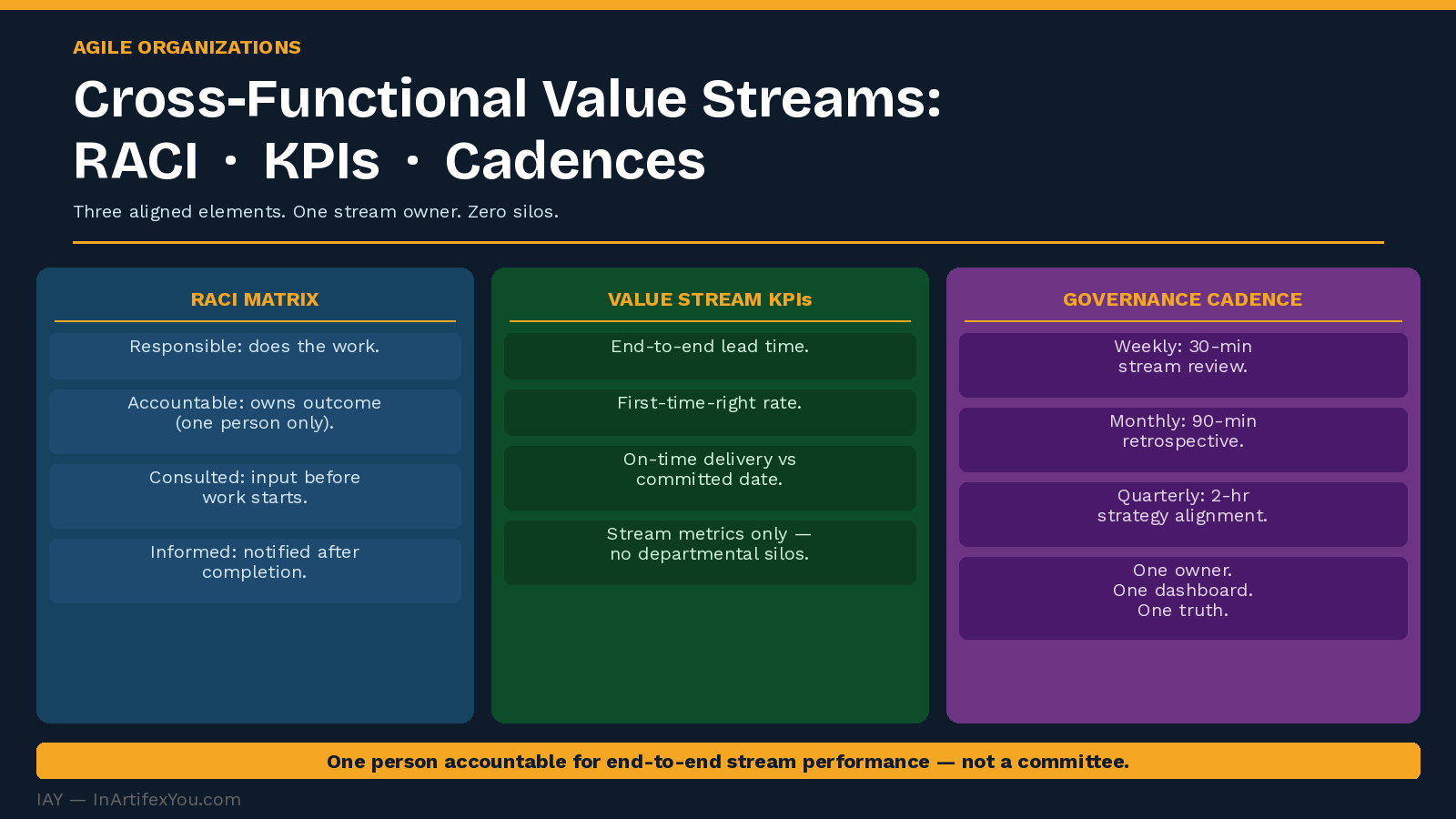
A cross-functional value stream is structured effectively when three elements are aligned: a RACI matrix that defines who is Responsible, Accountable, Consulted, and Informed for each step in the flow; a KPI set that measures the health of the stream as a whole rather than the performance of individual departments; and a governance cadence that brings the right people together at the right frequency to review performance and resolve cross-functional blockers. The most common failure in cross-functional value stream governance is measuring departmental performance rather than stream performance — which incentivizes local optimization at the expense of end-to-end flow. A well-structured value stream has one owner accountable for end-to-end lead time, one shared KPI dashboard visible to all functions, and a weekly cross-functional review that lasts no more than 30 minutes.
Cross-functional value streams are where most agile organizational improvements stall. Within a single team or department, agile principles are relatively straightforward to implement. Across functions — where work passes between sales, operations, finance, and fulfillment — the handoffs create friction, delays, and accountability gaps that no single team can resolve on its own.
Structuring the cross-functional value stream requires three aligned elements: clear accountability (RACI), shared measurement (KPIs), and regular governance (cadence).
Element 1: RACI for Cross-Functional Value Streams
A RACI matrix assigns four types of involvement to each activity in the value stream: Responsible (does the work), Accountable (owns the outcome — only one person per activity), Consulted (provides input before the work is done), and Informed (notified after the work is completed).
|
Value Stream Step |
Responsible |
Accountable |
Consulted |
Informed |
|
Order intake and validation. |
Sales coordinator. |
Sales manager. |
Finance, operations. |
Fulfillment team. |
|
Production scheduling. |
Planning team. |
Operations manager. |
Sales, procurement. |
Finance. |
|
Quality inspection. |
Quality technician. |
Quality manager. |
Production supervisor. |
Sales, customer service. |
|
Delivery and confirmation. |
Logistics coordinator. |
Fulfillment manager. |
Customer service. |
Finance, sales. |
Element 2: Value Stream KPIs vs. Departmental KPIs
The most damaging measurement mistake in cross-functional value streams is measuring each function's individual performance rather than the stream's collective performance. A sales team measured on order volume will process orders as fast as possible — and pass incomplete orders to operations. An operations team measured on production efficiency will optimize run sizes — and create delivery delays for small custom orders.
Value Stream KPIs Replace Departmental KPIs
End-to-end lead time: from order receipt to delivered value — owned by the stream, not any one department.
First-time-right rate: percentage of orders that flow through without rework, correction, or re-entry at any step.
On-time delivery: actual delivery date versus committed delivery date — the customer's definition of success.
Element 3: Governance Cadence
Cross-functional value streams require a regular review cadence that brings all functions together to review stream performance — not departmental performance reports.
- Weekly stream review: 30 minutes maximum — review end-to-end lead time trend, blockers by function, and top one improvement action for the week.
- Monthly stream retrospective: 60–90 minutes — review KPI trends, identify systemic friction points, and update the RACI for any steps that have changed.
- Quarterly strategy alignment: 2 hours — connect stream performance to organizational OKRs, adjust priorities based on customer feedback and capacity data.
The Single Accountability Rule
The most important structural decision in cross-functional value stream governance is naming one person accountable for end-to-end stream performance — not a committee, not a department, one person.
That person does not need to control every step. They do need the authority to convene the right people when a blocker appears, and the visibility to see the full stream performance in real time. Without single accountability, cross-functional streams default to departmental silos — every function optimizes locally and no one owns the customer experience.
Back to hub: Agile Organization.
|
||||||||||||||||||||||
The Continuous Improvement Certification at InArtifexYou gives you a complete, practical system to map, baseline, improve, and sustain any process — and the verified credential to prove you can lead it.
inartifexyou.com/continuous-improvement-certification-online.html |
||||||||||||||||||||||
|