Sustainability and quality management: the
environmental dimension
Sustainability and quality management are more closely connected than most practitioners realize. Both require process-centered thinking, fact-based decision making, customer and stakeholder focus, and continual improvement — the same eight TQM principles. ISO 14001, the international environmental management standard, is structured identically to ISO 9001 and can be implemented as an integrated management system alongside quality management. The operational connection: quality improvement reduces defects and rework, which reduces material waste, energy consumption, and emissions — so quality improvement is also environmental improvement. The strategic connection: sustainability targets are stakeholder requirements in the same way customer specifications are quality requirements — both define what conformance means. Organizations that integrate quality and environmental management systems reduce total compliance cost, share improvement infrastructure, and build a stronger case for the value of their management system investment.
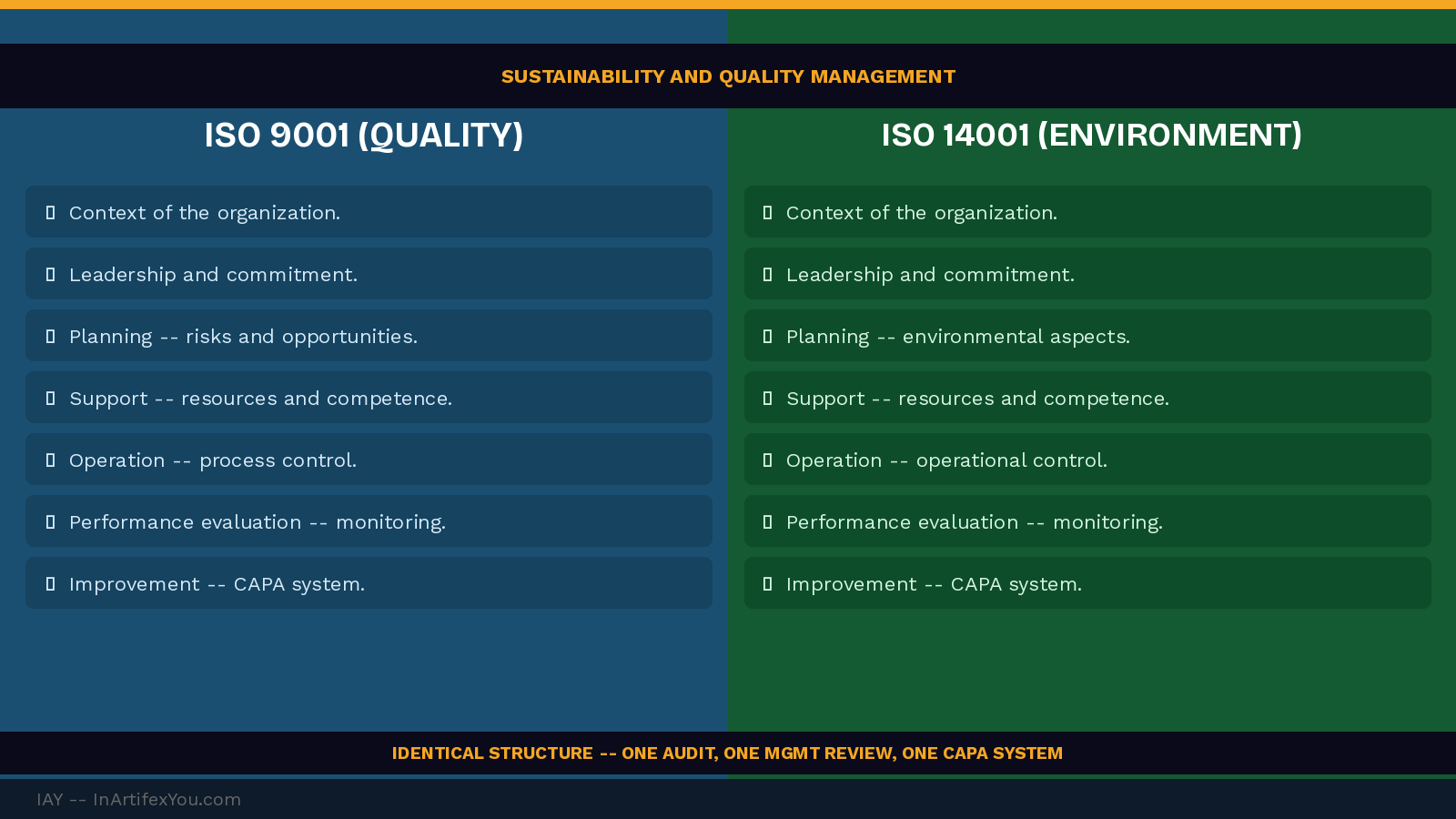
The integration of sustainability into quality management is not a trend driven by regulatory compliance alone — it reflects a genuine operational reality. Every defect produced is wasted material, energy, and time. Every rework cycle consumes additional resources. Quality improvement that reduces defect rates simultaneously reduces environmental impact. The practitioner who understands this connection can make a stronger case for quality investment by quantifying both the financial and environmental return.
The ISO 9001 and ISO 14001 Connection
|
ISO 9001 QUALITY Context of the organization. |
ISO 14001 (ENVIRONMENT) Context of the
organization.
|
The structure is identical — by design. The ISO High Level Structure (HLS) applies to all management system standards, making integration straightforward. Organizations certified to both standards share one management review, one internal audit program, one corrective action system, and one document control framework. The incremental cost of adding ISO 14001 to an existing ISO 9001 system is typically 30–40% less than implementing it standalone.
Quality Tools Applied to Environmental Performance
- Pareto analysis: identify the 20% of processes responsible for 80% of environmental impact — waste generation, energy consumption, emissions.
- Control charts: monitor environmental indicators — energy use per unit, waste generation rate, water consumption — for statistical stability and trend detection.
- Root cause analysis: when an environmental target is missed, apply the same 5 Whys or fishbone analysis used for quality nonconformances.
- Kaizen events: run rapid improvement events targeting energy waste, material waste reduction, or process efficiency gains with direct environmental impact.
Connecting Quality and Sustainability Metrics
|
Quality Metric |
Environmental Connection |
Combined Improvement Opportunity |
|
First Pass Yield improvement. |
Less scrap reduces material waste and disposal cost. |
Quantify both quality savings and environmental savings from FPY improvement. |
|
Rework reduction. |
Less rework reduces energy consumption and labor per unit. |
Calculate carbon footprint reduction alongside COPQ reduction. |
|
Setup time reduction. |
Shorter setups reduce machine idle energy consumption. |
Include energy savings in the ROI calculation for changeover improvement projects. |
The Integration Principle
Quality improvement reduces defects. Fewer defects mean less waste, less energy, less emissions.
Every quality improvement project has an environmental dimension — quantify it and include it in the project ROI to build a stronger business case.
Back to hub: Contemporary Issues in Quality Management.
- AI in quality management: how artificial intelligence is changing QM.
- Digital transformation in quality management: tools and approaches.
- Quality management in global supply chains.
🔗 INTERNAL LINK SUGGESTIONS
| ||||||||||||||||||||||
The Continuous Improvement Certification at InArtifexYou gives you a complete, practical system to map, baseline, improve, and sustain any process — and the verified credential to prove you can lead it.
inartifexyou.com/continuous-improvement-certification-online.html | ||||||||||||||||||||||
|