TQ marketing and brand quality: how quality builds
market reputation
Brand quality — the market's perception of an organization's quality — is built through the consistent accumulation of customer experiences, not through advertising claims. TQ Marketing recognizes that brand reputation is a quality output: it is determined by the gap between what the brand promises and what it delivers across every customer interaction. Organizations with strong brand quality share three characteristics: they define quality from the customer's perspective and measure it systematically, they have a closed-loop system that translates customer feedback into process improvement, and they communicate improvement results to customers — closing the feedback loop visibly. The most powerful brand quality investment is not advertising — it is consistently delivering what customers value, at a level that generates unprompted recommendation. Net Promoter Score above 60 is the objective evidence of brand quality strong enough to generate self-sustaining market growth through customer advocacy.
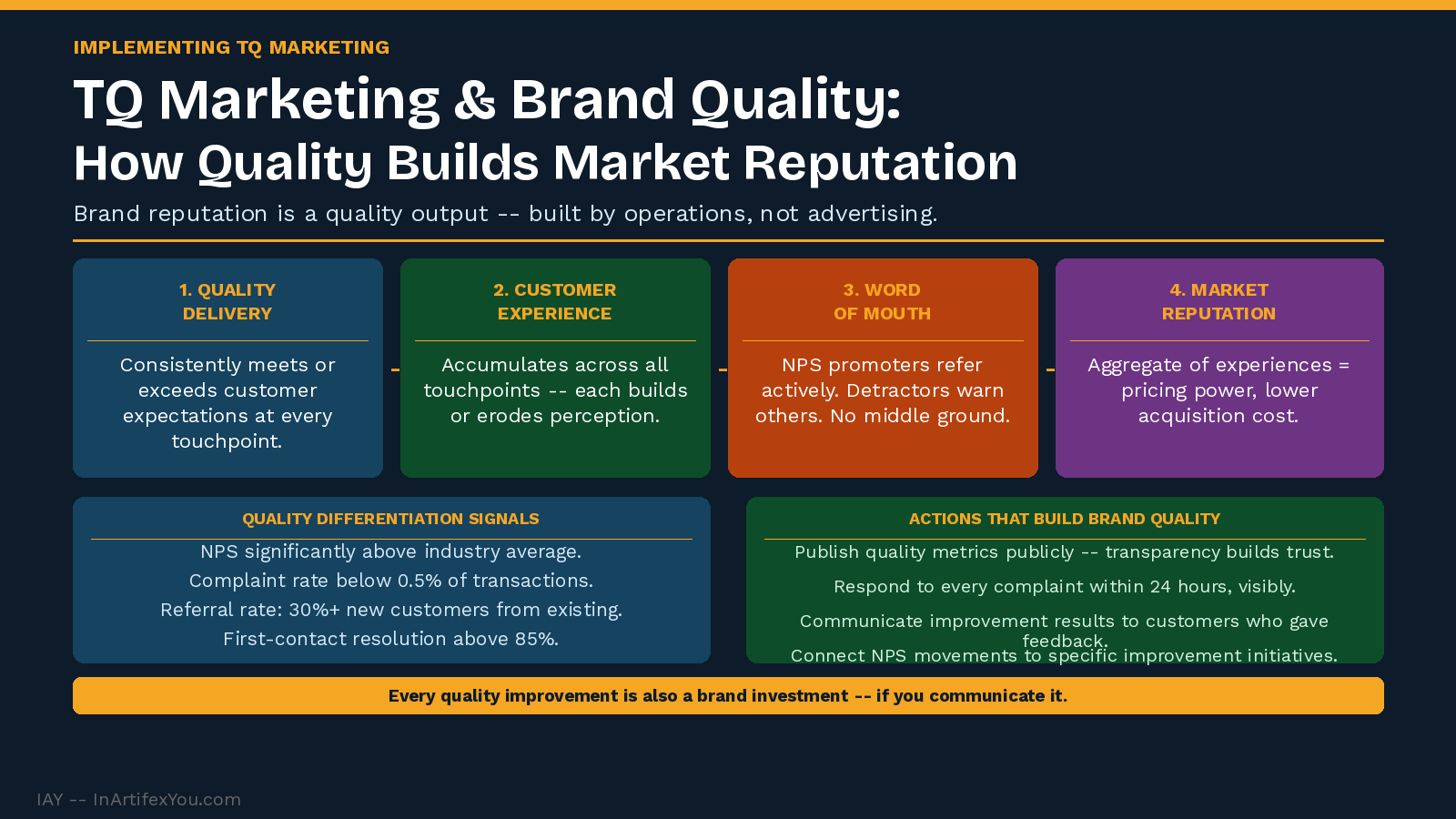
Brand reputation in quality terms is not built by marketing departments — it is built by operations departments, service teams, and the quality systems that govern their performance. Marketing can communicate a quality promise. Only operations can keep it. TQ Marketing's fundamental insight is that sustainable brand quality requires the alignment of what is promised with what is delivered — and that alignment is a quality management challenge, not just a communication challenge.
The Quality-Reputation Cycle
Brand quality reputation operates as a cycle with four stages:
- Quality delivery: the organization consistently meets or exceeds customer expectations at every touchpoint — product reliability, service responsiveness, communication clarity, and problem resolution.
- Customer experience: customers accumulate experiences across all touchpoints — each interaction either builds or erodes their perception of quality.
- Word of mouth: customers who consistently experience high quality recommend the organization unprompted — NPS promoters actively refer new customers. Customers who experience quality failures warn others.
- Market reputation: the aggregate of customer experiences and word-of-mouth creates a market-level quality reputation that determines customer acquisition cost, pricing power, and competitive position.
Quality as a Market Differentiator
In markets where products and services are technically similar, quality — as experienced by the customer — becomes the primary differentiator. The organizations that win on quality differentiation share a common practice: they measure customer-perceived quality more frequently and more rigorously than their competitors, and they act on the data faster.
|
QUALITY DIFFERENTIATION SIGNALS NPS significantly above industry average. |
QUALITY DIFFERENTIATION ACTIONS Publish quality metrics publicly — transparency builds trust. |
Communicating Quality Improvements to Build Brand
TQ Marketing closes the customer communication loop after improvement — a practice that most organizations neglect entirely. When a quality improvement is made in response to customer feedback, communicating that improvement to the customers who provided the feedback has three brand-building effects:
- It demonstrates that customer feedback is heard and acted on — increasing the likelihood that customers will provide feedback in the future.
- It creates a visible quality improvement narrative — customers become aware of the organization's commitment to continuous improvement.
- It converts complainants into advocates — a customer whose complaint triggered a visible improvement is significantly more likely to recommend the organization than a customer who received a standard service recovery.
The Brand Quality Principle
Every quality improvement is also a brand investment — if you communicate it.
The organization that consistently improves AND tells customers it improved builds a quality reputation that advertising cannot buy and competitors cannot easily replicate.
Back to hub: Implementing TQ Marketing.
| ||||||||||||||||||||||
The Continuous Improvement Certification at InArtifexYou gives you a complete, practical system to map, baseline, improve, and sustain any process — and the verified credential to prove you can lead it.
inartifexyou.com/continuous-improvement-certification-online.html | ||||||||||||||||||||||
|